Gibraltar to Melilla
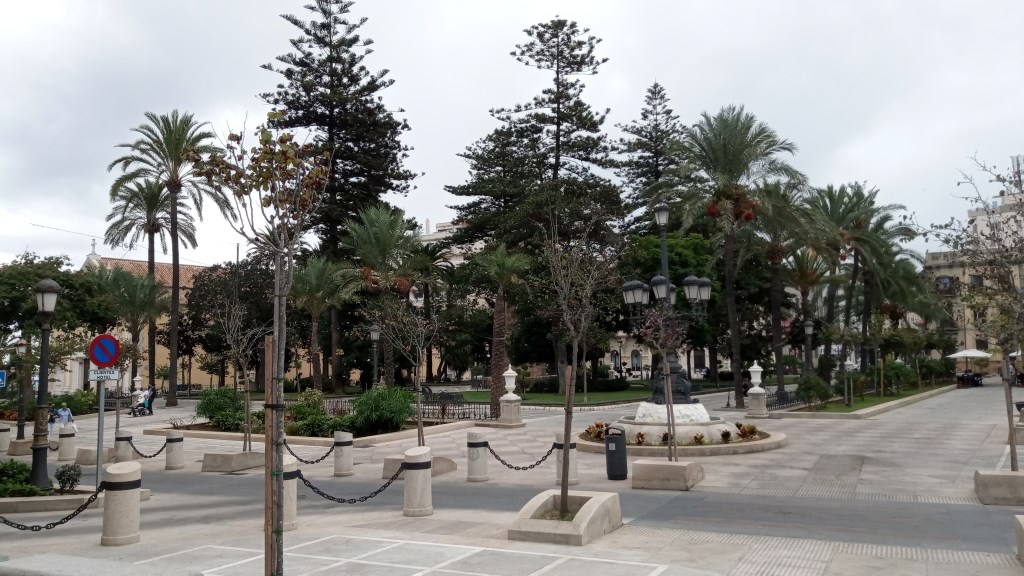
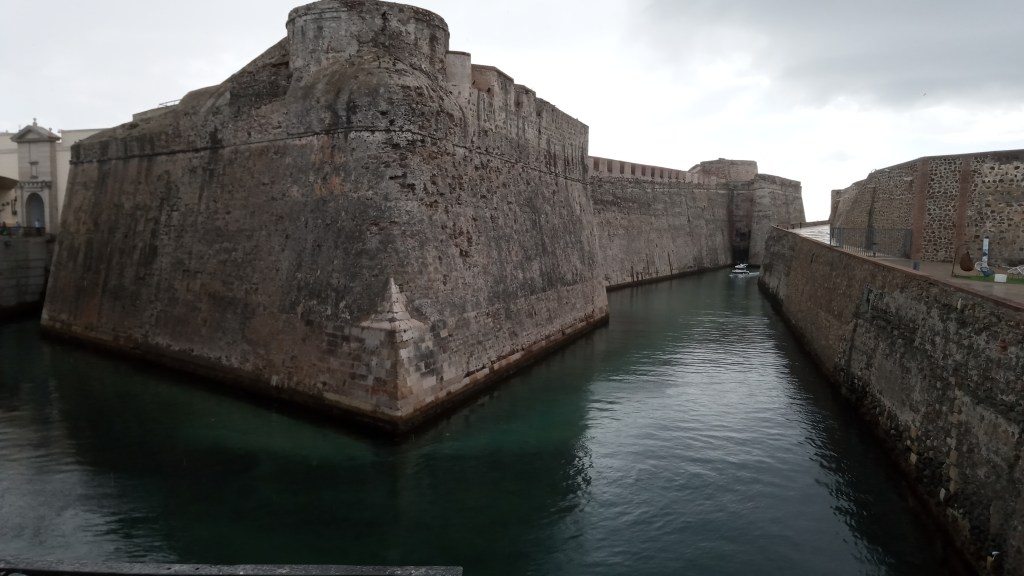
Saturday 23rd October – Rob caught the ferry over to Gibraltar side later yesterday, to catch a plane home today. I had a mooch around Ceuta for the day, there is a splendid fortification, many grand buildings, and shops selling mainly high end jewellery, perfumes and big name fashionwear, at tax free prices. Best of all though was the Lidl, which had the biggest range I’ve ever seen and just 10 mins walk from the boat. I took the opportunity to stock up the larder. The only spoiler was the nightclub just behind the boat. Crowds of youfs were enjoying a very late night out and even spilling onto the pontoon, so definitely not a secure place to leave the boat unattended.
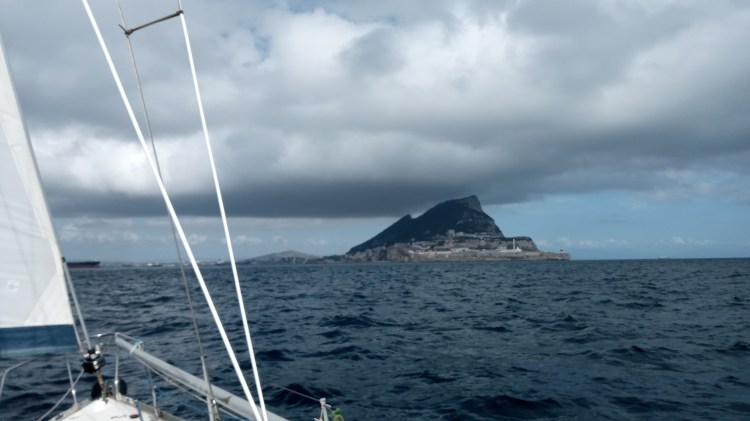
Sunday 24th October – Winds have returned to east, on the nose for the 140 mile voyage to Melilla. So I decide to cross the Straits to Gibraltar, about 12 miles away, where there is a very good anchorage, and wait a few days for the wind to come back west. Sunday morning 10.00 I leave the pontoon in Ceuta. I lay a course to the west of the direct line to Gibraltar, as the tide is flowing eastward at a good 2kts. I’m on a beam reach in 15 kts wind so make fast progress. There is the constant flow of shipping crossing my path in both directions as I skirt the end of the Traffic Separation. On one occasion I have to luff up and stop to go behind a ship rather than cross his bows at less than half a mile. As I close in on the Rock the tide slackens and turns westward. There are now many ships anchored ahead in the bay so I weave a path through them. As I am aiming to pass the bows of one of them I realise very late that it has actually just weighed anchor and is moving forwards. So have to make a rapid change of course around his stern. I’m now in the wind shadow of the Rock so the wind becomes fluky and gusty. I decide its prudent to drop sails and motor the last mile past the harbour entrance and past Ocean Village marina. Then it’s round the end of the runway and back into Spanish waters as I enter the sheltered bay at La Linea. I anchor just a few hundred metres off the beach in 3m of water and with good holding. There is less than half a metre tidal range. There are half a dozen other boats and we are all well spread out. Should be a very good place to wait, and dinghy ashore to walk across the border into Gib.
Thursday 28th October – Gibraltar, a place I do like, especially when you’ve been out of Britain for a while. You can get traditional fish and chips ! You can pick up British Forces radio which broadcasts Radio 2 news. And because it’s tax free, 1 litre of whiskey can be had for £6. Main Street looks like any English provincial town high street, with an M&S, Mothercare and Early Learning Centre. Then of course the Rock itself, a slab of limestone soaring over 600m straight up, and the rich history of its settlement, both ancient and modern. I visited one or two places that I missed last time here, two years ago. On the other side of the Rock from the town, facing east, there are many caves, two of which have been excavated by archaeologists in recent years. They have discovered remains of Neolithic man living here, and living till later than anywhere else, in other words this was their last refuge before going extinct. They come the direct route across the Straits from Africa, in fact neither did homosapiens, they came all the way round via the Middle East. They would have seen the smoke from the fires of distant cousins just 12 miles away over in Africa, but never made contact. At the border between Spain and Gibraltar, next to the runway, I now had my passport stamped by Spanish immigration upon going into Gib, and again by British immigration coming back out to Spain. Not sure why when Gib is inside Schengen. On local Gib radio there is talk of Lord Frost renegotiating Gib’s relationship with Europe. Sadly my stay was not all a positive experience. Upon returning to the beach in La Linea, on the Spanish side, where I leave the dinghy, it was nowhere to be seen. I could see the tracks where I had dragged it and left it and there was no evidence of it having been taken back to the water, so I conclude that someone deflated it and carted it off !! I was not so concerned about losing it, it was leaking badly, the issue was getting back to Sea Orchid, about 400m offshore. There was another dinghy pulled up next to where mine had been, presumably from one of the others anchored in the bay, so I decided to wait for the owners to return. They finally did just before dark, much to my extreme relief, I was not looking forward to having to swim for it.
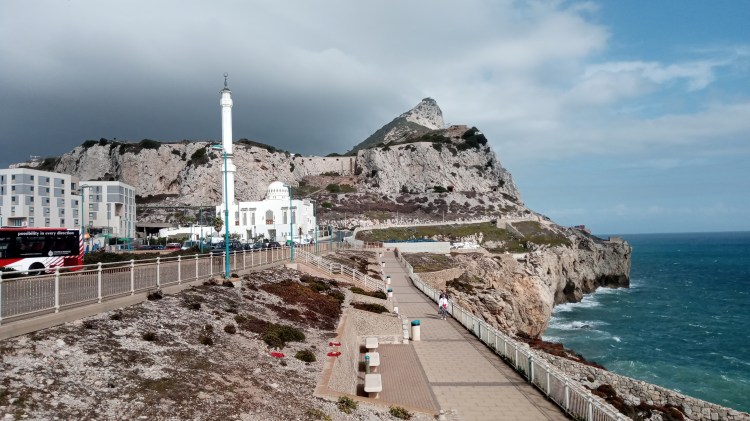
Friday 29th October – The easterly winds have ceased, at the moment there is little wind as it’s on the turn to west but by later this morning it will have filled in. So its anchor up and I make my way round to the fuel dock at Ocean Village to fill up (at just 75 cents /litre) before heading off and weaving a path through the anchored ships. At Europa Point, at the very tip of Gibraltar, I pick up a nice 12 kts on a broad reach. It’s a 140nm to Melilla so I anticipate arrival tomorrow afternoon. Winds are likely to be light and variable as I track south east and away from the Spanish coast where winds are expected to be strong from west. It’s a strange feature of this region, that in the space of just 30 miles there are very different wind patterns, the African side being dominated by winds off the Sahara. It should be a gentle sail downwind in flat water so not as tiring as last week. Through the afternoon I see quite a few naval vessels, some British and some Spanish. The Spanish ones come up on AIS but not the British ones. They are on channel 16 calling ships to keep out of their way so assume some sort of exercise, or maybe just patrolling for illegal immigrant boats which regularly try to cross from Morocco. I’m hoping not to encounter any. By sunset the wind has dropped to a meagre 7/8 kts, from astern, just not quite enough to get Sea Orchid going so I resort to motor assisted sailing. Tonight there is no moon, but as I’m motoring and not trying to see the sails it’s not a problem, in fact it’s a bonus as with no background light I can see billions of stars. All night I encounter just one ship, which I pass close by as she is drifting, presumably waiting for orders on where to go for the next cargo, or maybe all the crew have mysteriously vanished. It’s surprisingly cold and the condensation on deck has soaked everything by morning. At dawn I am just 20 miles from the Moroccan coast and being visited frequently by pods of dolphins. This suggests there are plenty of fish around but oddly no fishing boats at all. At least not until I reach Punta de Los Farallones, just before Melilla, when there are dozens of small sport fishing boats bobbing around in flat calm, in early morning sun. I enter the marina at 13.00 and tie up on the fuel dock. The marinera speaks not a word of English (why should she !) but we struggle through formalities with the help of google translate. She then helps me moor up on the visitor quay, it’s Mediterranean style now, reverse up to the quay, chuck a stern line ashore, grab the lazy line, pass it round all the paraphernalia on the back of the boat, run with it to the bow, haul it tight and lock onto a cleat, all in the space of 10 seconds and before the boat has had time to swing onto the one next door. Hard enough with crew, impossible single handed, oh how I dislike lazy line mooring.
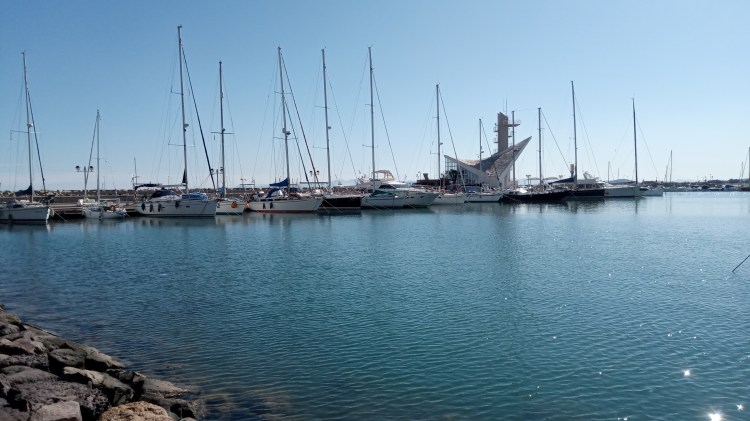
Have been in Melilla a little over a week now. This Spanish enclave on the coast of Morocco is handy, not just for me to park Sea Orchid, but because whenever Spain makes noises about Gibraltar we can say “‘what about Melilla ?’”, and Ceuta for that matter. The King of Morocco is presently more irritated than usual by Spain’s defiance to hand it back, and has closed the border altogether. This is a shame as I was hoping to travel into Morocco and go to Fez.
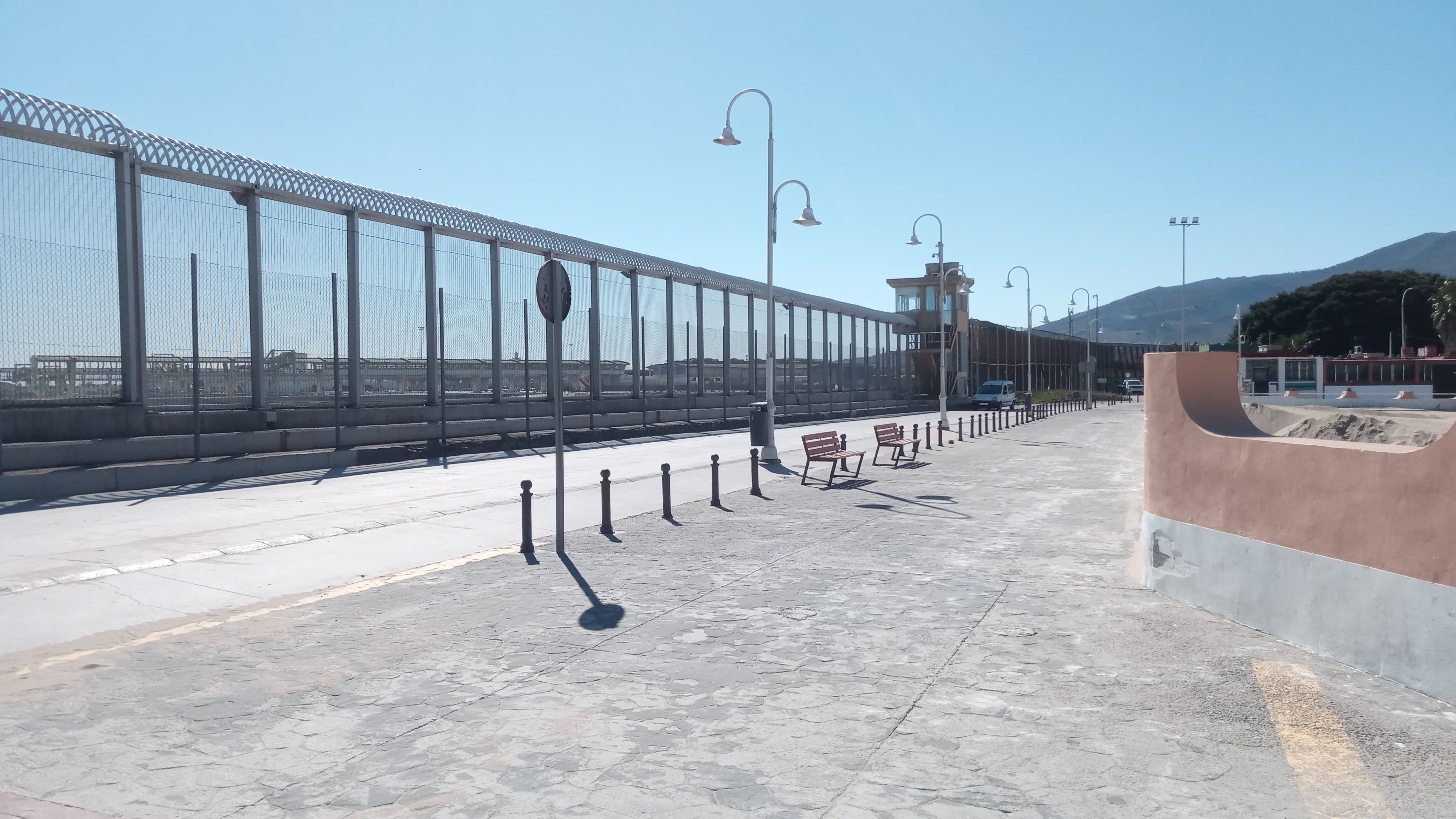
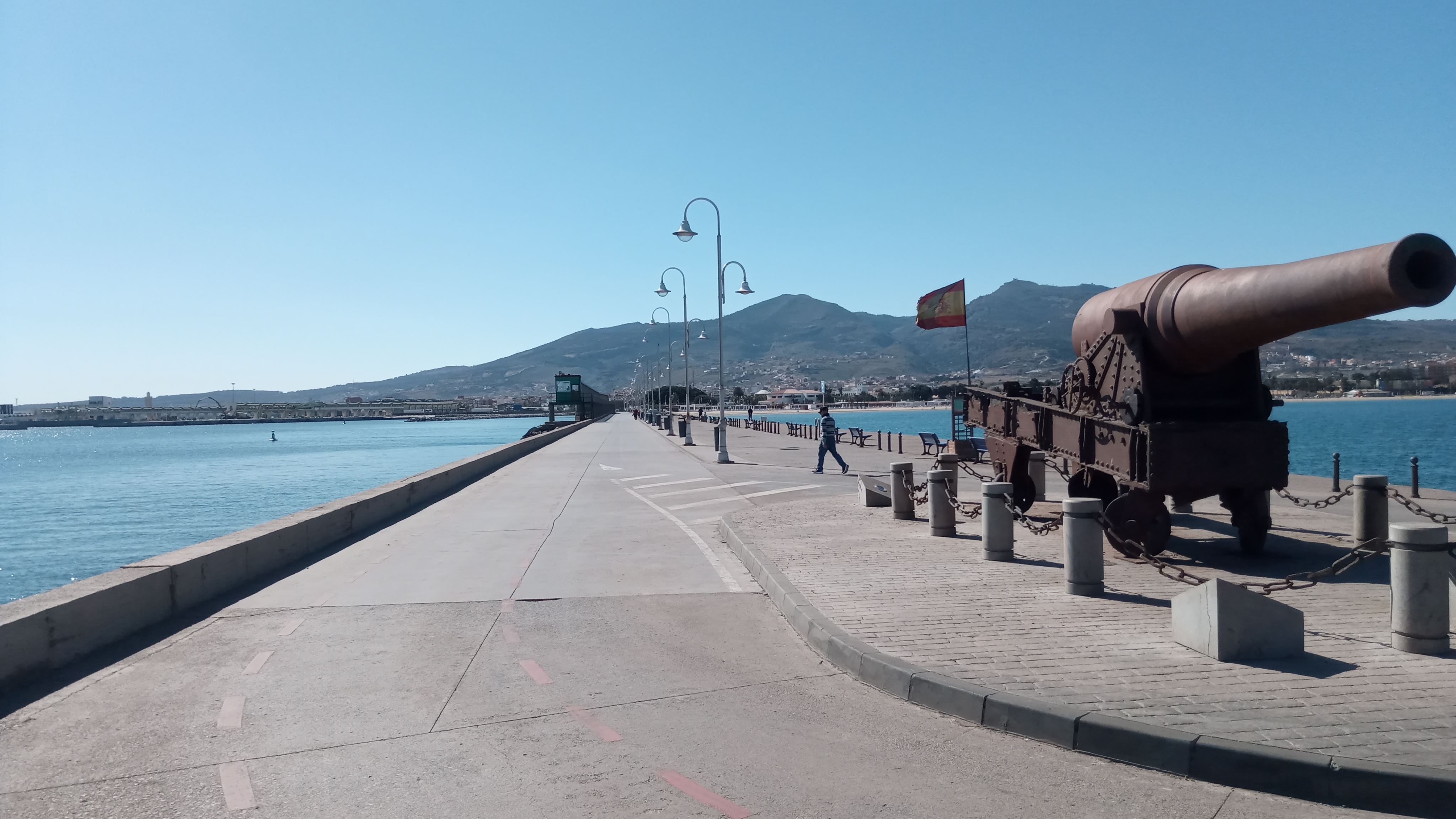
The outer harbour is interesting in that the port hand breakwater belongs to Morocco and the starboard one to Spain. On entering one turns immediately to starboard to remain in Spanish water and enter the marina. On the other side of an enormous fence lies the Moroccan town of Nador, while Melilla is crammed into an area about 2×2 km. The Civil Guardia are here in numbers to keep illegal immigrants out. I’m not sure why they would bother though because they can’t get any further into Europe without getting onto the ferry. Some seem content to stay, living in tents on small ledges on the cliffs.
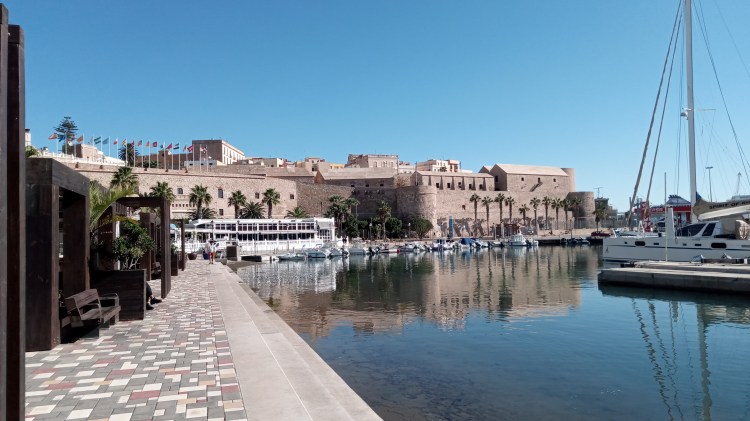
The beauty of this place for me is that it is not only very cheap to park but that it’s outside the Schengen area, although there are some who dispute that. The Schengen is a European region (almost but not quite aligned to the EU member states) into which UK citizens can now only stay 90 days in 180. Spain announced in June its intention to bring Melilla and Ceuta into Schengen at some point soon, hopefully not too soon.
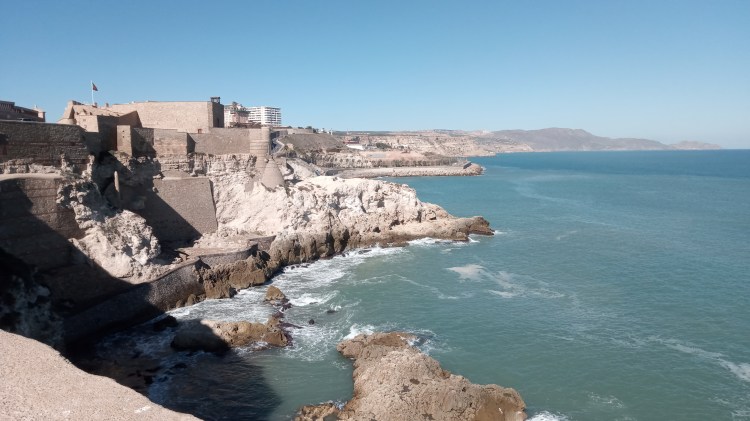
The history of Melilla is documented as far back as the Phoenicians and has been settled since by all the self respecting empires. Spain annexed it in the 1400s having booted out the Arabs. Today the population is about 50% Spanish and 50% Moroccan descent. Guess who live in the poorer end of town.
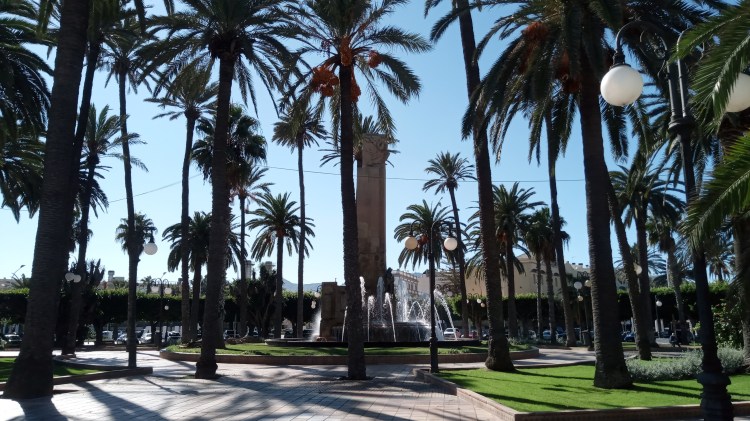
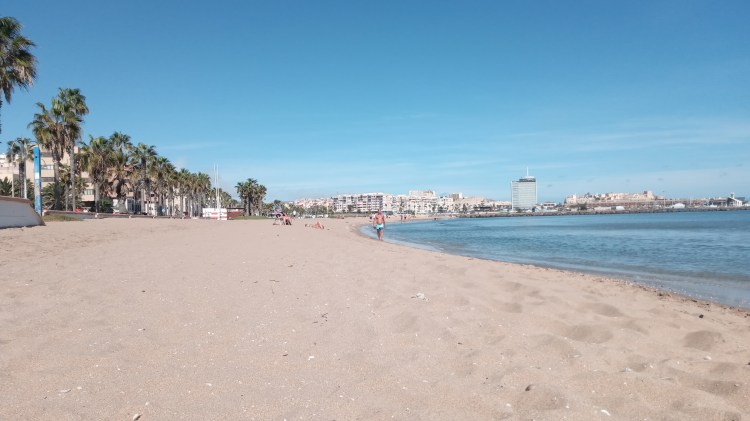
All that said, it seems to be thriving, with two ferries and many flights over from Malaga every day. It’s not a major tourist destination but has a lot going for it, from the ancient walled city, to the parks, squares and fine buildings, and an impressive beach. At the moment it’s about 18 degrees in the day and drops to 10 at night.
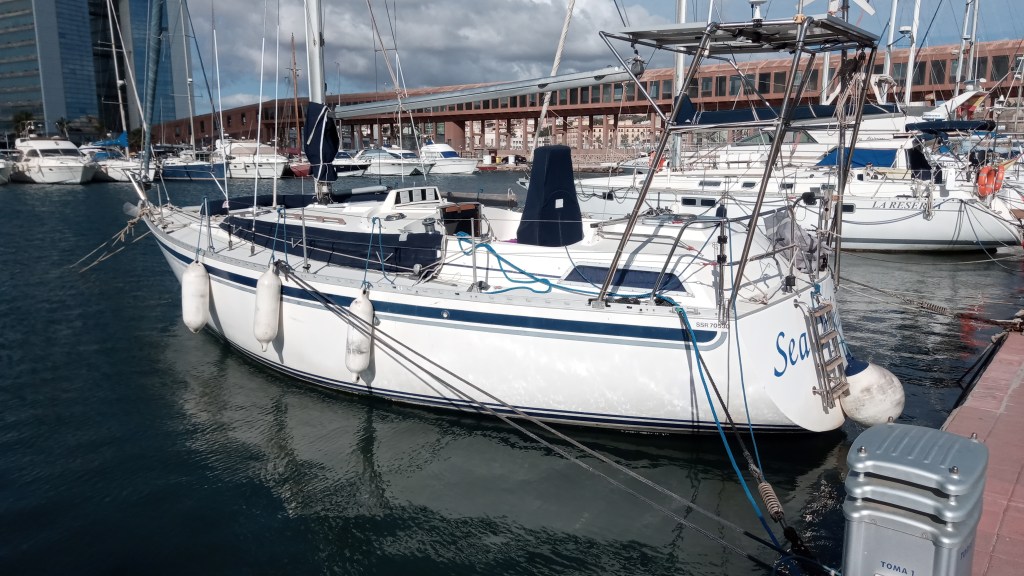
Here in the marina there are two other boats currently with residents, a chap from Dundee who arrived a week before me having spent the summer sailing down from UK. He has similar plans to mine for next year. The other is a Brit from Tanzania, he built his boat, which is not much bigger than a Flying Fifteen with a lid. He has spent the last two years cruising the Med and next year is heading where I’ve just come from. So we are swapping info on places to go and not go.
For a few days last week winds from west whipped across the marina with gusts of 30kts, which pushed the bows off one way and then the other. I have two lazy line moorings so remained relatively straight but the boats on either side were all over the place swinging a couple of metres this way and that, enough to rest upon my boat. So we spent some time trying to tame them. I am a little concerned about how it will be when I leave the boat for 2 months. But the marina staff seem to be ready and able to sort any issues.
Wednesday 17th November
Today is my last day before flying back home for a couple of months (famous last words !). Sea Orchid has been prepared for hibernation, the deck stripped of sails and canvas, and anything else removable has been stowed. Extra mooring lines have been rigged and protective coverings (hose off cuts) put around lines where they may chafe on fairleads. Halyards have been covered to protect from the damaging UV and I’ve used the old stack pack to cover the windows on the sunny side. Inside, despite another blitz on the cockroach family over last few days, I’m sure a few are still lurking in the darkest most inaccessible corners. I will be deploying half a dozen traps (which contain a sticky substance) and putting a special chalk along their favourite routes eg. door frames. They may die of thirst anyway as the boat is now absolutely bone dry. I have taken the opportunity to tackle a job that’s been put off for a couple of years, namely to strip down the two fresh water tanks. They have been leaking through the lid seal, needed a good clean out, and it has been an opportunity to improve the water extract configuration. Previously the water extract was on the stbd tank only so water from the port tank had to travel back to the stbd one first, via a crossover pipe. The problem was that because all Moody boats have a slight list to port, due to the fuel tank being that side, water tended to extract from the stbd tank first, causing the boat to list further, resulting in there being a lot of water that could not be extracted at all from port. So I have now added a T junction on the crossover with a stop cock on either side, and leading off to the extract pump. I can now close the stbd tank and extract from port first. It has the added benefit that when the port tank is empty I know I have used half the water. I have been very fortunate to have Jason to hand. He worked in the boat building business so when it came to refitting the lids and making sure there is a good seal, he knew exactly what to use and how to do it. Hopefully it’s done the trick but I won’t know for sure until I take the boat out for a sail again.
So signing off for now. Next February, if Morocco has opened up to private boats, I hope to visit a couple of their ports and explore inland. Then in the Spring sail over to mainland Spain, make my way up the east coast, before heading over to the Balearics.
Sunday 13th February
Well hello again, and welcome back aboard Sea Orchid for another season. Its almost spring (here in Melilla anyway !) and about time to go sailing. I arrived a couple of weeks ago and have been prepping the boat for the next leg of the journey. This will be over to mainland Spain, up the Cost Blanca, and then over to Ibiza, the first in the chain of Balearic Islands that I hope to visit through to the end of May.
I’m happy to report that SO was just as I had left her in November, albeit covered in a lot of sand from the Sahara. The bilges were bone dry and the cockroaches exterminated, or at least so I thought until the other day when one appeared moving very slowly. I think the combination of traps, no water and temperatures below 10 degrees at night, has either finished them off or at least comatised those that are left. Everything seems in good shape and I have a replacement dinghy which is going to be essential as I anticipate being able to anchor in bays much of the time. The dinghy is bigger and heavier than the last so I am experimenting with stowing it suspended from the back of the arch where it can be lowered on block and tackle. I think it will be trial and error to get it just right but seems to be feasible. Mainsail is back on, the genoa furler serviced, sprayhood back on, engine run, and all electrics and navigation gear tested. I would like to have the bottom checked and the prop cleaned, and for this my friend Jason, who has just returned from Tanzania, is willing to don his diving equipment.
At the moment though the weather is grim, wet and windy, with winds from NE, pretty much the direction I wish to go. A weather window looks to be opening up from mid week so I’ll be stocking up on food and water in readiness. In the mean time it’s a good opportunity to do some decorating, so I’ve been stripping woodwork and getting high on on a mix of varnish and thinners !
Here are a few more snaps of the locality, notably the border fence which runs down the centre of the breakwater until about 100m from the end. One could easily walk around the end but sadly as the border is still firmly closed I think it would attract a lot of attention. The Moroccan ports are also still closed to private boats which is a shame.
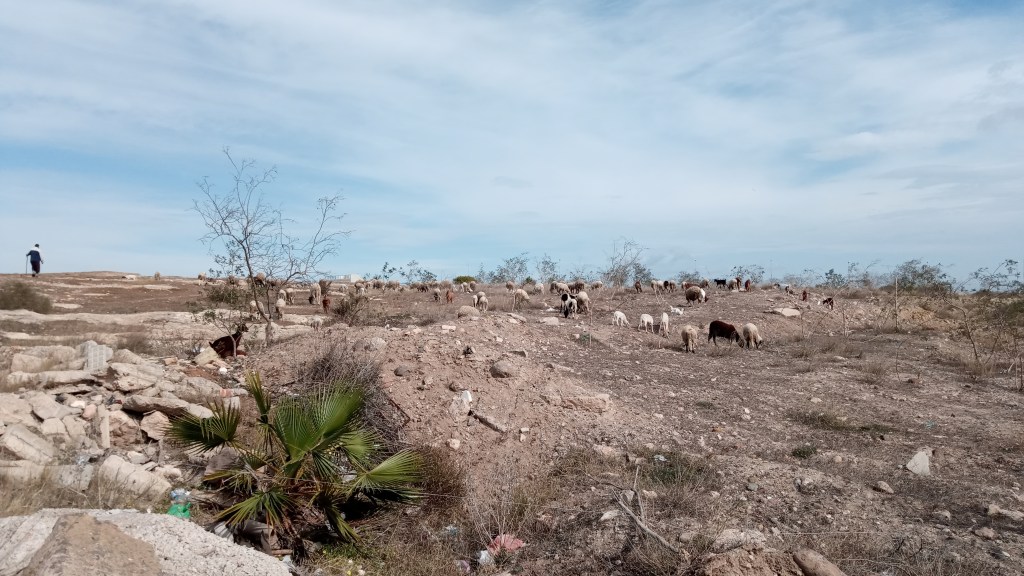
Tuesday 1st March
The day to set sail has arrived sooner than I expected. The forecast has been improving day by day and what was looking like an earliest departure of Saturday just three days ago has now become today. Slightly disappointingly it’s shrove Tuesday and I was looking forward to making pancakes, they’ll just have to wait. So at 1000 hours exactly I let go the stern lines, dropped the bow lazy line and crawled out of the berth. Jason had called by and we had exchanged well wishes. He is leaving also this morning but heading west , eventual destination the Canaries. It’s a glorious day, wind SE 10kts, just enough to push us along at about 4kts. Everything soon clicked back into place, routines and managing those little idiosyncrasies that any boat has. Its 96 miles to mainland Spain, and I anticipate it taking about 24 hours, but the winds are going to go more NE and die away in the night.
The day passes uneventfully. The sea is very flat, and SO settles onto a close reach and then close hauled. She is so well balanced that she will hold the angle to the wind with the wheel locked, better than the autopilot can do as this tends to oversteer and weave a path. The sun sets at 1900 hrs and half an hour later it’s pitch black. Progress has been slow averaging nearer to 3kts than 4 and my heading has been steadily deteriorating, so I can still see the lights of Melilla reflected on the sky. It doesn’t take long for the temperature to plummet to 10 degrees and with the wind chill it feels much colder than that. So I settled into a corner of the cockpit under the hood and admired the dazzling display of stars. A few times dolphins came to have a race, ducking and diving under the bow and leaping alongside, and making trails of luminescence.
Late in the night I had to be on high alert as we approached the shipping lanes running along the south coast of Spain. There was a constant procession in both directions with vessels often just a mile apart, so I was the chicken crossing the road. Normally I don’t expect a ship to take any notice of me and certainly not take any collision avoidance measures, whether I have right of way or not. So I was surprised and slightly alarmed when one did alter course to starboard to go behind me as I approached from his right. But I had already slowed down and just turned to port to go behind him, so by the time I had turned back onto my original course, and sped up, he was bearing down on me and less than a mile off. What made it more exciting, for him at least, was that on his starboard side another vessel, carrying dangerous waste materials according to AIS, was overtaking him, so he had turned into the path of that rapidly closing ship.
At sunrise I was just 10 miles from my destination, an anchorage in a bay just south of San Jose on the south eastern tip of Spain. The wind had died away and the sun was out as I dropped anchor. Time to catch up on some sleep.
Thursday 3rd March
The anchorage here at Los Genoves has been delightful, if somewhat roly poly. It is a nature reserve and seems to attract campers and walkers. In the evening a bunch of folks set up a camp on the beach, playing music, prancing around and performing strange movements, some of them naked ! This morning I launched the dinghy and finalised arrangements to suspend it from the arch. I took a trip ashore and climbed a nearby hill from where the photo is taken. Its another fine day but the forecast is for 40kts to come through this evening from the west. So I have upped sticks (or anchor to be correct) and moved to another anchorage 10 miles up the coast. Here at Ensenada de Rodalquilar the wind is supposedly only going to be 30kt gusts, and I’m tucked in under a cliff. Loads of chain out and anchor well dug into the sand. If I do drag I’ve got 5 miles of downwind water before reaching the cliffs on the other side of the bay. As I came along the coast I did encounter just one or two pots, well marked. There was a scattering of grand design looking homes along the cliffs, and San Jose has some development. Otherwise its barron and remote.
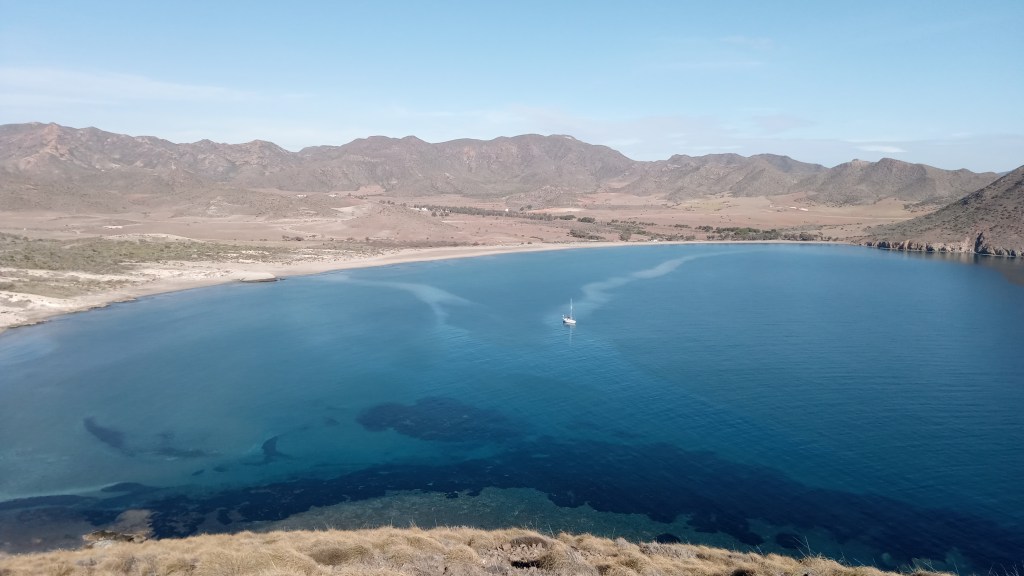
Saturday 5th March
Thursday night the wind finally topped out at 34 kts, the anchor holding nicely in gently shelving sand and a super long and stretchy rope hooked on to stop snatching. It was short lived and all over by midnight. In the morning I moved on to another anchorage, one that would provide shelter from strong northerlies due to come through later in the day. Called Cala de San Pedro it was just a few miles on the other side of the bay. Above the beach is a so called hippie commune. Its a collection of makeshift shelters mostly using wood and canvas but a few built of bricks and mortar. Some are perched precariously on ledges up the steep cliffs. There was a substantial swell finding its way into the Bay which not only made it very roly poly but also a bid surf on the beach so not conducive to dinghying ashore. At least it was very sheltered with NE gusts a mere 25kts.
At this early stage in the season the weather is very changeable, even the 24hour forecast cannot be wholly relied upon. I was anticipating staying put until Tuesday when northerlies would give way to southerlies, but this morning its all change. There is a light onshore easterly, so an opportunity to get closer to Cartagena. It has turned out to be a fine day if rather cold, only about 12degrees. Wind has been too light, just 6 to 8 its, to sail in a reasonable time but motor sailing has worked well. Using just 1500 revs and with both sails sheeted tight at 90 degrees to true, 60 degrees apparent, I was able to maintain over 5kts speed. On engine alone speed was just over 3kts. I am now anchored in Bahia del Hornillo just east of Aguilas. Its a steeply shelving bottom and surrounded by steep high hills. Forecast is light winds however a couple of hours ago a thunderstorm moved in so right now its chucking down and we’ve got lightening. One thing I’ve been meaning to get round to doing is running a conductor from the foot of the mast to the keel to take the worst out of any lightening strike. Also to get a steel box to put all portable electrical devices in, eg vhf handset, phone, tablet. This can provide some protection.
Hopefully tomorrow nothing will have been fried and I can push on to Cartagena.
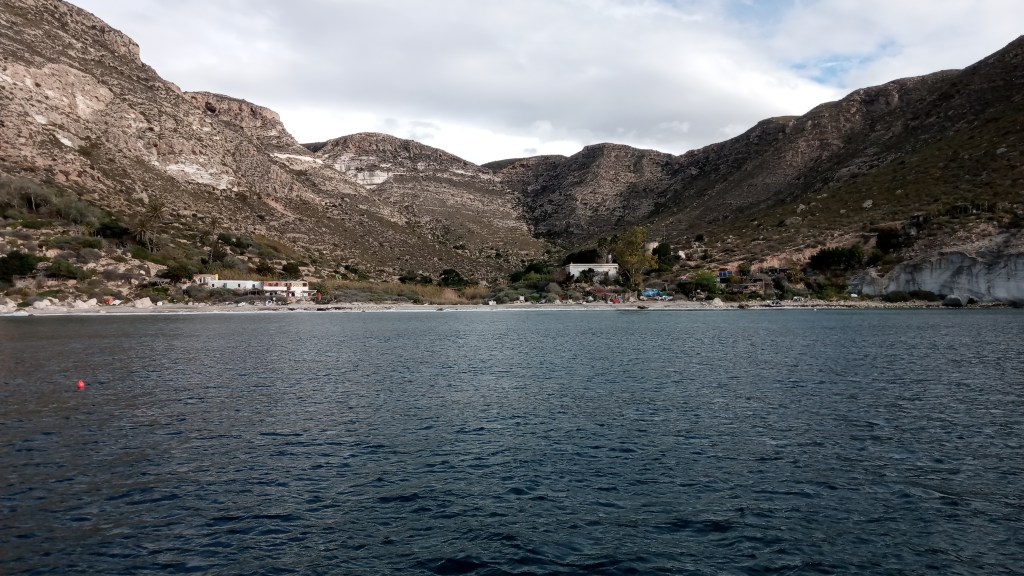
Sunday 6th March
Left the anchorage at Aguilas before sunrise as the plan is to reach Cartagena, 30nm away, before very strong winds come in from north east by early afternoon. Whilst still on the anchor I raised the main with 2 reefs in for starters, however until I had passed the huge rock of Cabo Cope, there was hardly any wind at all so both reefs soon came out. For the next 20 miles the wind turned out to be just west of north, and with a flat sea SO raised her skirts and flew along at 6kts. Along the coast just a few miles away on my port side the sky was ominously black and at times the hills were completely obscured by rain storms. I reached the high rocky outcrop of Cabo Tinoso still dry and with just a few more miles to go was thinking what a lucky escape. Then as I rounded up to a close hauled final 6nm to the harbour, I was hit by 20kts. Sod’s law, just when I needed the 2nd reef, the reefing line managed to unknot itself at the boom end fitting, with no hope of retying it on the go. So heavily over canvassed SO kicked and bucked here way upwind. To add insult to injury I finally copped a huge rain storm. The new Tribord waterproofs from Decathlon were given the ultimate test and passed with flying colours. Upon arrival at the marina I headed straight for the fuel berth and got the shock of my life when the man asked for €200 to fill her up. Never before has it cost more than £100. What is the world coming to.
Tuesday 8th March
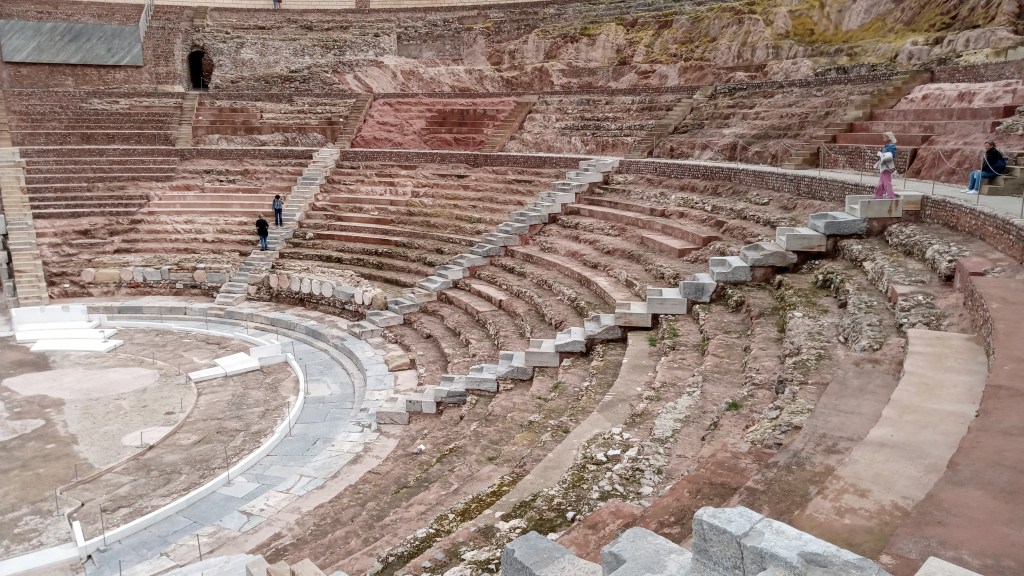
Cartagena has seen some action over the years. Carthaginian’s occupied in the 3rd century BC after being thrashed by the Romans at home in Carthage. They decided to go west to the Iberian peninsular for a quiet life, where they would be less likely to bump into the Romans again for a while. The region is rich in silver and lead and the natural harbour is reputed to be one of the best in the Med. They prospered for a while until Hannibal (he of elephant fame) decided to avenge his ancestors defeat, and have a go at taking Rome. Big mistake, while he was away with most of the army, the Romans descended on Cartagena by sending a fleet of ships. It took a while to take the city but in the end the residents gave up the fight. Sounds all too familiar doesn’t it The Romans rebuilt the impressive walls and the city flourished again under their rule for another few hundred years. Eventually though as the Roman Empire disintegrated it fell into serious decline and Visigoths moved in. Exquisite buildings were repurposed and lost altogether in time. In the 9th century the Muslim Moors and Berbers from North Africa moved in and redeveloped in their style, but by the 13th century Christian expansion was underway, pushing the Muslim world back out of Europe. King Alfonso of Spain took the city and purged it of all inhabitants who were not ever going to convert to Christianity. So the Muslims were despatched in ships back to North Africa and the Jews, well they just went anywhere that would have them. Ethnic cleansing. In recent years there has been a different sort of occupation, we Brits ! The marina is an enclave of expat live aboards and a winter parking lot for many more. The marina have done a great job at attracting British boats, all staff speaking good English, all very keen to make you welcome, and excellent facilities. Its a stones throw from the town and as sheltered a spot as you could ever hope to find. Probably should stay longer but a good forecast, the call of the sea, and the promise of more jewels around the next corner, ensure that I will be moving on tomorrow.
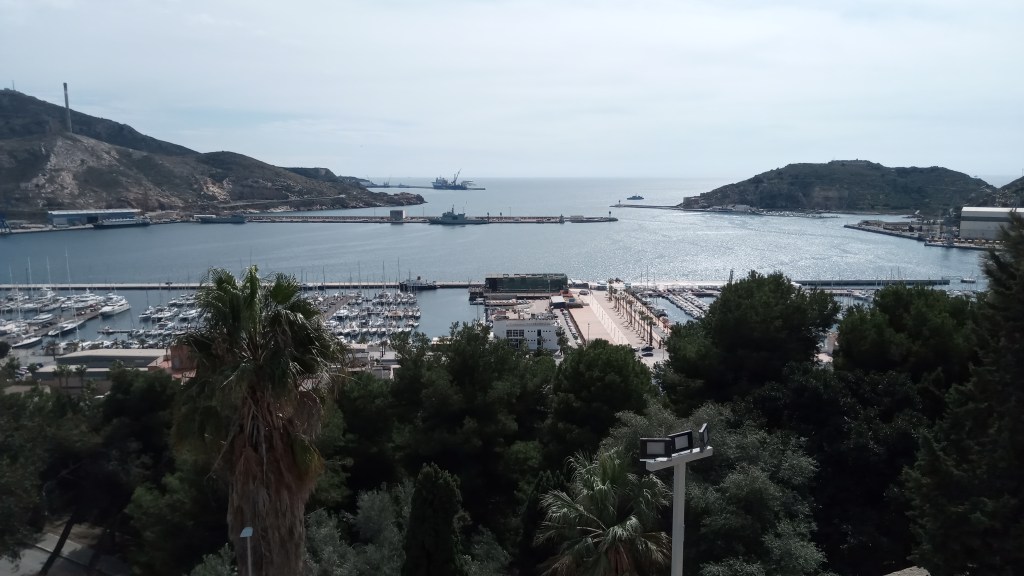
Friday 11th March
I have spent the last two nights in the Mar Menor , an inland sea five times bigger than Poole Harbour. It is enclosed by a 12 mile long sand bank that stands only a few metres above sea level. Despite this, the entire length has been built upon, with rows of tall apartment blocks (think Miami) . The entrance is via a narrow channel and there is a lifting bridge which opens every two hours. I arrived just 10 mins late to catch one so anchored just outside the channel in a strange lagoon full of rusty piles where once upon a time there was a plan to build a marina. Just before the next bridge lift I set off down the channel , there was a good one to two knot current flowing out but that was good cos it meant I wasn’t being pushed down onto the bridge before it opened. Once though I headed to an anchorage on the lee of one of four islands. Depth throughout is about 4 metres so in theory anchoring is possible anywhere. In season this place would be packed with marine enthusiasts of all sorts but now there are just two other sailing boats I can see.
The island that I anchored off, called Isla Perdiguera, has had a chequered past. During the civil war it was used for shelling practice and for years after there were unexploded bombs. It was cleaned up and became a popular destination for day trippers, there were bars and restaurants. But it was being badly damaged by over commercialisation and eventually the government shut it down. 30 odd years later and all that remains are the ruins of buildings. Nature is swiftly recovering and the island now is host to a significant colony of guls, which were very put out by my arrival. Their presence though was a pleasant reminder of cruising Scotland and Ireland. I took a trip ashore to explore. Upon landing the shoreline was a very smelly and gooey sludge, so not sure how polluted the Mar Menor might be. As I climbed to the top of a low hill hundreds, maybe thousands, of guls took great exception ,screeching and whirling around . The best thing about being here is that there is no swell so no roly poly at night just absolute peace and quiet.
Saturday 12th March
Yesterday morning I weighed anchor in time to get to the bridge for the 10am opening. I was the only boat coming out or in, and strangely the current this time was running in so again I was able to face into it and make a controlled approach. My destination was Ibiza, 120 nm roughly north east. Forecast was S to SW till about dawn, about 10 to 15 kts, and indeed so it proved to be, all day at least. I averaged 5 to 6 kts in flattish water on a broad reach and then a run, with the genoa goose winged. I fiddled with the tuning of the autopilot to try and get it to not oversteer and do so much work. In the end it was much improved, tending to oscillate up to 10 degrees either side of the set heading. I crossed the shipping lanes running up the east side of Spain, moved out beyond the fishing trawlers and had the place to myself before sunset. Then around 3am the rain started, at first just light, but it steadily increased to a deluge which continued for the next 3 hours. In that time the wind became temperamental changing strength and direction frequently. So I was up forward changing the pole over on the genoa and reefing and unreefing the main. It was pitch black, the deck leaping around and water streaming down sleeves. Oh joy ! But like all good things, bad things come to an end too. The rain stopped, day broke and I could see Ibiza just 20 miles ahead. But just when I thought the last few miles would be downhill, the wind rapidly built, this time from East, just aft of the beam. It reached 25kts and the sea became chaotic. SO was being tossed around but I know she can handle this. My concern was that the bay I had planned to make landfall was not now going to be tenable. I headed for the only shelter along this southern coastline, a half mile stretch under some cliffs, but not a place indicated as an anchorage in the Pilot book. However it would have to do and indeed it is sheltered from both wind and the boiling sea, though still very roly. I have managed to anchor in 10m of water on a stony bottom. This would be good enough but sadly tonight the wind is coming south, decreasing, but it will not be sheltered any more. I will have to ride it out as there are no other viable options short of going well out to sea again and sailing round to either Ibiza town or San Antonio.
Thursday 17th March
I see it is 17 degrees in London today, it’s only 14 here in wet, cold and windy Ibiza ! It’s been like this for 5 days now and set to continue for another week at least with only the odd day of respite. So am taking shelter in San Antonio, famed for its partying, not that there’s much of that happening right now. It is a very sheltered anchorage, and has been used as such back to Phoenician times if not before. The problem with anchoring here now though is that Spanish law says no closer than 200m from a beach, and the central part of the harbour does not permit anchoring in the main channel, or in the areas of sea grass where moorings are laid. This effectively leaves just one very small patch in a corner for anchoring and this is not well protected. Spain is streets ahead of UK in terms of protecting sea grass, which is known to be a foundation for a healthy marine environment. Anchors play havoc with it so there are hefty fines for anchoring in these areas, and there is an App (as always!) which maps exactly where they are. The problem for cruisers is that with this and the 200m rule, many of the bays can be difficult to find a spot to anchor. The plan here is to lay visitor buoys, one’s that screw down into the seabed and don’t damage the natural fauna, but it’s going to take another couple of years to roll them out.
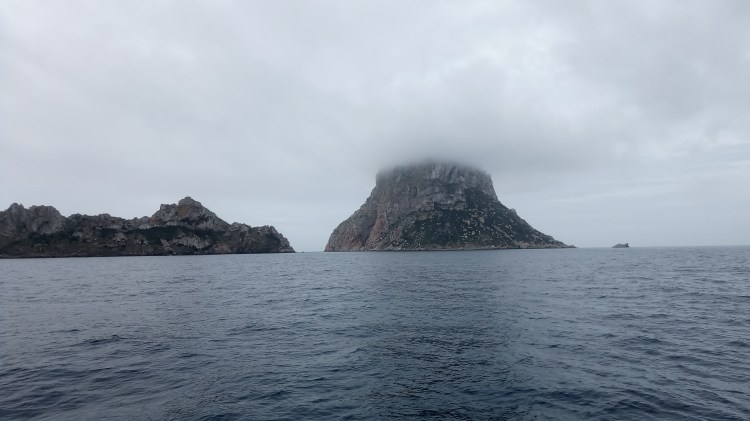
On the way around to here from the anchorage where I made landfall last weekend, I passed Es Verda in early morning mist and low cloud, very atmospheric. It is a rocky and uninhabited island, standing 1,355ft high. Folklore says not only that it is the third most magnetic place on earth, but that it is the birthplace of Phoenician goddess Tanit, and that it was home to the sirens and sea nymphs who tried to lure Ulysses from his ship in Homer’s Odyssey. Just my luck I could find none.
Monday 21st March
I’ve been on the anchor now a few days, here in San Antonio bay, because the winds have been persistently from NE to SE and ranging up to 25kts. The bay is actually sheltered in anything but due west and has very little swell so is comfortable. There are boats at anchor here that look like they’ve not moved in years. I’m anchored in sand and silt 200m off a gently shelving beach, in 5 metres of water and with 30 metres chain out. After so many days I’m confident the anchor is well dug in. Well this morning that confidence was shattered. The wind is gusting 30kts and I’m not about to dinghy ashore. Good thing too, as I’m sitting down below and suddenly realise the motion of the boat and sound of wind has changed. It’s only a subtle change but when you get used to every sound that your boat makes you know instinctively when something is not right. One look out of the window and it’s clear, I’m on the move, nothing around is where it was. There was no warning, no scraping as the anchor dragging along. It takes no more than a minute to get the engine started, the wheel cover off and unlocked, and I can stem the drift, but by this time I’m half way to the ferry laid up on the breakwater, and I’ve just passed a starboard channel marker, close shave ! I retrieve the anchor, it comes up with a wadge of mud and weed, so clearly was dug in at least some. I look around for anywhere that might be more sheltered but the whole bay is much the same. Then I notice the catamaran that was next to me is also dragging and they are running around on deck. The forecast is for 30+ kt gusts for next three days. I could consider laying out two anchors, and if there was no alternative then that is what I would try next. But I’m within spitting distance of the marina and decide it’s just not worth the angst trying to re-set the anchor and then laying awake all night, so I call PortsIB and ask if I can come in. I am now safely moored and looking across at the anchorage which is a maelstrom. It has been a salutary reminder never to rely 100% on an anchor, no matter how big, what type, how much chain you’ve got out, or what the bottom is made of.
Friday 25th March
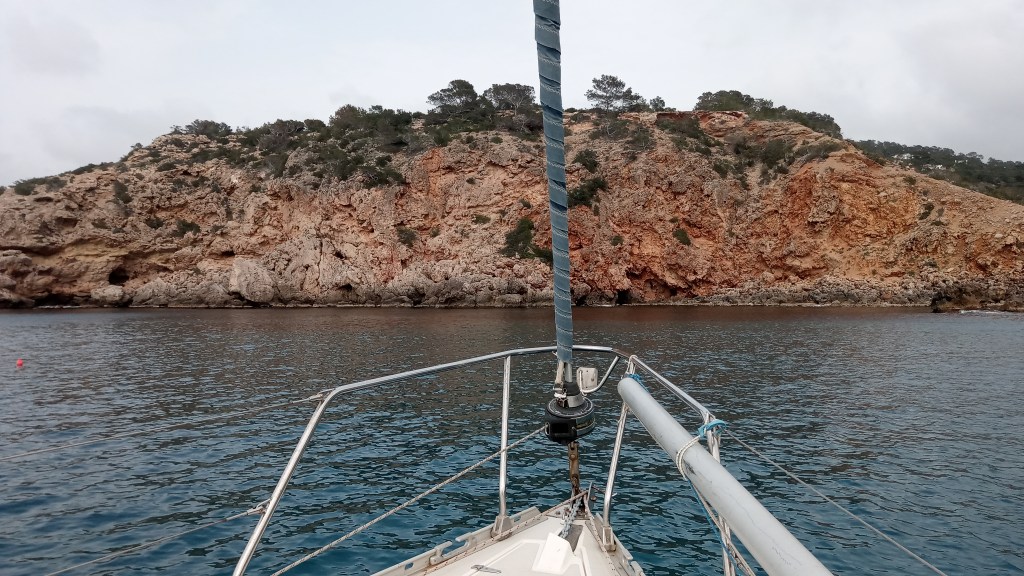
After days and days of endless rain it has at last stopped but winds are still blowing hard from NE. Locals say it’s very unusual and that it was much warmer and settled in December and January, which was not really what I wanted to know . So I have departed San Antonio bay for a change of scenery, but sticking to the sheltered west coast for a bit longer. I retraced my steps back through the channel between the islands of Sa Conillera and Isla des Bosc. This has charted minimum depths of 3m and a few isolated rocks, so I stuck firmly to the track that I recorded on the plotter when I passed through coming north. Wind was blowing hard from astern so I had just a handkerchief of genoa to keep enough steerage, but also the engine idling in case I might need to rapidly go into reverse. I was concerned because there was a lot more swell than before, but as it happened I cleared through with no less than 2m under the keel. There are numerous Calas or bays along this stretch but Posidonia limits anchoring possibilities. Cala Moli is described as being surrounded by high cliffs and with a beach at its head. The Posidonia satellite image showed a large clear area near the entrance with 8m depth and a sandy bottom. So using the power of modern technology, I was able to drop the hook precisely in the right spot to give enough clear swinging room. In the season this would have been impossible to achieve as there are mooring and swimming buoys all around. I had a go at putting out a kedge to hold the stern into the swell and minimise rolling, but wind gusts, whilst only moderate in strength, would curl round the cliffs from one end and then the other, so making it impossible to choose an optimum direction to face. The water is crystal clear and against the white sandy bottom I can see shoals of bright blue fish. I threw some leftovers over the side and these fish were on it in an instant, easily beating a pair of gulls that had been bobbing close by and eagerly awaiting my offering.
Monday 11th April
After staying at Cala Moli, which provided excellent shelter under the cliffs, I then moved on to visit other Calas as I made my way anticlockwise around the island and toward Ibiza Town. Cala es Torrent provided good shelter from NW around to East, under high sandstone cliffs. I anchored one cable south of a small stone pier where there was a sandy bottom clear of posidonia. The wide bay is backed by a long but narrow sandy beach. It didn’t look terribly safe to sit on under the cliffs as they showed evidence of frequent collapse. However it doesn’t seem to deter people from building exotic villas in ever more precarious positions.
The next stop was at Ensenada de La Canal, on the southern tip and facing Formentera. It provided limited shelter from east to north but good from north west to west, under distant hills. I anchored one cable off the beach and one cable due east of the jetty that is used for loading ships with salt from the nearby salt pans. Plenty of space clear of posidonia. The bay is backed by a long and wide sandy beach with many bars. There is a bus (#11) twice a day from Ibiza Town. Its a short walk to Ses Salines national park where the ancient salt pans are to be found, home to a variety of birdlife, including Flamingoes at certain times.
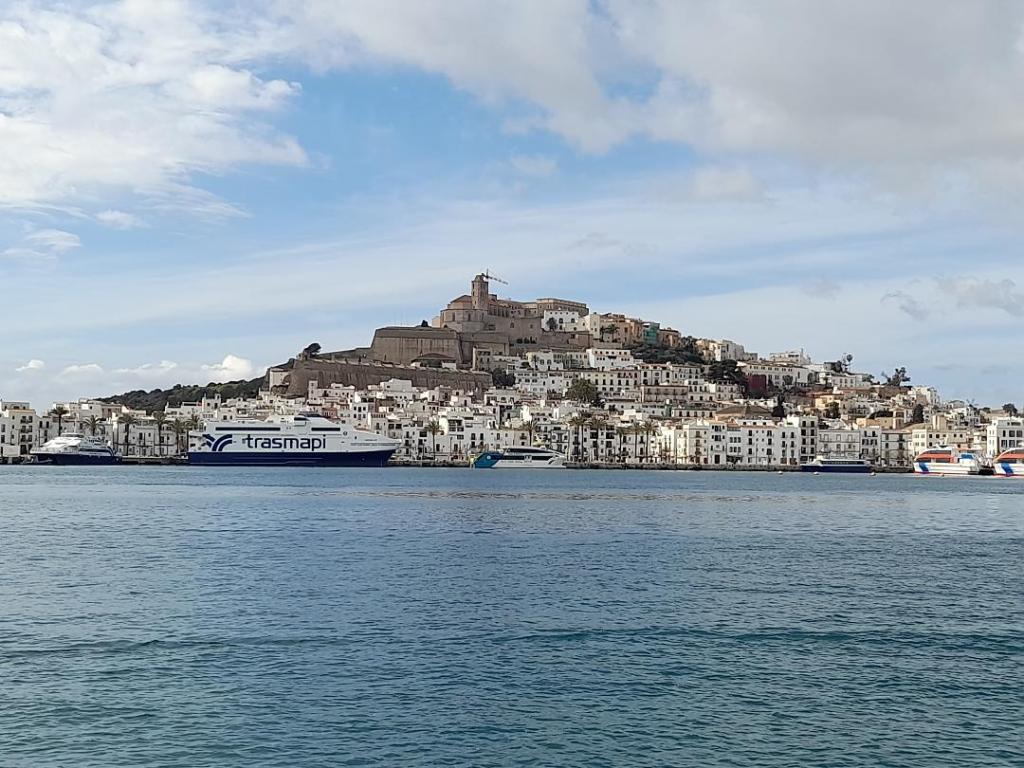
There are six marinas in all in Ibiza Town bay. However some will only take boats of the oligarch sort and only one replied to my booking request. This was Marina Ibiza in the northern corner. It has two parts, one for the super yachts and one for everyone else. I moored stern to a wall which is backed by a strip of park and then the main road. No security at all other than cameras, but there was a night watchman on his bike. As we appeared to be the only people in residence at this time, he tended to spend the night right next to our boat, which was comforting. The problem here though is very bad surging if winds are anything other than offshore. I think its exacerbated by the fact that the whole bay is developed with quays and hard walls so there is no beach or natural shoreline to soak up the wave energy. I recently made up some mooring lines with coil springs designed to dampen the effect of the boat surging. So I was glad of these to reduce the strain on deck cleats, but they are very squeaky, something Amanda will testify to. Other than that it was a good place to stay, a week in the end due to bad weather. The old town stands majestically on a hill overlooking the harbour and is packed with history. It is still early in the season so most cafes and the like were still closed but there was feverish activity getting places ready to open by the end of our week.
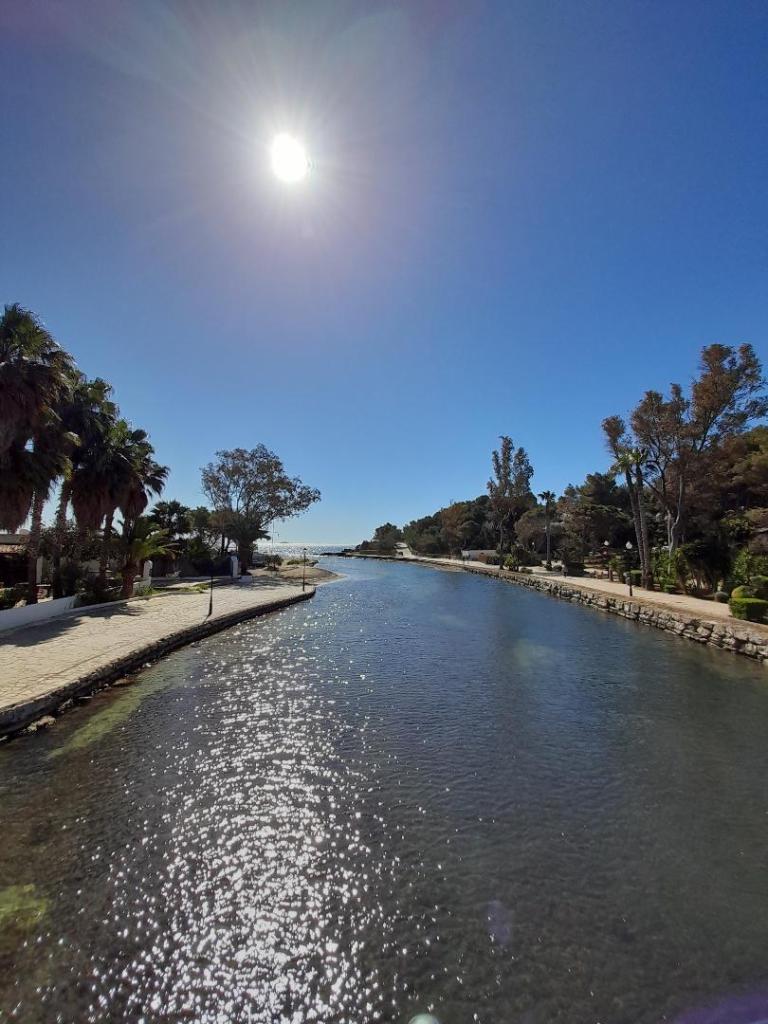
We moved on a few miles north east to Santa Eularia. It was a pretty lumpy sea outside the harbour after days of strong winds, but we made good time on a beam reach in a steady 10kts offshore wind. The large marina is located right in town and has 700 berths. We were pretty much the only people in residence, with a few locals working on their boats or going out for a short spell. On Saturday the town was scene to the Ibiza marathon so it felt like the season had now started in earnest. One point of interest is that the only river in the whole of the Balearics, flows into the sea at Santa Eularia.
Yesterday, after Amanda left to return home, I cleared out to find a good anchorage. It was a very lively exit as depths just off the breakwater are down to 3m in places, and with a fairly big swell the waves rapidly steepen and break. Once clear it remained lumpy until through the passage between Ibiza and Formentera and on a broad reach in 18kts, Sea Orchid charged along at hull speed, about 7.5 kts.
Friday 15th April
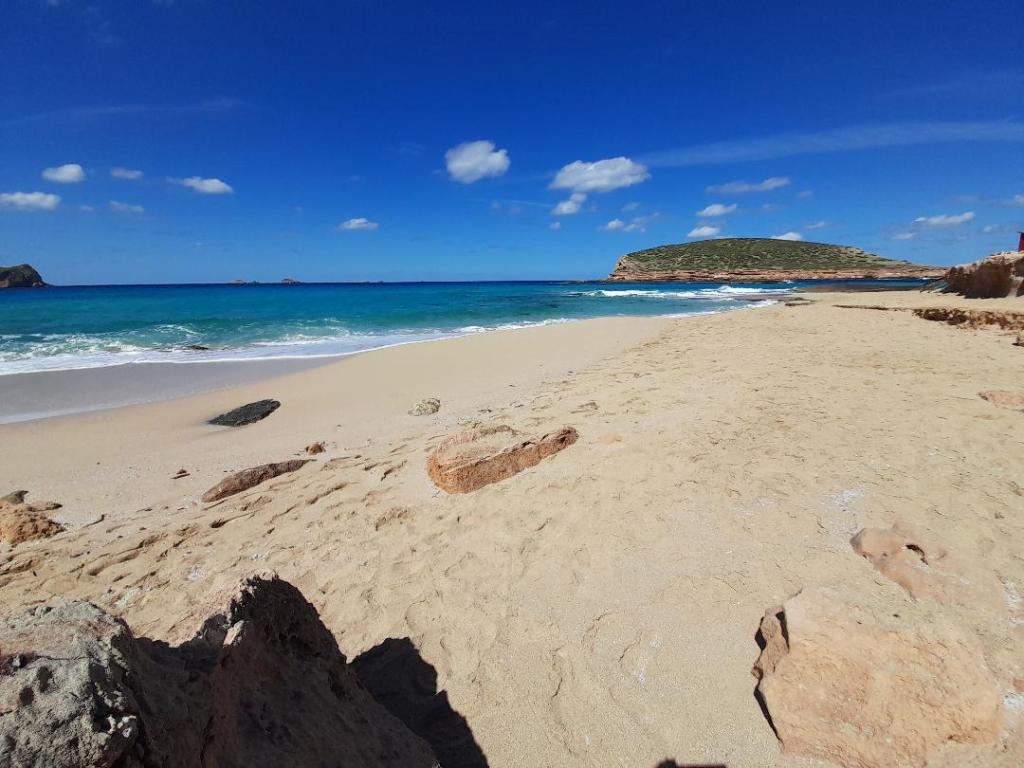
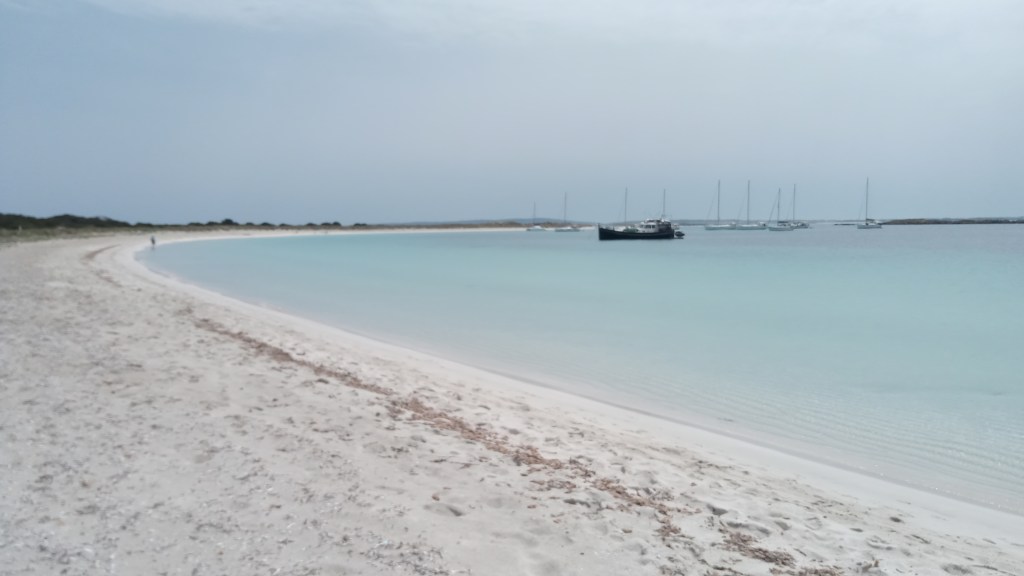
Yesterday and the night before there were strong winds again from NE through NW, maxing around 32kts. So I returned to the anchorage at Cala Torrent where I knew I could tuck in under high cliffs and there is shelter from any winds with north in. Short sharp gusts still found their way in, as ever, so I deployed an angel or chum to dampen the effect of snatching. I used the 10kg kedge anchor and set it 8m down the chain just clear of the bottom. It worked a treat and had the added benefit of reducing the effective scope, so that when the wind died away and went round to onshore, I was still a good distance off nearby shallows. A flotilla fleet arrived in the anchorage last night, a sign that the season is starting to take off. And the weather has just come good for Easter, today being the warmest yet, and set to hold for another four days. So I have sailed over to the island of Espalmador, the smaller sister to Formentera. Here on the west side there is an anchorage in a bay lined with a long white sand beach. Behind that are dunes that are a nature reserve and incorporate some ancient salt pans. It is a private island and has one house, who’s owner seems to be in residence, but the beach / shoreline can be accessed by the public. Soon after I arrived another flotilla came in, providing entertainment as each boat searched for clear sand in between the patches of posidonia. Two kite surfers on foils scorched up and down the shoreline. This evening there is just SO and one other. It’s very still, there is a full moon, a clear sky, and just the sound of wavelets lapping on the beach.
Sunday 17th April
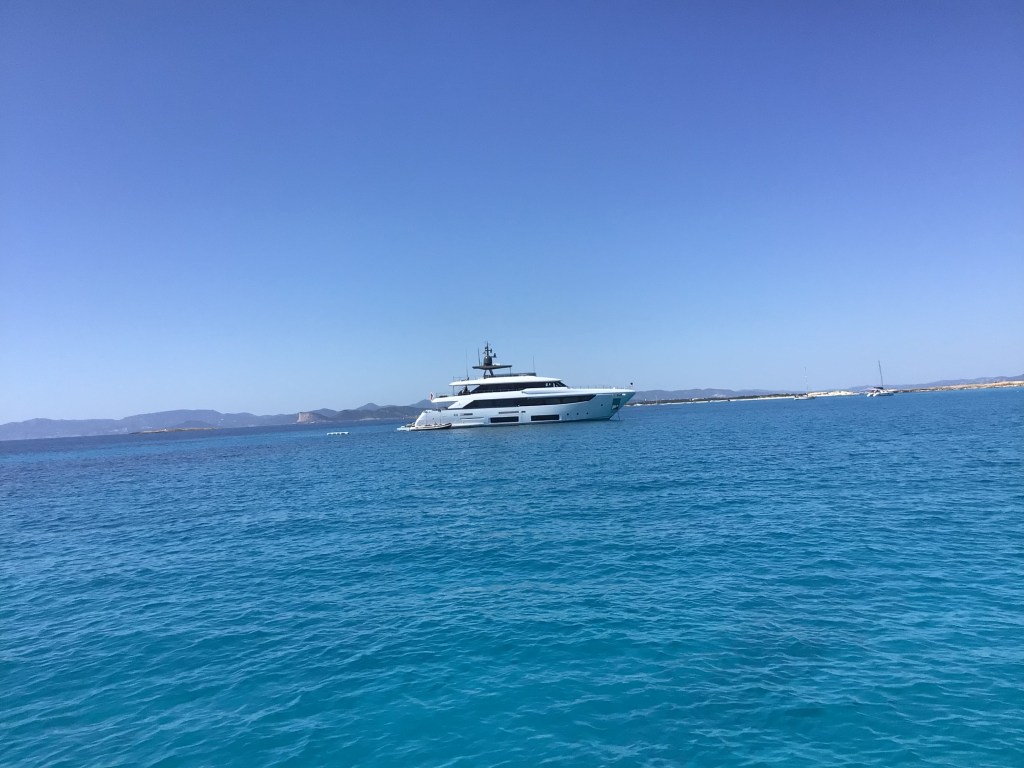
If you’ve got the storage space on board there are some new and exciting toys to be had, for those with a low boredom threshold. There is the scuba propulsion thingy which appeals to those who like to be dragged through the water at speed without scuba kit, but you do need gills. Then there is the powered surfboard thingy, just a bit bigger than a skateboard, with an electrically driven propeller. You have to stand up (unless you don’t mind looking very uncool) and hold onto the handset which is attached by a cable to the front. There are two speeds, subsonic and dead slow, and it switches between them in an instant, so hold on tight to that cable as you take off, and prepare to be launched like a missile when you’ve had enough of that. But for the supreme poser nothing less will do than the hands free, powered board, with foil. As you stand, arms outstretched, clutching the controller, this will lift you clear of the water and take you supersonic across the anchorage, slicing through the water and any organic material in its path. Silent and deadly. All these devices harness underwater electric propulsion units, the possibilities seem endless. At least they are greener than combustion motors, and with the cost of fuel, perhaps we will see the demise of those traditionally annoying devices that have plagued anchorages, jet skis.
And while I’m in the mood, I’ll also mention the drone that has just hovered directly overhead of SO for two full minutes, presumably armed with video camera and super zoom. Look out for me on the front cover of Hello, baring all !
Sunday 24th April
Today I am crossing from Ibiza to Mallorca, a passage of 54nm. Weather forecast is saying westerly 18 to 25kts to start, decreasing as the day goes by to about 10kts when I get there. The past 3 days it’s been blowing old boots again, we had 35 kts in the marina at Santa Eulalia, but is finally blowing itself out. My route goes along the south east coast for a few miles so I will be in the lee of the island to begin with. I slip lines at 0800 and get the main up with one reef as soon as I clear the breakwater, as sea conditions in the bay are good. I’m soon clocking 7kts over the ground and reach Isla Tagomago on the eastern corner. From here I set a direct course for the western end of Mallorca, roughly northwest. For a little longer I’m in the lee of the island but then as I clear land the wind increases and the sea starts to build. It’s a confused sea with an underlying swell from south west overlayed by a westerly short sea driven by the current wind. By midday I’m getting phases of wind around 30kts and a few peak at 35. More problematic though is the sea conditions, with steep waves combining from differing directions. Keeping a line and working the waves to avoid broaching becomes a full time job at the wheel. The autopilot loses it within a couple of minutes, veering wildly, as much as 40 degrees either side of the course. At times I’m doing over 10kts surfing down waves, a speed SO rarely achieves. It’s not till mid afternoon that the wind starts to ease but progress has been so good that I’m now only 10nm from Mallorca. It’s now a case of choosing an anchorage that will be least affected by the continuing bad sea conditions, which are likely to last through the night. There are a couple of bays, or Calas, that face more south or north than west and I head for one called Cala Blanca. I see a big Lagoon cat heading there and by the time I reach the bay he is tucked well inside so I have to anchor further out as it’s not a big space. It’s going to be a rather bouncy night, but after the roller coaster day I can put up with that.
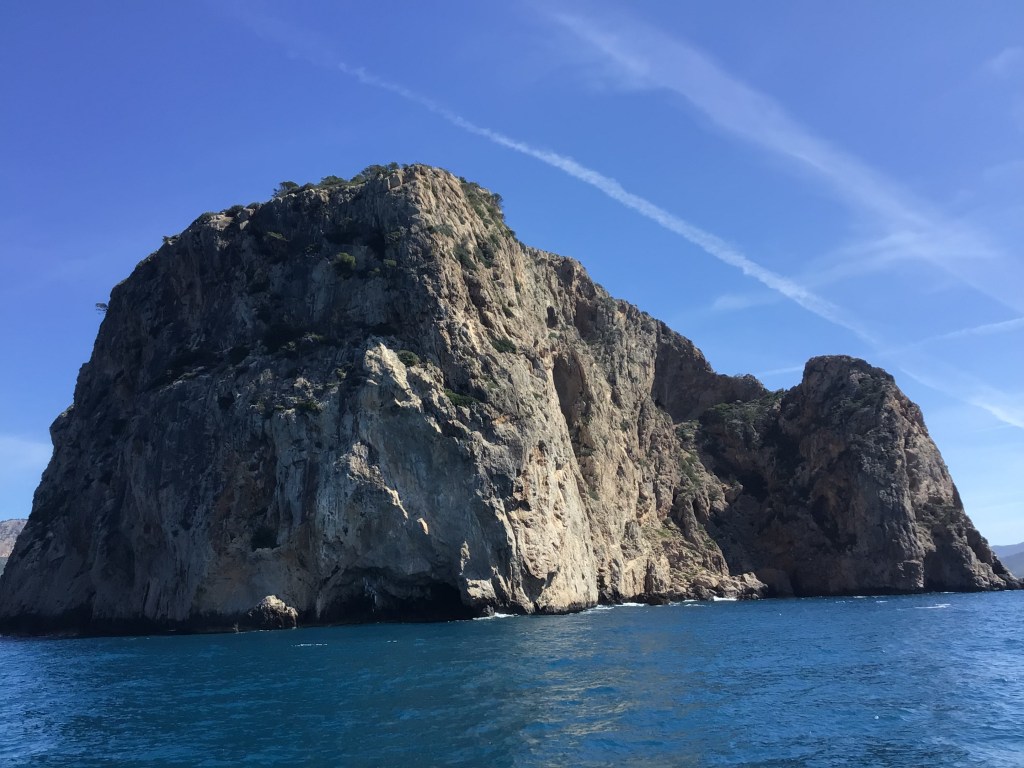
Thursday 28th April
Over the last few days weather has been very settled and only very light winds so I’ve been pottering between most of the anchorages along the west side of Mallorca. It’s still relatively quiet from the point of view of visiting boats, and Posidonia seems to be fairly sparse, so no trouble finding a spot to drop the hook.
Cala Blanca proved to be a good anchorage overnight. It is backed by cliffs around 180 degrees and provides good shelter in anything from SW to NE. It has a small stoney beach, not ideal for dinghying ashore but it is only a 20 minute walk over the hill to Port D’Andratx.
Santa Ponsa bay is just 4 miles east. It is sheltered in anything but west if located at least half way in. I anchored just off the very small beach about halfway in on the south side. In between the underwater cables and mooring buoys. On the small beach it’s easy to land and secure the dinghy to a tree. 10 minute walk into the town and the main beach.
At Paguera, just 2 miles north, anchor 200m off the semicircular beach. Sheltered from anything with N in it but could be rolly. Nowhere to secure dinghy but beach seems to be well populated. Very nice small resort. Car rental at Autos Custodia.
Sant Elm is the small village at the north west corner of Mallorca. It faces Isla Dragonera (where there be dragons Ooo arr). Well actually I believe they are small green lizards. The small bay hides behind another small island and is sheltered in anything but due south. But only half of it is available for anchoring, the other half being part of the marine reservation all around Dragon Island. Good secure beach for landing and a very nice village with a small supermarket. Probably the best spot on the west coast. This superb Baltic 87” anchored next to me. Called Shaya, she is on the market for a cool €900,000.
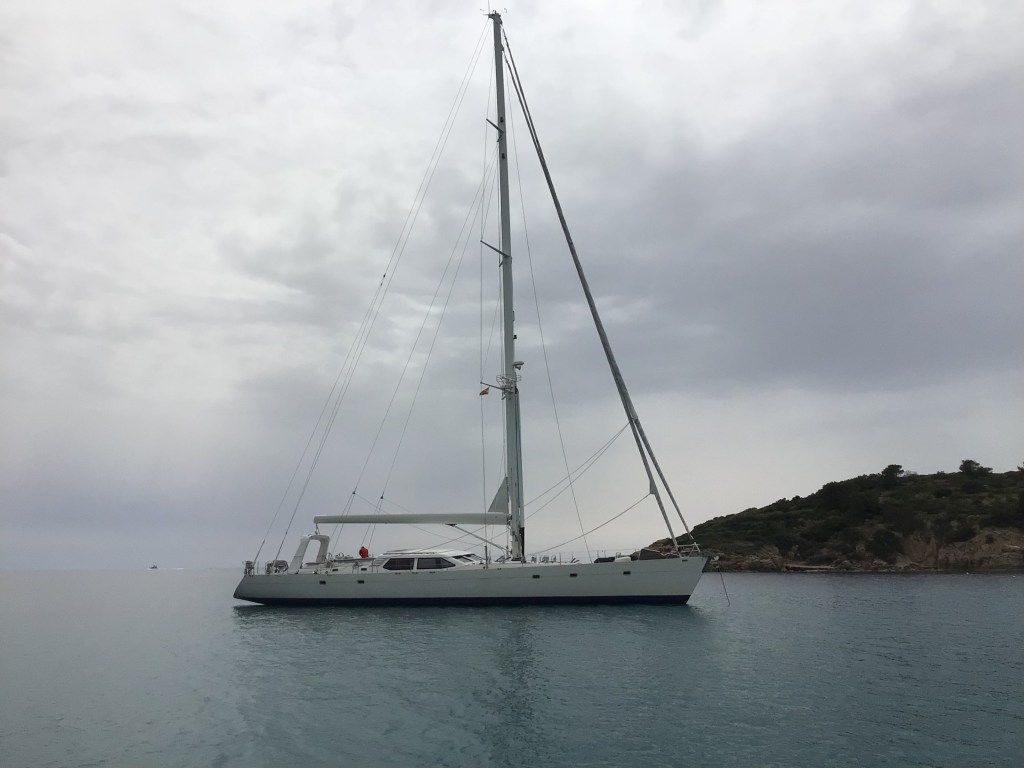
Sunday 1st May
From the western end of Mallorca I sailed south east across Palma bay. This bay is 15 miles wide at its mouth and on a warm sunny day it drew in air from the cold sea beyond. This sea breeze was a god send for without it I would have made no progress at all. It provided about 8 to 10 kts of wind on the beam and with flat water SO was able to achieve a top speed of 4.5 kts. Deep in the bay I could see the tall black rigs of maxi racing yachts that were out practicing in advance of Mallorca’s biggest sailing regatta in the calendar, taking place this week. Upon reaching the headland at the southern end of the bay, the sea breeze gave in and I had to motor the last 8 miles to my night time spot, Playa Trench. This 2 mile long beach, regarded by some as the best on Mallorca, is the first place for 15 miles where it is possible to anchor. It’s also a good stepping off point for the Islas Cabrera, my next destination. Fortunately it is a windless night as there is no protection to speak of from any direction.
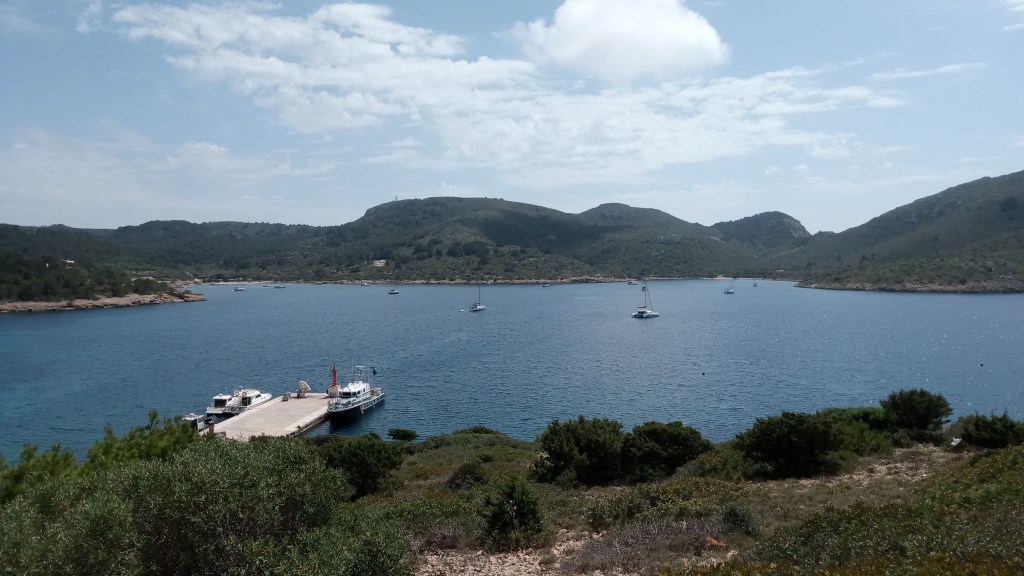
The following morning I set off early to make the 10 mile crossing to Islas Cabrera. These islands are a National Park and I had to obtain a permit to visit. Access is strictly controlled as they are home to a number of plants, and one or two species of endangered wildlife, that are unique in the world. Anchoring is not permitted, visitors are allocated a mooring buoy in a bay which is a perfectly sheltered natural harbour. The dinghy has to be landed on one of two jetties. Guardia Civil and a few wardens are the only residents and there is a barracks for a small army if ever the islands need to be defended. Access for walking is limited. A track around the foreshore of the bay, leads up to a small 14th century castle. Another track, inland, goes to a botanic garden which contains examples of the plants to be found across the islands, all carefully labelled. And a third track takes you to the remains of a building where during the Peninsular War (Spain v France) as many as 9000 of Napoleon’s troops were incarcerated, a large number of which perished due to starvation.
There a half dozen other boats here in the anchorage which has to be the most peaceful spot to spend a night in the whole Balearics.
Friday 6th May
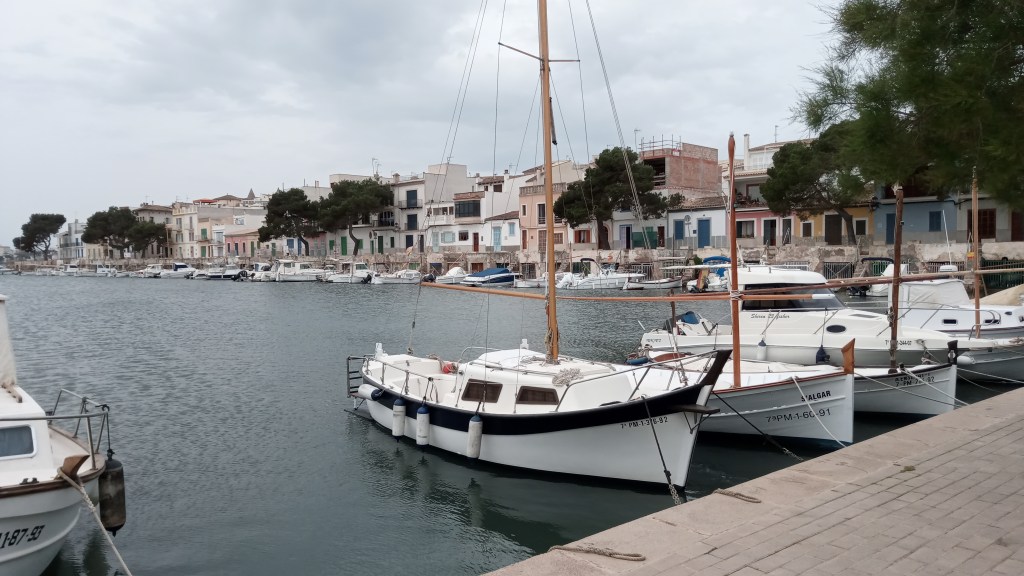
I left Isla Cabreras and headed north east with an ideal F3 to 4 from E to SE. The coastline on the east side of Mallorca is one of low cliffs indented with multiple small Calas with sandy bottoms. Sadly however nearly all are off limits to boats anchoring due to posidonia and swimming buoys. So I continued till late afternoon and had to decide between going into Porto Colom or Porto Cristo. The former is a large shallow lagoon, mostly full of private moorings and technically nowhere to anchor. The latter is an estuary and again nowhere to anchor outside the channel. I opted for Colom after calling the local Yacht Club who had available visitor moorings. A rib came out to escort me to a buoy and take my lines to thread through the pick up, all very civilised. It’s a delightful town that has somehow escaped being developed. Most of the buildings along the foreshore are the traditional fishermen’s houses complete with a boathouse in front. It’s all low rise and leafy. Commercialisation is limited to a few cafes and ice cream parlours. The bay itself reminds me of Mudeford, very shallow with surrounding flat land only a few meters above sea level.
The following day the forecast was deteriorating fast, the next two days were expected to be 35kts from NE, ie along the coast. Since there was nowhere further north which could provide much shelter I decided to stay put. But I moved from the mooring to the Ports IB pontoon, partly because it was cheaper than the mooring (surprisingly) but also because I needed to fill up with water, plus I would be able to get ashore when the wind got up. This has to be the cheapest berth on the whole island at €22 a night !
The next 2 days were indeed rough even in the harbour and with just a quarter of a mile fetch from the other side. Tucked in, stern to, on the leeward side of the pontoon and with boats moored on the windward side, I was still bounced around, but altogether very secure. Fingers crossed Hester will join me on Monday so I think this will be the best place for her to board.
Saturday 7th May
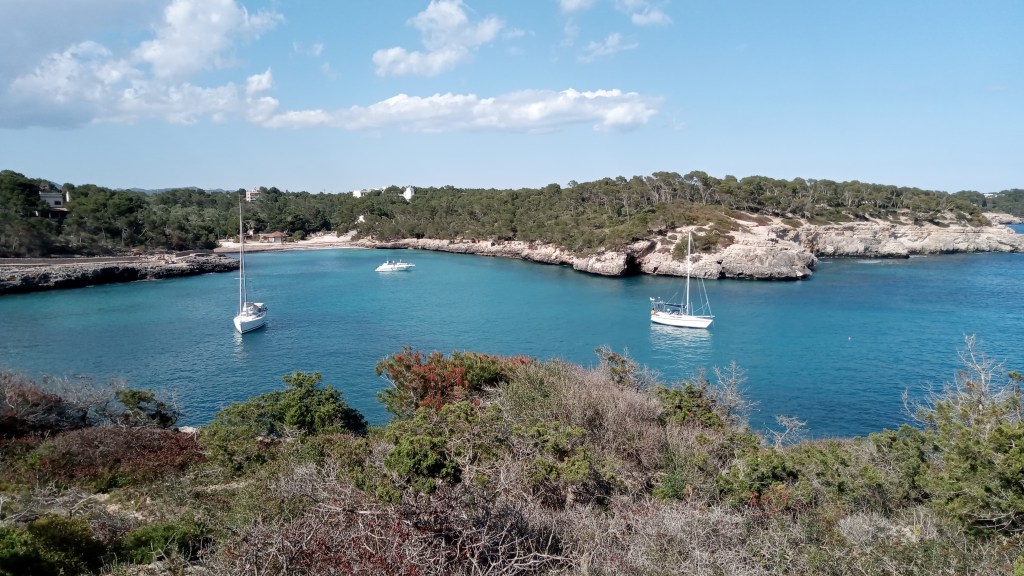
I took a short trip along the coast to reccy Cala Mondrego, one of the very few that has large areas free of Posidonia. This Cala has two branches, each with a fine beach at its head, the remainder lined with low vertical cliffs which overhang the water at sea level. As I went deeper into the Cala the extent of the swell, which had developed following days of strong onshore winds, became more apparent. Each swell would steepen as the water became shallower, then be trapped under the rock overhang and explode outwards with the pressure. There were three boats already anchored, all quite close to the edges, and were being tossed around, so I anchored further out in the middle where at least I didn’t suffer the effects of the waves reflecting. Almost immediately a lifeguard on a jet ski came over and I thought he was going to tell me to anchor somewhere else, instead he told me not to go in the water for a swim. Apparently a shark had been sighted so all bathers off the beach had been recalled. I have not heard of sharks being an issue in the Med and I’m pretty sure if there really was one that it would have been a tiddler or likely vegetarian. I think it was an excuse for the lifeguard to show off his prowess at driving a jet ski, as he spent the next hour patrolling at full speed.
I had no intention of taking a dip anyway but later that day I nearly did as it happened. Another British boat came in and anchored close to SO only to discover he had got the anchor well and truly stuck on something. The guy was snorkelling around to look at the problem and swam over. He had had the most rotten luck and caught his brand new 25kg Rocna under an old chain, probably used once upon a time as a mooring for a trip boat. I always put a trip line on the head of my anchor in case of such an event but he had not. Anyway I was glad to offer my small folding grapnel to hook the chain and lift it off. It took a bit of fishing from the dinghy but eventually we did lift it clear. If we had not been successful, and I was doubtful in 5m of water, the alternative would have been to engage a diver. I was offered dinner and later we discovered our paths had probably crossed many years earlier when racing Sigma 33s. It’s a small world.
Monday 9th May
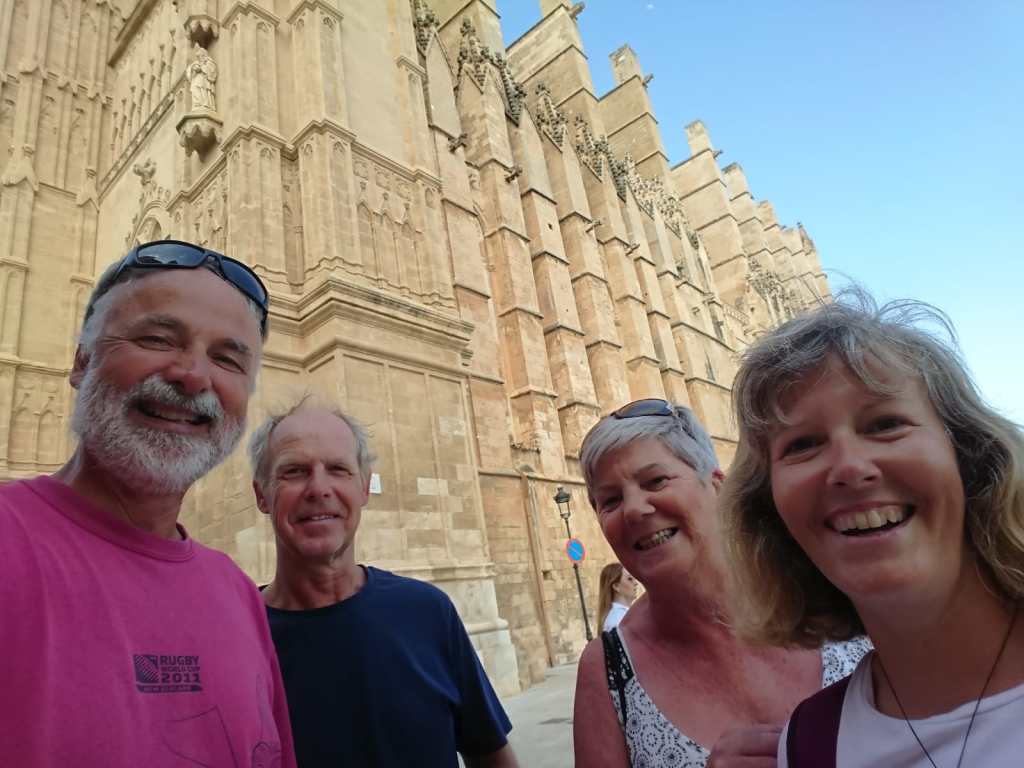
Met up with Duncan and Diane in Palma as they pass through the Balearics at pace, heading for Croatia before their 3 months is up. Hopefully catch up with them again next summer.
Friday 20th May
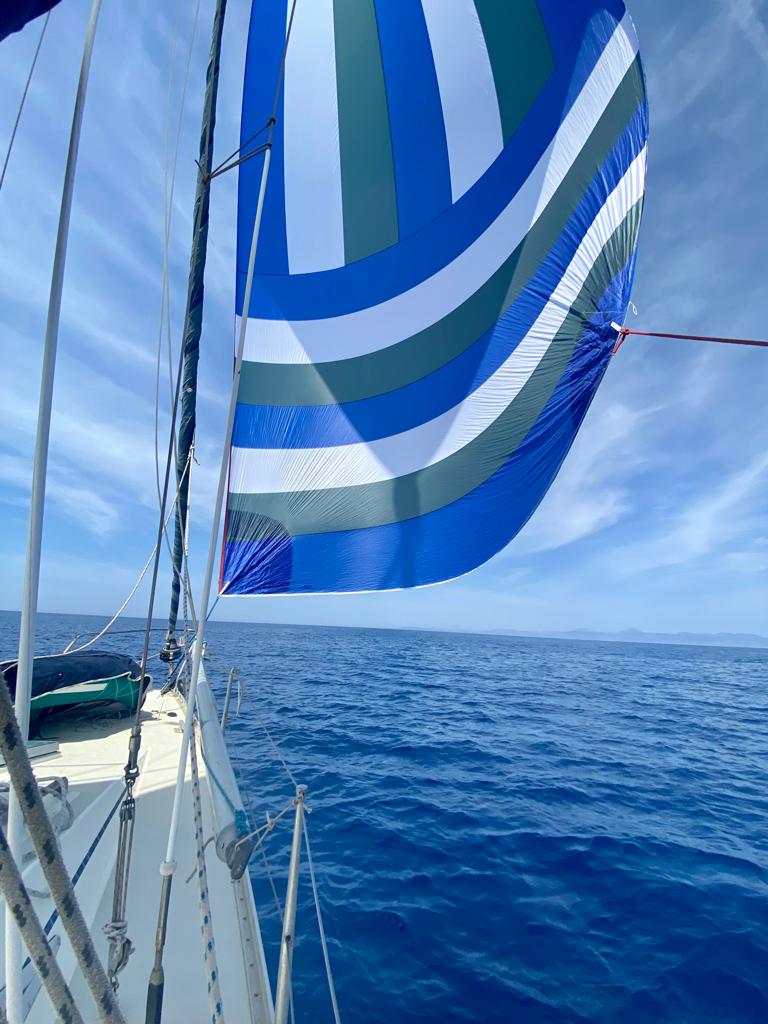
When Hester joined SO in Porto Colom we retraced steps back first to Cala Mondrago, then Isla Cabrera, Playa Trench and Santa Ponsa. The passage to Santa Ponsa, about 30nm, was bestowed with a steady 10 to 12 kts on the quarter to beam. It was therefore an ideal opportunity to get the cruising shoot flying, the first time this season. Quite remarkably it was launched without a hitch and looked fabulous crossing Palma Bay. I’ve often regretted getting the cruising shoot in favour of a conventional kite, as it’s useful range of points of sail is limited, but on this occasion it was just the ticket. After Ponsa we went to Port D’Andraitx to the Ports IB pontoon for a few days. Once again it was all very well run, with efficient service, new pontoon electric and water points that were card operated and working, and good showers etc. All for just €22 a night, at least up to end of May when apparently it doubles. The town too is in my view the best place to moor on Mallorca. It’s very sheltered, has a backdrop of high hills, and all the shops, bars and restaurants you could possibly want, right at the end of the pontoon. There was even a live band playing most nights on the balcony of a bar just across the way, which we could enjoy from the comfort of our own cockpit. After a brief visit to Sant Elm we returned to Ponsa for Hester’s last night as in the morning she was able to catch an airport bus from a very convenient stop just behind the beach. As the anchorage is good in almost any weather this makes it one of the best places to guarantee a crew change, short of going into one of the Palma marinas.
Saturday 21st May
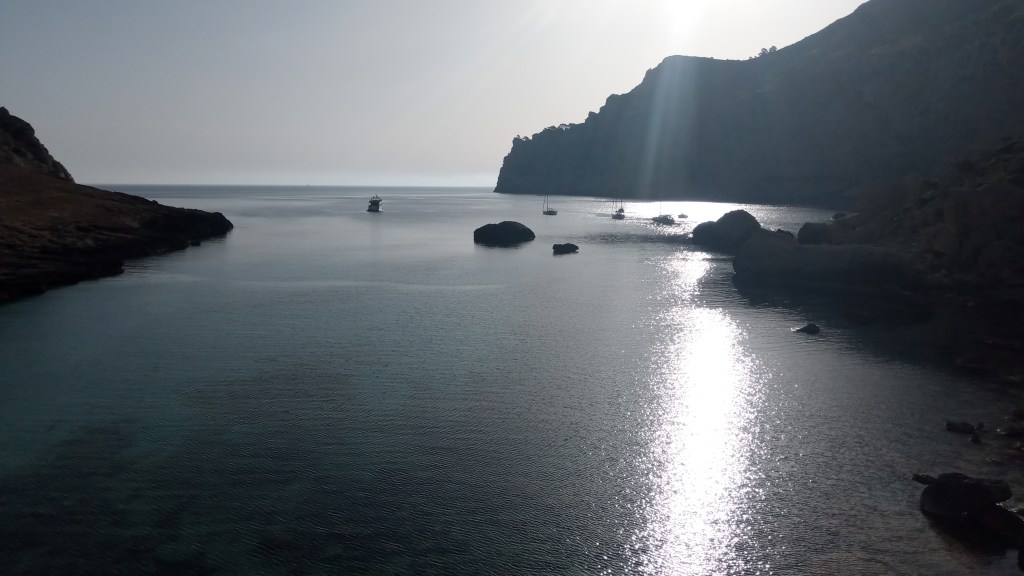
It’s time to head for Menorca where liftout of SO is scheduled for 28th. A study of Windy for the next week shows a complex picture of wind speeds and directions, at a localised level. From Ponsa, at the western end of Mallorca, to Mahon, at the eastern end of Menorca, the distance is roughly the same whichever route around both islands you take. I opt to go around the north side of Mallorca, and then decide which way to go around Menorca, but it’s really six of one and half a dozen of the other. The north coast is one of high mountains plunging steeply into the sea. The scenery is spectacular and it’s eerily quiet. There is virtually no tourist development, just the occasional bunch of traditional homes nestling in a hollow high above the sea. There is a noticeable absence of seabird life, quite why I’m not at all sure, as the cliffs look ideal territory and if this was Scotland they would be teaming with seabirds at this time of year. There is a distinct lack of any shelter on this coast except for Soller, about half way along. I pulled in for a night and anchored in its large and well protected bay, amongst a good number of other boats. During the civil war Franco made it his military base for his grab of the islands, and there remains to this day a very small naval base. Last week was the town’s annual festivities to mark the repelling of a fleet of moorish pirates long ago. There is a mock battle between two fleets of home made ‘boats’, involving blackened faces (not very PC !), lots of alcohol and getting wet. My last stop on this coast and indeed Mallorca, was at Cala Figuera at the very north east tip, and probably the most isolated anchorage on the island. There are goats clinging to the steep hill sides which tower over the narrow inlet.
Wednesday 25th May
The crossing from Mallorca to Menorca proved to be a frustrating day with fickle winds. The forecast had said 5 to 10 kts from SW veering SE, providing a broad to close reach. The following night it would increase and be onshore all along the south coast of Menorca where the Calas do not provide any protection. So it determined that I go around the northern side, a distance of 30nm to the first potential anchorage. When I weighed anchor there was a good breeze to carry me the mile to Cap Formentor, but then it died and there was barely a ripple. On with the engine, furl up the genoa, centre the main, engage autopilot, sit back and read a book. Half an hour later the wind has increased to 7kts, put down the book, unfurl the genoa, ease the main , kill the engine, do some helming. Fifteen minutes later the wind has died again, and the whole cycle repeats itself over and over. The best spell of sailing occurred as I approached Cabo Nati on the northwest tip of Menorca, when I had a good northerly for about an hour, when I should have actually been experiencing a south easterly, inexplicable. The vista of Menorca from a few miles offshore, at this end at least, is one of low flat land with rolling hills, no trees, a few stone walls and very few buildings. It is reminiscent of the Orkneys, and I’m sure not a coincidence that it was a significant habitat for humans some 5000 years ago, with plentiful ancient remains. My stop for the night was to be Cala de Algaiarens, just a few miles along. It is a large bay with plenty of space to anchor, and two small sandy beaches at its head. Behind the beaches there are fields of freshly cut hay, dissected by a shallow stream with reed beds, and low rocky bluffs. You can easily imagine that you are in Devon or the Scillies.
The following day I moved on just another 15 miles along, passing a stretch of coastline that is a Nature Reserve where no anchoring is allowed. Recently I heard that the whole of Menorca is going to become a Marine Reserve so in future anchoring may become more restricted. I stopped for a night at an open bay just south of Cap de Favaritx. On arrival the genoa furling line shredded, leaving it half furled and flogging in 15kts of breeze, creating a rather undignified scene ! I did know that the line was dodgy but had hoped it would last just one more day till I got to Mahon, but as usual leaving such things comes back to bite you in the end. It also proved to be a bad choice of anchorage, as SO rolled excessively all night. I left very early in the morning and sailed the final few miles to Mahon under main only. The only official anchorage, in what is one of the finest natural harbours in the Med, is right at the entrance, in Cala Teulera. It has all round protection, and I was keen to find a good spot as over the next 3 days we are going to have gales. Decommissioning will now commence before moving up the harbour to the yard for lift out on Saturday.
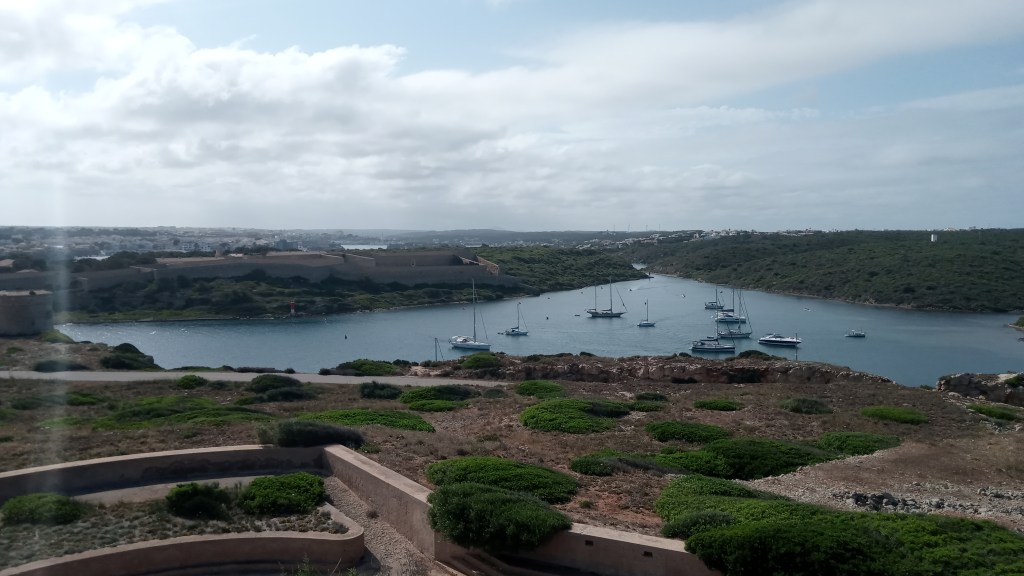
Saturday 28th May
Sea Orchid is on a pontoon just a few hundred meters from the boatyard travel lift. Arrangements are in hand to arrive at the dock at 0800 hrs. I’ve spent the last couple of days preparing her to be left for three months on dry land. This has meant stripping off the sails and all canvas work, and as much rope as can be easily removed, to minimise UV damage. Inside has been deep cleaned, toilet flushed through with fresh water, water tanks filled and purification tablets applied to prevent mould, stabiliser added to the diesel tank, and floor boards lifted and bilges dried. But the wind is still gusting 30kts, and more concernimg, coming from random directions. I slip the stern lines and go forward to drop the bow line, then as SO is almost clear of the boats on either side, I engage forward, the prop judders and the boat jolts to a stop. I knew immediately what had happened, the prop had caught the lazy line that attaches the bow line to the shore. It should sink to the sea bed when released and only come to the surface when picked up from the shore, but on this occasion it has not sunk below the prop in time. The only solution was to get in the water and under the boat and have a go at releasing it. If this failed I would have to get a diver out, at considerable cost and probably not in time to have the boat lifted before the yard closed at lunchtime. Fortunately the rope had not completely wrapped around the prop, but was jammed between the prop and the rope cutter, which by the way had partly done its job of cutting the line. With some underwater acrobatics I eventually managed to free the rope, with enormous relief. So a bit later than scheduled I finally made it to the boat lift where there was more fun and games manoeuvring into the slings with high cross winds. I was pleased to find that the bottom of the hull is very clean and the anodes are still good, so the only task was to clean the prop which was nowhere near as bad as when in Las Palmas a year ago.
The adventures of Sea Orchid will resume in September all being well.
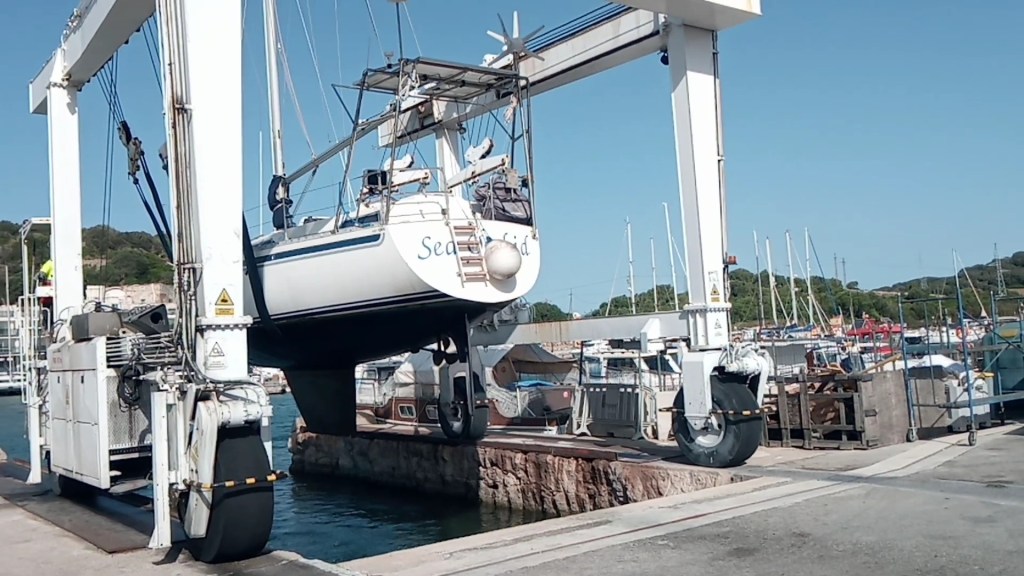
Monday 29th August
Amanda and I arrived at the boatyard in Mahon around midday. Compared with when I had left SO back at end of May, the place was almost empty. Also the yard has changed hands and in the process the hoist that I was lifted out with was no longer on site. The only hoist was a huge 150 tonne one. It was so big that it could only just squeeze between SO and the boat next to it, and SO was not central in the slings. When she was raised off the chocks she wanted to slide sideways which put strain on the keel. It all took a lot longer than expected but eventually she was back in the water and all was well. The only issue was a fresh water pipe to the taps which had parted at a joint. When I turned on the pump nothing was coming out of the taps and it seemed that perhaps the tanks were empty. Only later did I discover the bilges full of water and what the problem really was. It was so reminiscent of what had happened in Las Palmas almost exactly a year ago.
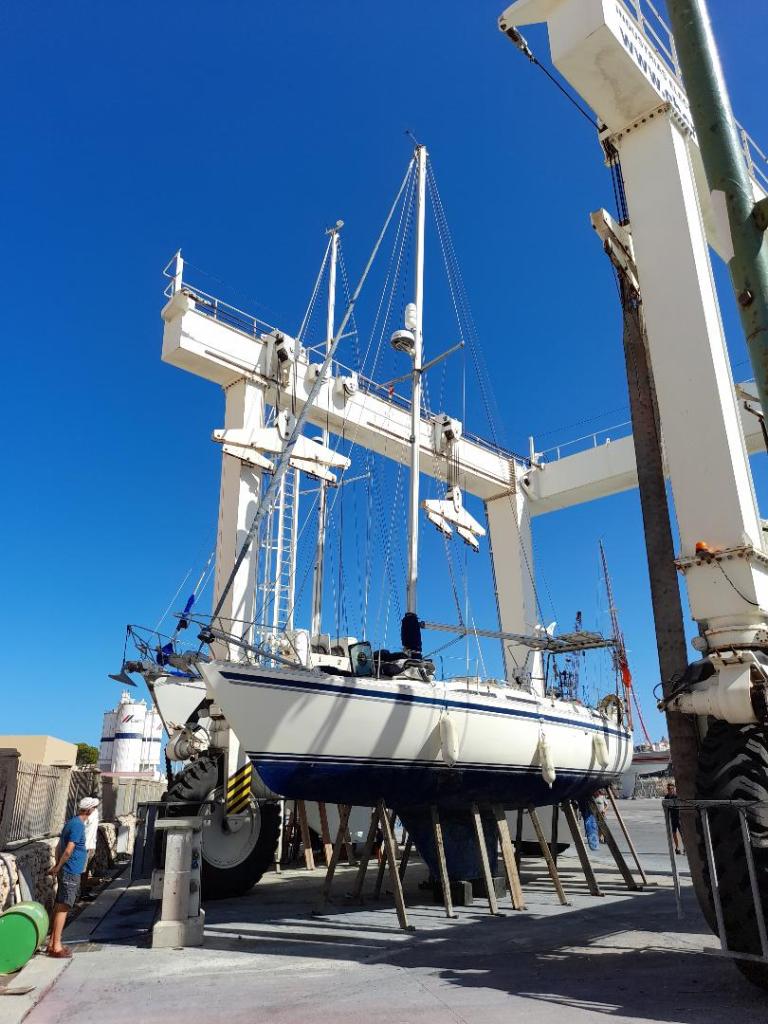
Wednesday 31st August
After a run to Lidl and a dash to Pedros for an exchange of gas cylinder, we exited the marina and headed down to the anchorage at the harbour entrance, just a couple of miles. It turned out to be busier than hoped and it took two attempts to find a suitable spot, partly caused by an enormous catamaran that was taking the space of about 3 boats with his scope. In the afternoon, as forecast, torrential rain moved in for a couple of hours, which had the benefit of giving SOs decks a good wash. It was also an opportunity to search for cabin leaks, which thankfully proved to be minimal. After the rain I re-rigged the main and then tackled the job of fitting a new furling line onto the furlex genoa. Normally I find that a YouTube video is very helpful for such a job but on this occasion it led me astray. Taking the drum apart and attaching the new line was straightforward enough but trying to reassemble proved impossible until I ignored the video, it then went back together in a jot ! It was another very hot and sticky night, resorting to sleeping in the cockpit again.
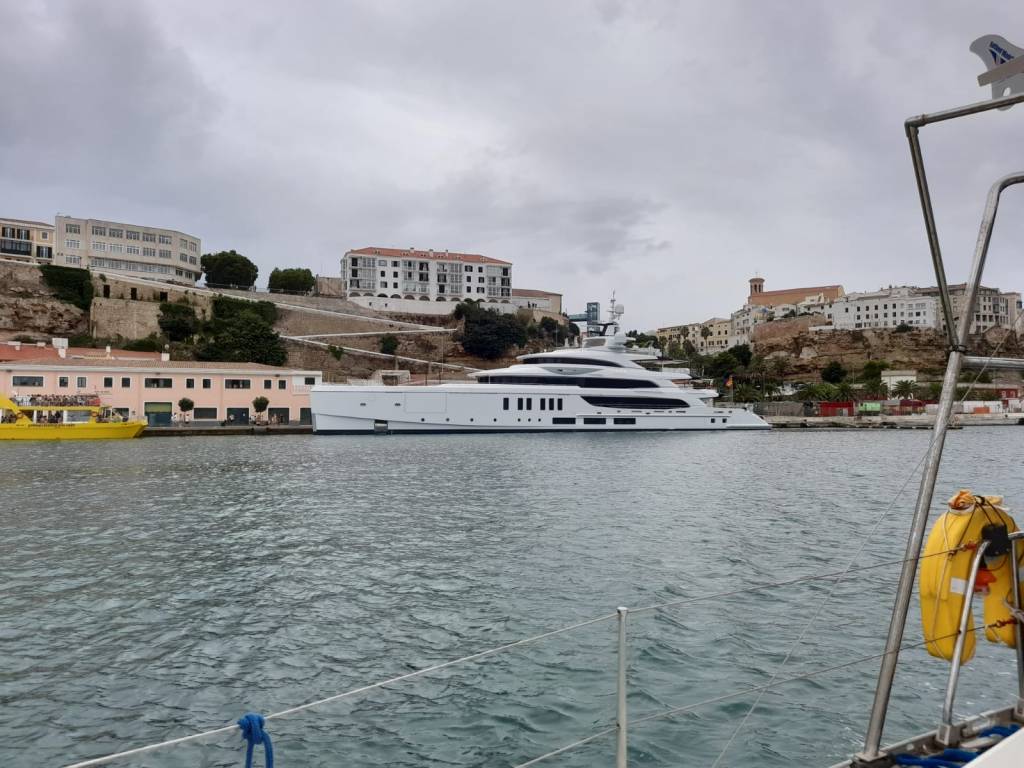
Friday 2nd September
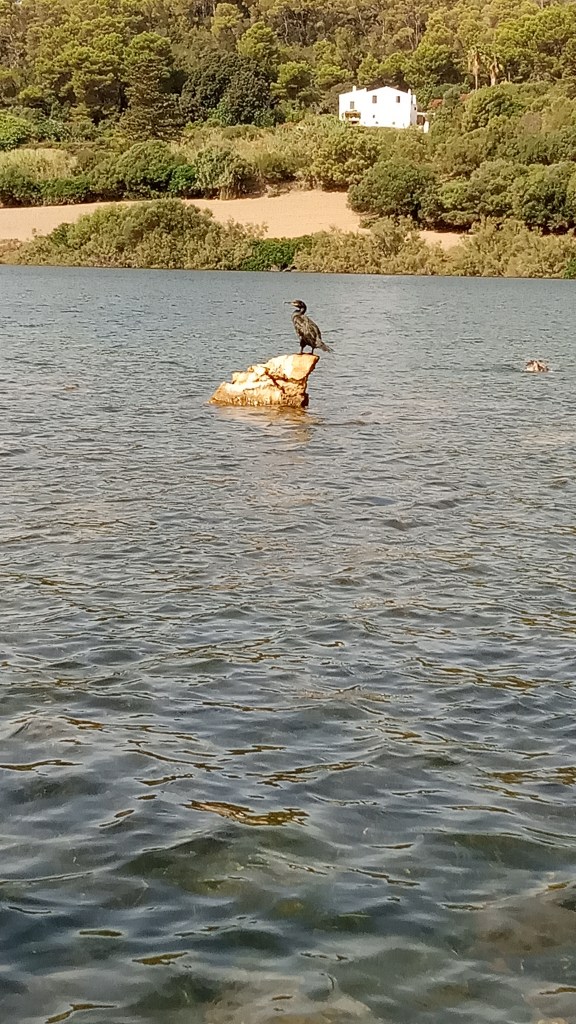
Yesterday we sailed up the coast to Addaya in a gentle 5kts of wind on the beam. The entrance is a narrow channel through some ugly rocks so it’s important to stick carefully between the red and green cans. Once inside the lagoon it’s a beautiful and peaceful spot with a very small harbour and one bar. The following day we took the dinghy for an excursion further up the lagoon to a nature reserve. We went as a far as we could before it got too shallow. Wildlife spotted was limited to a number of cormorants, each choosing its own rock on which to perch and sun itself. Then on the way back from a walk along to the headland, and looking down over the harbour, I realised that SO was not where she was supposed to be. Hurrying back down to the dinghy I then could see she was adrift ! It took another 5 minutes to get the dinghy out of the dock and reach SO, by which time she was quite literally a couple of boat lengths off the rocks. This was a very very lucky escape and I would have to cross off another of my nine lives. Two observations I make are, 1) wind was only about 12kts in flat water and I am bewildered that the anchor should drag in those conditions, bearing in mind that we had sat at anchor already for 18 hours without an inkling of an issue. 2) there were people sat on three other boats all close by and not one of them had jumped in their dinghy to intercept SO as she drifted away. This would surely be the normal response ?? It certainly would have been mine. After three further failed attempts to reset the anchor and not drag, we gave up and left Addaya for Fornells in a rising F5 wind. On arrival just an hour or so later, we picked up one of the visitor moorings, having had quite enough of anchoring for one day.
Saturday 10th September
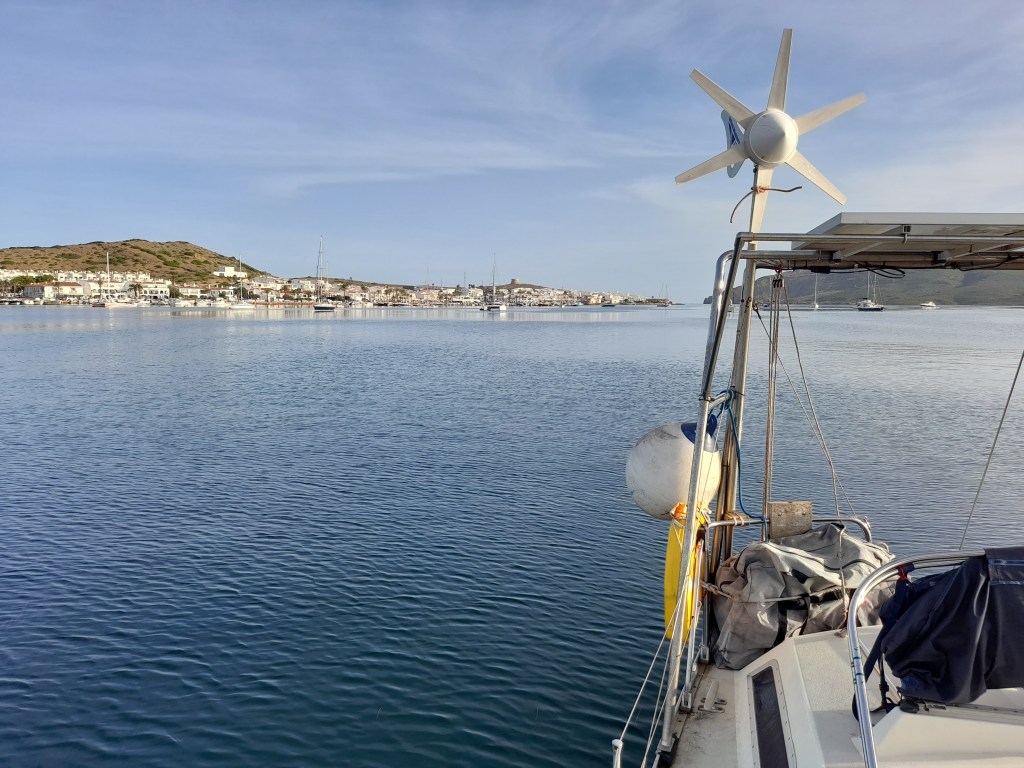
We have stayed a week in the bay of Fornells, which in my opinion is the best spot to stay on Menorca, if not the whole Balearics. There is plenty of space to anchor with good holding and shelter on all compass points. There is also a choice of mooring buoy or the Ports IB quay if things get really lively. The scenery is beautiful, and out in the middle of the bay it’s quiet and free of mosquitos at night. On the quay it’s relatively cheap to moor, with access to new facilities, and helpful Ports IB marineros. The town of Fornells is also the nicest we found on the island. It has bars and restaurants along the waterfront and tucked away in back streets, there are a couple of small supermarkets, bakeries and delicatessens. There is also a good marine chandlers, a fuel quay and even a swimming area. It really has it all for the sailing cruiser, for either a short or long stay. The time has come though to head back to Mahon for the last couple of nights before Amanda flies home. Outside Fornells the sea is rather lumpy after a night of onshore north westerly winds, now being confused by onshore north easterly. Wind is only about 6-8 knots so we motor sail for a short while until past Punta Pantinat when the sea settles and we can just hold a close hauled course to Cap de Favaritx. It’s good to get some cooler air for a while after the stifling temperatures of the last week. When we get to the anchorage at the entrance to Mahon, mid afternoon, it’s packed with both day trippers and cruisers, but we still manage to find a good spot to drop the hook. It’s not a patch on Fornells bay, but then very few places can manage that.
Saturday 17th September
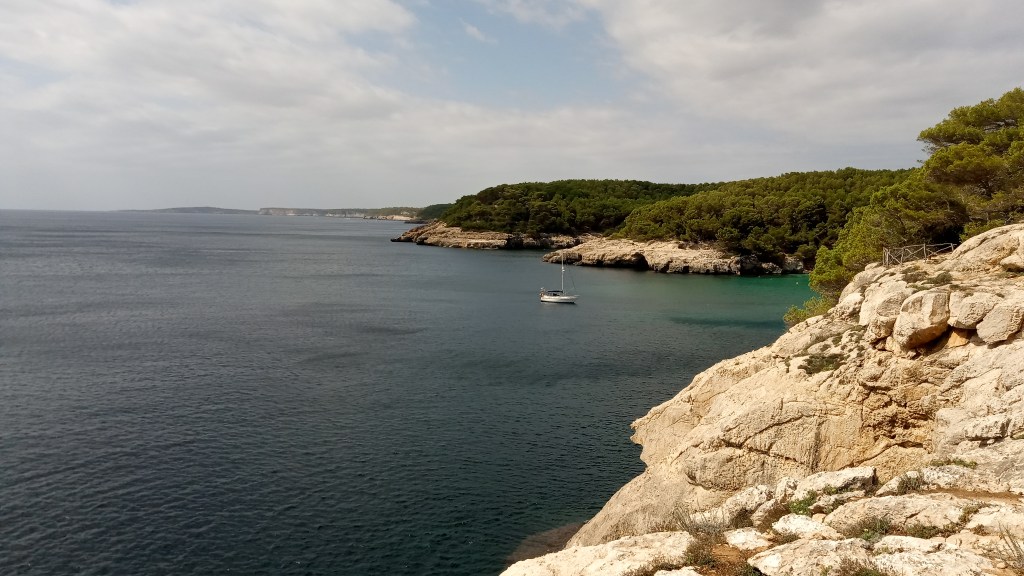
After a couple of days back on the anchorage at Cala Teulera, at the entrance to Mahon harbour, the winds finally went to the northern sector for a while, providing the opportunity to explore the south coast. Early Friday morning in a light NW breeze I made my way south at a rather pedestrian 2kts . On the south eastern tip of Menorca the Illa de L’Aire lies half a mile offshore. The gap is just 5m deep in the middle so careful attention was made piloting through. Then heading north west and rounding up to a beam reach in flat water, SO picked up her skirts and made 5kts In just 8kts true wind. My destination was Cala Escorxada about half way along the south coast, one of the more remote bays with a fine beach only accessible via boat or a long walk. Upon arrival there was plenty of anchoring space but restricted by posidonia, and using the app I was able to locate the sandy bottom, clear or weed. Indeed no sooner had the hook hit the bottom than out of nowhere Posidonia Policeman appeared and checked my anchor using a device for viewing underwater. He gave me the thumbs up. I laid out 40m chain in 7m depth, not taking any chances as the following day there would be 30kt gusts, coming over the cliffs and trees. It was still a bit swelly from earlier easterly winds but by night had settled down. I had the whole bay and beach to myself in the morning. As the wind increased I decided to deploy the 10kg claw anchor as an ‘angel’ down the main chain, just touching bottom. This I have found works really well at dampening the impact of gusts.
Tuesday 20th September
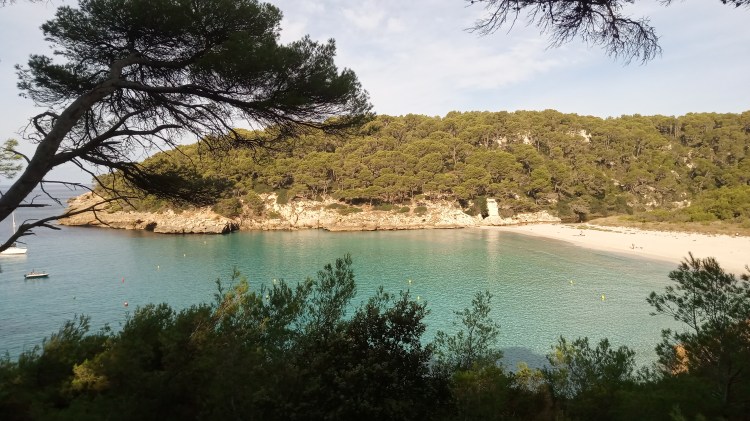
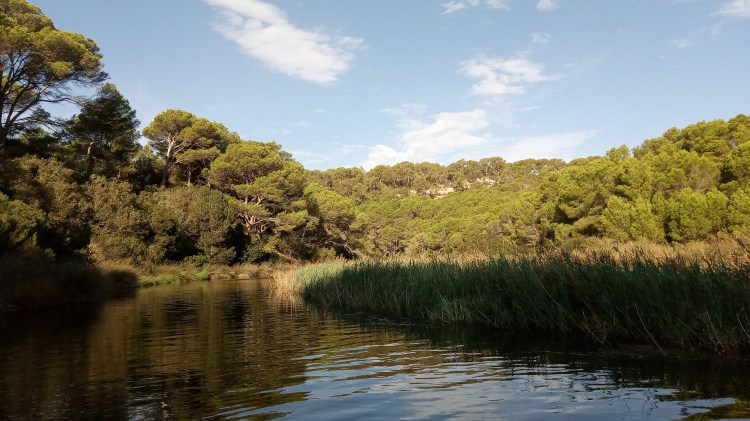
The south coast of Menorca has many beautiful Calas with low honey coloured cliffs, a gently shelving sandy bottom, a beach at the head and backed by forest. I have visited a few over the last few days, my favourite has to be Cala Trebaluger. When I arrived in early morning there was just me and one other boat and a couple of early risers on the beach. It’s more than an hours walk from any direction to get here on foot. Its special feature is a narrow saltwater lagoon that stretches a mile inland. I hauled the dinghy over the sand bar and paddled very quietly up about half of it, in a cool soft morning breeze. The only sound was the rustling of tall reeds. I had read that one might see turtles but no such luck, just the one heron circling above, and adding to the almost Jurassic appearance of the place. By lunchtime many small hire boats were arriving from the resorts further along the coast, but by evening they had all gone.
Another great passage anchorage is at Cala Son Saura, close to the south western tip. It’s a wide bay with plenty of weed free anchoring room, and sheltered on three sides.
I booked a night on the Ports IB pontoon at Ciudadela as I needed to address the ongoing problem of inadequate battery capacity before the trip to Sardinia. I was pointed in the direction of a marine shop in town where the proprietor turned out to be very helpful (unlike Pedros Boats in Mahon who were useless!) In one afternoon he managed to visit the boat, discuss a solution, go to a battery supplier, come back with a battery and two cables made up, and install. Job done. I now have a third 100ah lead acid battery which will I hope see me good for a while, and until I have decided to transition to lithium.
Tuesday 27th September
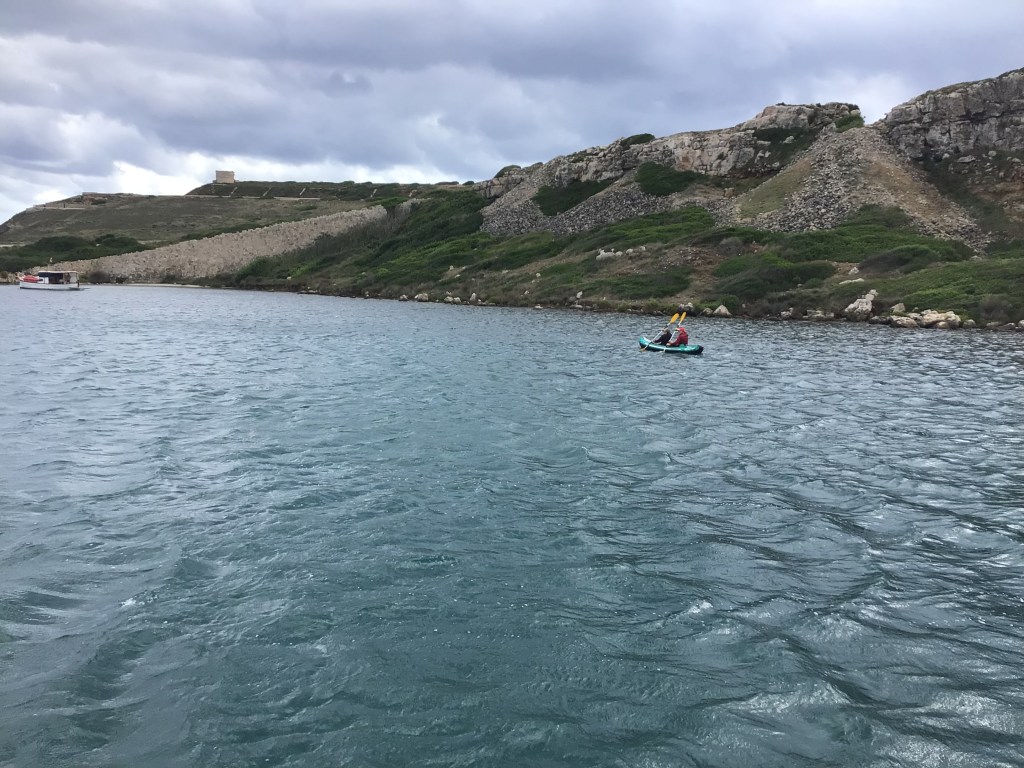
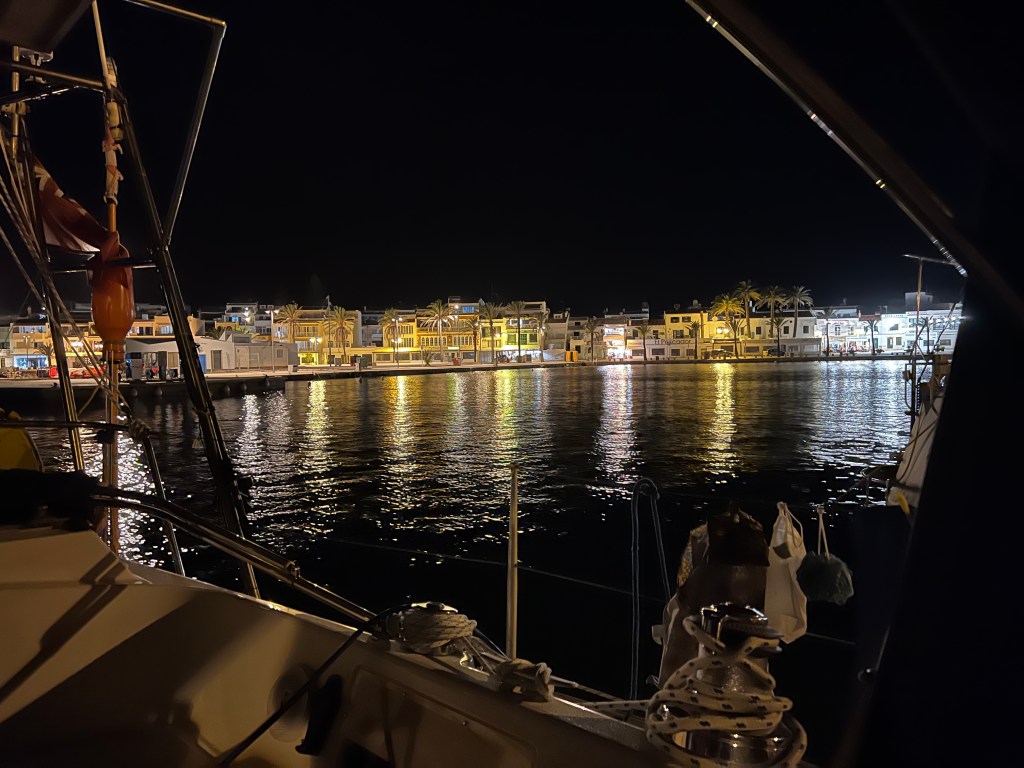
Brian and Jennie arrived at the weekend. They brought monsoon rains with them, and the winds from the north west were building, so the crossing to Sardinia was put on hold for a few days. We made a brief stop at the Cala Teulera anchorage where they took the kayak to visit the huge La Mola fort. In the late afternoon we ventured out of the harbour in a decreasing Norwesterly, to sail around to Fornells. As expected we soon had headwinds and progress in a lumpy sea was slow. As we steadily came round the NE side of the island I had hoped the wind might give us an angle but it was not to be and predictably it bent around the coastline. We arrived at the entrance to Fornells just as darkness fell, but that did not present a problem as the two red leading lights on the islands half way down, make it a safe approach. The only hazard to look out for were the unlit yellow visitor buoys as we headed half way down the harbour to find a good spot to anchor in clear water. It was a very peaceful night. The following morning we went onto the Ports IB quay to spend the day making final preparations for the crossing and a little R&R. It was a very different place to the one Amanda and I had experienced just a couple of weeks earlier. All the small hire boats had gone and half the restaurants and cafes had packed up for the winter. But it still retained its charm and even the sun made an appearance.
Wednesday 28th September
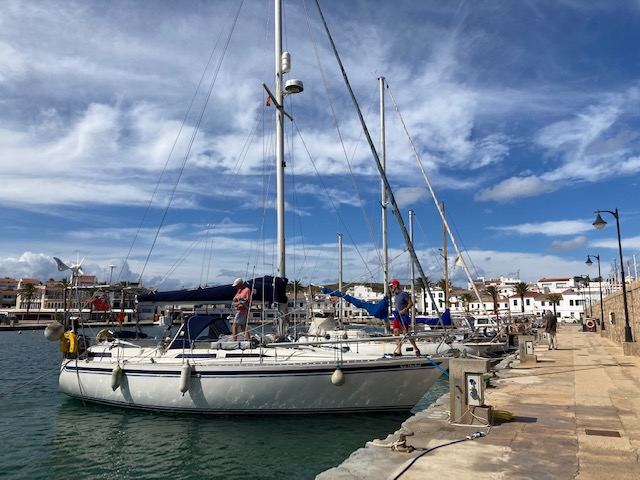
At 0700 precisely SO creeps out of Fornells harbour under cover of darkness, well almost, there is a glimmer of light on the eastern horizon. We are bound for Sardinia, 190nm to the port of Alghero, towards the northern end of the west coast. The forecast is not ideal but that’s the penalty of cruising on a deadline. For most of today we should get a favourable following wind of around 15 to 20kts from west. Then it’s going to pot through the night, there could be wind from any direction or none at all. Tomorrow as we close on Sardinia we might get a good SW to push us in, but time will tell. We set up both sails initially on port, with the pole on the genoa and the main on a preventer, to reduce impact of an accidental gybe. Later as the wind veers, we goose wing to get more out of the genoa. Sea conditions are unpleasant, still suffering the after effects of strong NW winds of the last few days. Steering dead downwind requires a lot of concentration to counter the effect of waves trying to push the boat first one way then the next. For Jennie and Brian they it’s a steep learning curve so we do 3hour watches starting at 10.00. It’s sunny so we put the cockpit cover up and settle into a round of relaxing, dosing, eating and drinking, listening to music, conversation, and taking watch. We make good progress through the day keeping up an average 5kts. We have Brian’s pre-prepared chilli for supper just before 1900, then before the light fades altogether we put 2 reefs in the main, even though the wind is at this stage reducing. As darkness falls the stars are out but sadly no moon to light the horizon or the outline of the sails. It’s even more challenging now keeping the boat on course, the only assistance coming from the wind instrument. When you have to rely on this and can no longer see the bow of the boat turning against the horizon, any change of helm to correct heading is inevitably a few seconds later than otherwise. To avoid an accidental gybe we have to steer 20 degrees or so off downwind to give some margin of error. Later the wind drops and we resort to motor sailing for a few hours, which does at least make steering a little easier. Then in the dead of night we are becoming surrounded by thunderstorms, bright flashes of light on the horizon forewarn of impending doom !
Thursday 29th September
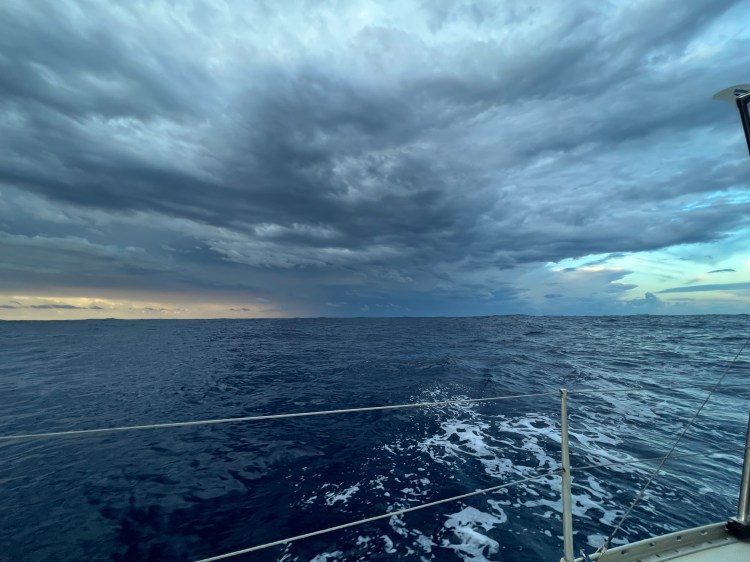
Day 2 begins as a very very dark night but at the same time regularly brightly lit by flashes of lightening from many directions but primarily the west and northwest, ie behind us, and steadily moving past on either side. It seemed now to be a case of when and not if we would catch a thunderstorm. Meanwhile the wind moved around and we found ourselves being headed and having to steer a course some 30 to 40 degrees to south. Dawn breaking at around 0700 was the most welcome sight. Whilst the sea was still very lumpy and the sky very threatening, it didn’t seem quite so bad in daylight. Then the sky darkened to the northwest, and became a huge expanse of inky blackness that began to surround us on three sides. The wind began to shift again and I had just taken the pole off the genoa and returned to the cockpit when I could see the surface of the water behind turning white. It still came as a surprise though when it hit us moments later, Jennie saw the wind dial hit 34kts as she grimly hung on to the wheel and the boat bent to the wind on the quarter. We tore along at 8 to 9 kts off the back of waves. We had put our mobile devices and vhf handset inside a baking tray in the oven, the only defence against a lightening strike that I had heard of, but never personally put to the test. Then the rain started, slowly at first, steadily building up to a horizontal monsoon, so heavy the waves were being flattened, and visibility reduced to just ahead of the bow. It probably lasted less than a half hour but seemed longer. The sight of a bright sky following, brought welcome relief. By afternoon the wind had shifted to SW and we were back on course, the distance to go number tumbling fast. At about 30 miles we spotted land so had something to aim at instead of watching dials and numbers. Supper was served just before 1900, Tim’s pre prepared chicken pasta dish, and spirits were high as we closed in on lights ashore. It seemed like plain sailing from here on, with an ETA of around 0100. Before dark though we put the 2nd reef in again, and this proved to be a wise move. The wind built to 20kts plus and steering downwind became increasingly difficult, so that we were veering away from the course. At 10nm off we had to gybe and head north till a couple of miles off our course when we gybed back and were able to hold a course directly for Alghero. Just as it seemed all was well the weather had to have the last say. Although we were aware of thunderstorms around again, because it was dark it was difficult to judge their direction or distance. Then the rain started and it was clear what would happen next. Within seconds the wind accelerated and we quickly furled the genoa, but it soon became apparent that we had limited manoeuvre ability on a fast approaching lee shore. As horizontal sheets of water flew across the decks Brian bravely went forward and clung to the mast to bring the main down, while everyone quietly prayed there wouldn’t be a lightening strike at that moment. In visibility so bad I could barely even see the instruments in the cockpit, we motored slowly, as I needed to keep steerage but didn’t want to get closer to land till it had passed. When it had passed we were able to anchor in calm waters outside the harbour in the lee of the breakwater at 0300. Boat and it’s crew thoroughly soaked, and still running on adrenalin, so it took a while to get to sleep.
Thursday 6th October
This week has seen a whistle stop tour of the west coast of Sardinia. This side of the island is less frequented by cruisers as it typically experiences onshore winds, and the relatively few anchorages are consequently untenable. However I was lucky to have offshore winds apart from afternoon light sea breezes. First stop was just across the bay from Alghero, under cliffs on the north west side. The only visitors were early morning long distance swimmers, and out in the bay a fleet of more than a dozen yachts racing. From here I was able to walk to the nearby Nuragic (around 1500 BC) site of Palmavera. It was then a 35nm sail south to Mandriola, a wide sandy bay open SW but the light wind kept the boat head into the very slight swell so minimal rolling. The forecast repeated itself daily, E 8-10 kts till midday, then dying for an hour before a light sea breeze from W rolled in for a few hours, then dying again for the night. So an early start was rewarded with a fine reach in flat water all morning, a stop for lunch and siesta, then another short distance in the afternoon. The next stop was just inside the long tongue of Capo San Marco, right in front of the ancient Phoenician town of Tharros. The whole area around the Capo is a marine reserve where no anchoring is allowed, instead they have laid mooring buoys for visitors. About 20 buoys in all, it can be very difficult to get one in high season, but I arrived to find not another boat. One did turn up later, which incidentally was a very rare Moody 45 mk1, the same as one that we occasionally sailed on back in the ‘80s. A short paddle ashore enabled a walk around the archaeological remains. Next day it was a further 30nm sail south, made longer when I was called up on VHF by Oristano Marine control, ordering me to go 5 miles offshore to avoid a military exercise area. Although a number of jets were circling around it did seem a little over zealous, and I noticed fishing boats seemed to be exempt ! There was a stop at Piscina and run ashore to see the enormous (some reports suggest highest in Europe but I doubt) sand dunes. Then on to Cala Domestica, a beautiful cliff sided gulley, open NW and with a fine beach at its head. It can only be visited by boat in very settled weather, so it was an opportunity not to be missed. I arrived as the sun was about to disappear behind cliffs, the only other inhabitants that night being a couple of kayakers who camped on the beach. The final hop was a short one to the town of Carloforte on the island of San Pietro. It’s a charming slightly faded place, mostly built by Genoese who settled in the 1700s. The marina is good and amazingly cheap at just €20 a night, the only issue being the frequent ferries which generate enough surge to make the pontoons heave and cause snatching of mooring lines. Thankfully they don’t run all night .
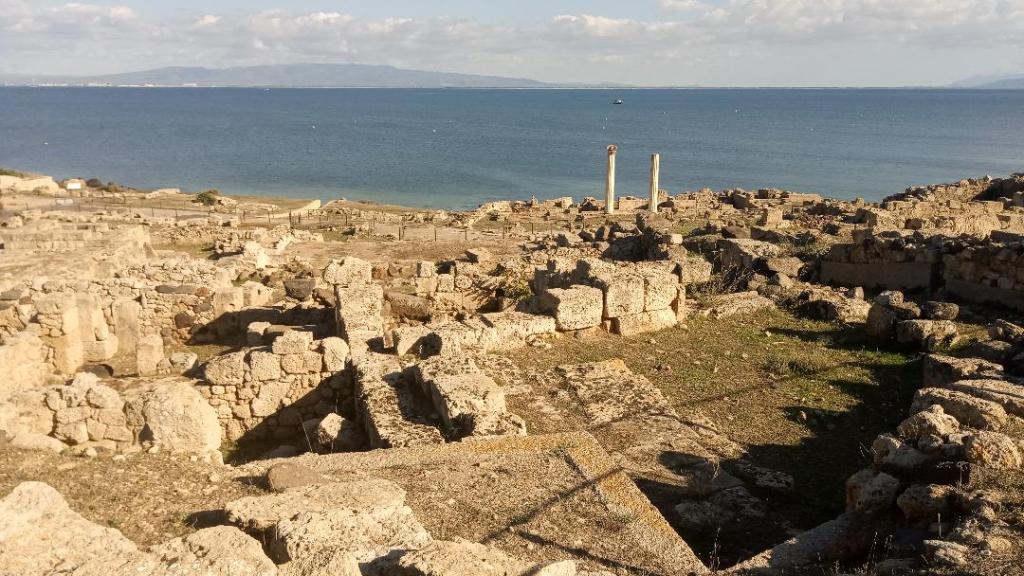
Wednesday 12th October
A couple of miles across the bay from Carloforte is a great anchorage. Just behind the breakwater of Calasetta, it is blessed with land on all sides, and consequently no swell. It’s a short row in the dinghy to a landing spot where various remains of small craft adorn the bank, and then a 5 minute walk into the small town. I spent a couple of quiet nights waiting for the weather to settle before embarking on the crossing to Tunisia. From this spot it is 135nm to Bizerte on the north coast. Monday morning and a window of opportunity was taking shape. There were still ominous thunderstorms milling around off the coast but due to fizzle out. Forecast was for light variable winds till midnight then steady north easterlies for the next 24 hours right the way across. I weighed anchor at midday hoping for an arrival before dark the following day. All afternoon had me beating down to the southern tip of Sardinia where I had to skirt another firing range area. As the sun set the wind died, the sea flattened, and a bright full moon rose in the east into a clear sky. It lit the world around me all night and was still high above the horizon as dawn broke 12 hours later. I motored until the small hours when the nor’easterly filled in, building to 10kts on a close reach. With minimal sea running this was just perfect for SO to lift her skirts and was soon cracking along at 5 to 6 kts. The autopilot can handle these conditions well so I was able to leave it to get on with the job while I got some sleep. With the AIS alarm set to maximum range, (ie 20 minutes or 2nm to target), and now well offshore for minimal risk of fishing craft and nets, I took naps of about an hour. There was a steady flow of ships crossing my path but none needed a change of course until the following morning. The wind shifted around by 20 degrees or so, so I trimmed sails and tweaked the heading every now and then to maximise speed. As the sun came up I was already down to 50 miles to run. The wind steadily increased to 15kts and SO was now charging along at 6 to 7 kts. Shipping increased too as I got to within 20 miles of the coast of Africa, huge tankers and container ships, oddly all but one travelling west. With the sun in the south and some haze, I was down to 15 miles before I caught sight of the dim outline of land. The final approach into Bizerte was tricky as wind was now over 18kts on a beam reach, and the water shallow so kicking up some sea. Although tidal range is minimal, there are strong currents around the harbour entrance where a big river flows out through the breakwaters. It was 15.30 when I tied up to the quay, next to me was a huge super yacht called the Samar, with a whole road tanker to himself filling up with diesel. Apparently it is a third of the price than in Europe just now. Entry formalities in Tunisia are typically onerous, starting with a visit by a doctor to verify that I am covid free, although this actually simply meant he looked at my NHS vaccination certificate, no medical examination at all. Then the Police, then customs, then immigration. Each brought their own forms requesting the same information, but at least they were friendly and jovial and did not ask for baksheesh, though I had come prepared with a couple of bottles of scotch. Come to mention it, time to crack one open me thinks !
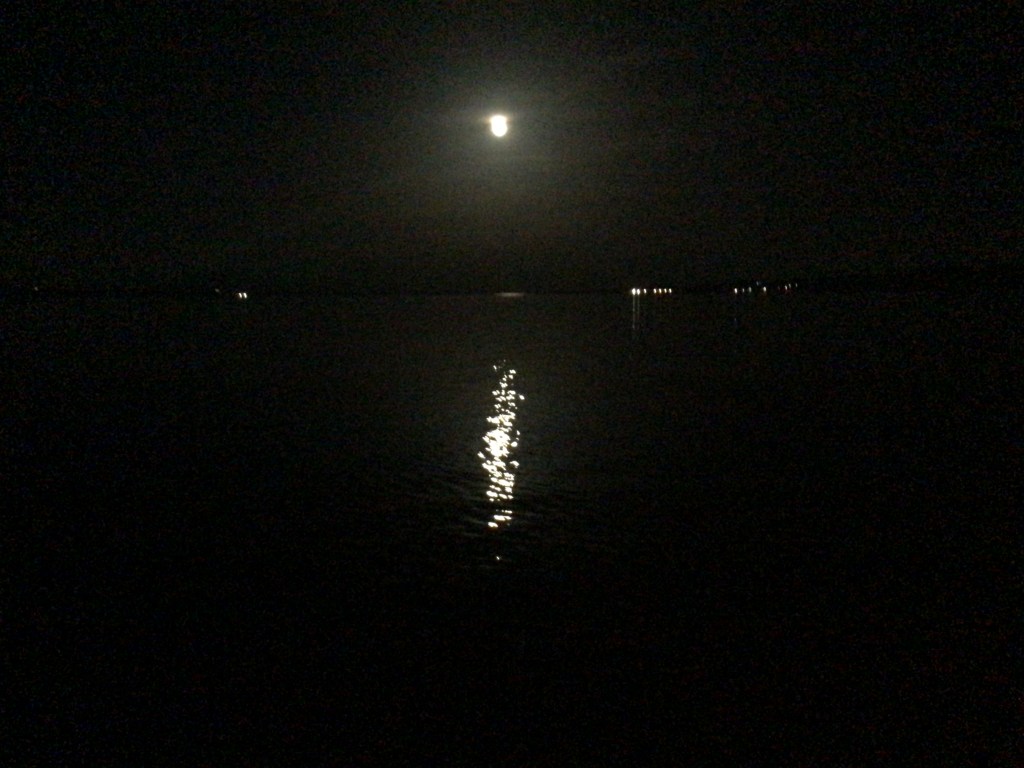
Saturday 15th October
So The plan was to leave Bizerte at 0900 in order to reach Sidi Bou Siad before dark. But I had failed to take into account that the president of Tunisia was in town that morning. Apparently he is about as popular as Ms Truss and was avoiding protests in Tunis. Anyhow the harbour was in lockdown, a warship patrolled the entrance, a helicopter patrolled the skies, and police and army lined the quay. For 2 hours we waited to be released. Every now and then an official would ask where I was going, Sidi Bou Said I would reply and they would get on their mobile to inform someone who presumably needed to know. In the mean time I did take the opportunity to fill up with diesel, at only 70p a litre how could I not ! At 11.00 we were suddenly told we could go, but by this time 2 hours of good sailing wind had been lost, and I had over 40 miles to do before dark. Still we cracked on at a decent 5 to 6 kts on a broad reach, heading first east and then south east into the bay of Tunis. By mid afternoon on a dead run the wind was starting to fade, my ETA was 18.30, even with engine I couldn’t bring this down. The pilot book recommends “if unfamiliar with the port do not attempt entry at night”, well I really had no options. The sun deserted me at 1740, within 30 minutes it was dark and I was still a mile from the harbour. Then the chart plotter decided now was a good time to throw a wobbly and promptly shut down, but I still had Navionics on the iPad. So not totally blind I was able to get into the entry channel, or at least what was meant to be. Then just 100m from the fuel dock and breakwater opposite, mid channel, the depth sounder hit 0, in fact it hit -3 when I touched bottom. Soft sand fortunately so with frantic reversing I was able to back out but had no idea whether to go left or right to find the deeper water. Every direction I tried I kept grounding, but there had to be water somewhere, after all the harbour was full of boats, many bigger than SO. Eventually I could see in the gloom a nearby dark cone shape, an unlit stbd channel marker, and from that I was able to fumble my way in. And where were all those officials who should have been expecting my arrival ! I eventually found the Port Police office and after getting over his surprise to see a foreign arrival at this time, the helpful officer sorted the formalities as efficiently as he could. Tomorrow I will explore the ancient remains of Carthage, just 2 miles down the road, it had better be worth it after the trouble I’ve had to get here !
Monday 17th October
Today sees the start of the final leg of this years travels. A 97nm passage from Sidi Bou Said to Hammamet going first NE around Cap Bon and then SW down the east coast of Tunisia. The forecast is for SE winds 8 to 14kts, so should be a beam reach in flattish water to the Cap. Coastal sailing through the night is not an option so I plan to anchor at the very tip of Cap Bon in a bay on the west side. It’s not quite half way but will be sheltered and I checked with the Guardia National chap that anchoring here is permitted. The day went pretty much to plan, I was called up a couple of times by the navy enquiring where I was going. By 1700 I was pulling into the anchorage, sheltered below a high hill on top of which is the coastguard lookout, one of their most important as it’s radar will see most of both their north and east coasts. In all other respects it’s as remote from civilisation as you can get. I was called up again by the navy asking why I had stopped (they can see my every move on AIS of course). I told them I would be resting before moving on again at 0400 the next morning, they asked I let them know when I set off again. It was a peaceful if short night and at 0400 I called up the coastguard but got no reply. By 0530 the first signs of light were appearing in the eastern sky. The wind was forecast to be difficult, either on the nose or too light. So I motored the first 20nm as far as the ancient town of Kelibia, with its imposing fortress. Then it became a reach ever broadening as I went round headlands and turned SW. There were periods of motor sailing when wind speed dropped below 8kts, and boat speed fell off to 3 or less, but at 9.5 to 10 kts of wind SO would pick up quickly and do over 5kts. The only obstacles along the way were a few fish farms, but the final run into Port Yasmine Hammamet was littered with pots with just a plastic bottle as a float. Impossible to see especially as I was heading directly into the setting sun so massive reflection off the water. I arrived at Port Yasmine at 1700. This is a relatively new marina and run along European lines. They answered on the vhf in English and sent a rib out immediately to escort me to a berth. I was then taken in the rib to the marina office to check in and they handled all the police formalities too. Within half an hour I was back on board all done, very professional.
So that’s it for this year. Winter maintenance jobs will include a major service on the engine, fixing a leek at the top of the rudder post, getting a new sacrificial UV strip on the genoa, and possibly recovering main cabin cushions if there is someone local who can do this. The chart plotter is being taken home to be fixed. I’ll be setting off again around end of March. Thanks for following the blog.
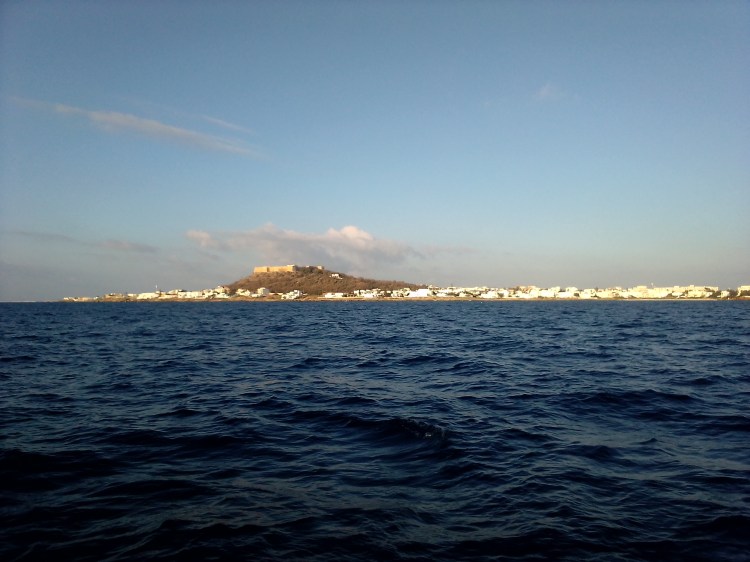
 The Adventures of Sea Orchid