Wednesday 1st October 2025
Sunday, left the berth at Glenarm at 0400 in order to catch enough north going tide to get through the North Channel before it turned. Leaving in pitch dark made it tricky avoiding the fish farm that occupies a large part of Glenarm Bay. With a F4 SW to W wind I was doing average 6kts with tide and by sunrise was just a few miles off the Mull of Kintyre, and crossing the southern end of the TSS. When the tide turned I was well on the way up the Sound of Jura but the wind was dropping and I motored the last few miles into Twin Beaches Bay at the northern end of Gigha, anchoring at 1300. I could have continued motoring north all afternoon but it is such a fabulous spot and tomorrow I would have wind to carry me north. The beach is compared with ones in the Caribbean but with Otters ! Some folks were braving the chilly water.
Monday, I set an ambitious target to reach the Sound of Mull, about 50nm. However the day would be dictated by strong tides, the key one being through the Sound of Luing where it runs at up to 6kts. It meant fighting a contrary tide for most of the 30 nm up the Sound of Jura. Fortunately it was F4/5 S to SE wind which pushed me well against the current. As I was approaching the eastern end of the Gulf of Corryvrekan, famous for its whirlpools, I slowed to almost a standstill in a particularly fearsome tidal race and had to motor briefly to get through it. I ultimately enjoyed the pay off though as I then had 4 hours of favourable tide which carried me through the Sound of Luing and up the Firth of Lorn. I reached Craignure at the southern end of the Sound of Mull just as it was getting dark and anchored clear of moorings and the ferry jetty. It was a very small space to fit, as was very soon highlighted by the Calmac ferry which arrived soon afterwards and passed less than 100m away as it came alongside.
Tuesday, as the weather forecast is now deteriorating rapidly it becomes imperative to make it to Skye, the final destination, today. It’s another stretch of about 45nm and needs maximum use of tides so I set off at 0700 at the start of the north going flood. A good F4 from S blows me rapidly up the channel and I’m kept busy making several gybes of the main and poled out genoa. By 1000 I’m passed Tobermory and heading for Ardnamurchan. As I round the headland the water is now open to Atlantic swell and the sea becomes very lumpy and confused with waves reflecting off the cliffs. But once around and heading north east toward Skye, it settles down to a steady rolling following sea. The wind increases to 20kts at times and I’m bowling along at an average 6kts. Heavy dark clouds hang over the highland mountains to my right, with beams of bright sunshine breaking through here and there, shedding patches of sunlight onto the slopes and reflecting bright colours. To my left the islands of Muck and Eigg sit shrouded in mist and occasionally lost in a rain cloud. With just a few miles to go I’m now racing along at over 7kts, it’s as if SO can sense we are nearly there. A large pod of dolphins join us, performing acrobatics and squeaking to each other. At 15.30 I pull into Armadale Bay near the southern corner of Skye. Martyn and Stephanie are expecting me and sitting in their dinghy behind their boat, Sandpiper, on a mooring. They show me to a nearby visitor mooring where I make fast. SO will stay here till next week when she will come out of the water and be laid up for the winter at the nearby boatyard.
And so ends another season, next year we will be back and exploring northern latitudes. Thankyou once again for following the blog.
Saturday 2nd May 2026 – Launch Day
So another season is about to begin, the yard here in Ardvasar is buzzing with excitement, and a little trepidation. The last 2 weeks have seen glorious weather and allowed folks to get on with their long lists of jobs. Sea Orchid is looking ship shape now but looked decidedly sorry for herself when I first arrived, after a long damp winter. Focus or work has been the hull, areas of old flakey antifoul have been scraped back to the GRP, sanded, and primed before two coats of antifoul all over. The keel too has been ground back to bare steel where there was rust, treated with rust remover and primed.
The launch process involves the use of a clever trailer which picks up the whole cradle. It took some tricky manoeuvring to extract it from between two other boats with literally a couple of inches to spare either side. Then at low water it’s towed out into the bay and deposited on the mud where we sit and wait for the tide to float us off the cradle. Simple and effective but one is a little anxious as the tide rises since if there is an issue with leaks or engine there is no way back, you have to go ! All was well and I motored round to Armadale bay where I had hoped to pick up Stephanie and Martin’s mooring, as they have just departed for 4 months. However the mooring has not gone back in yet so I took one of the visitor buoys. Later on a guy from the moorings association called me to say that the mooring I was on had just last week been condemned by the diver, following inspection. So I moved onto another nearby. Good to be afloat again but it was a bumpy night as luck would have it, as the wind went round to NE, straight down the Sound.
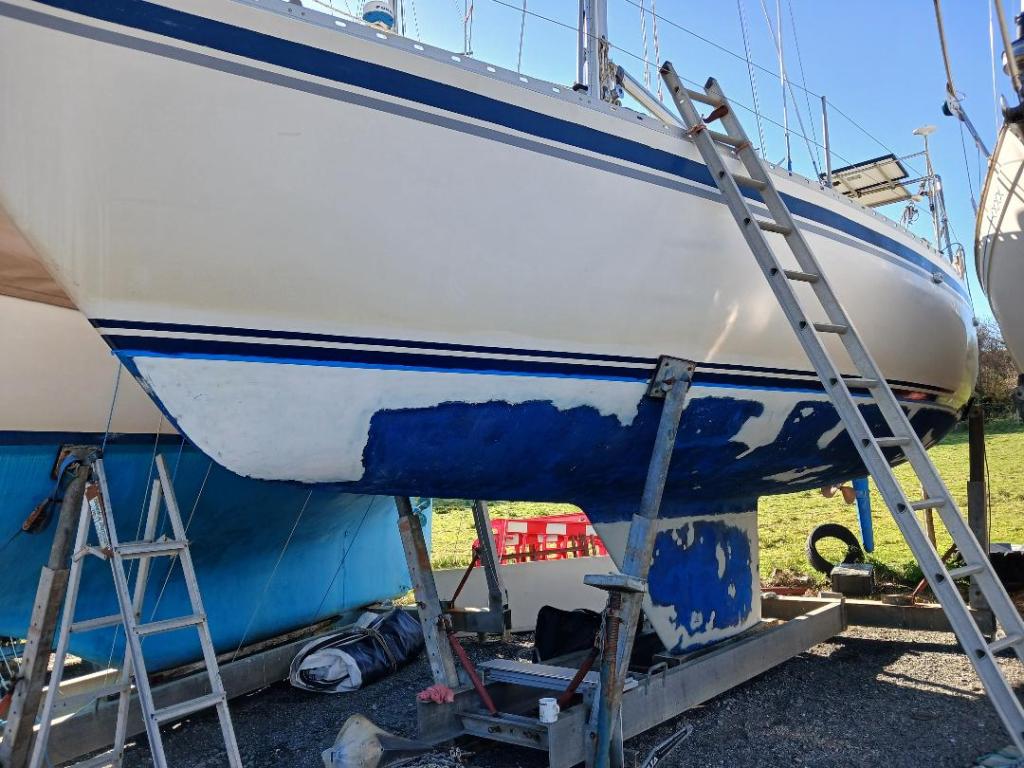
Work in progress
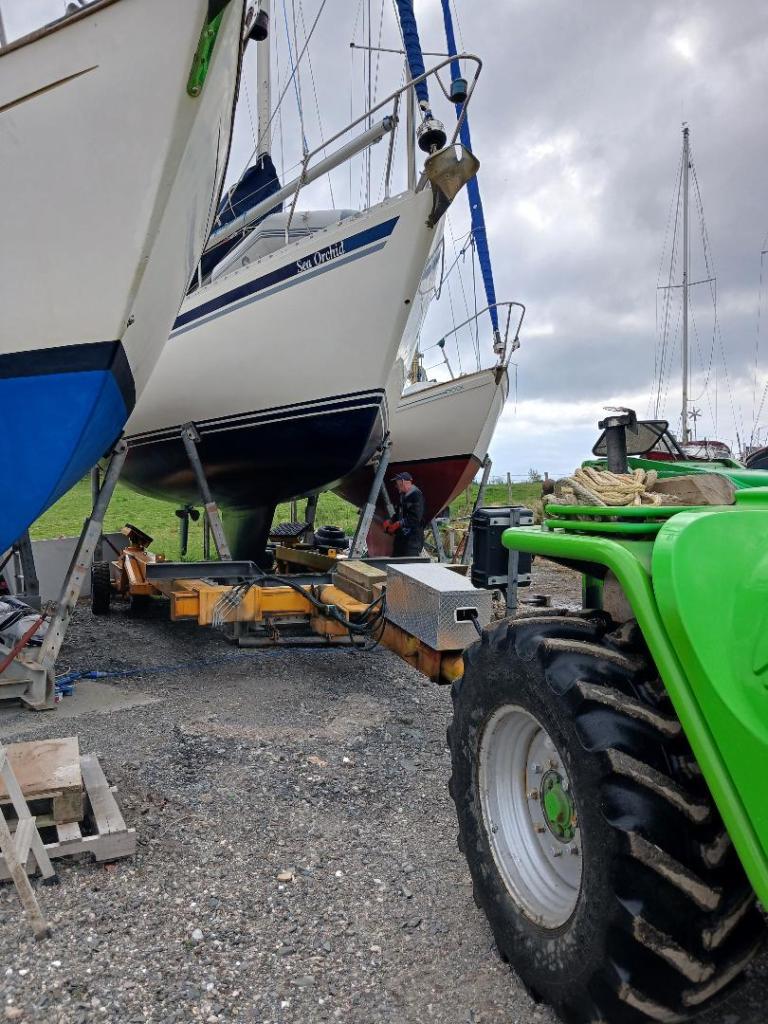
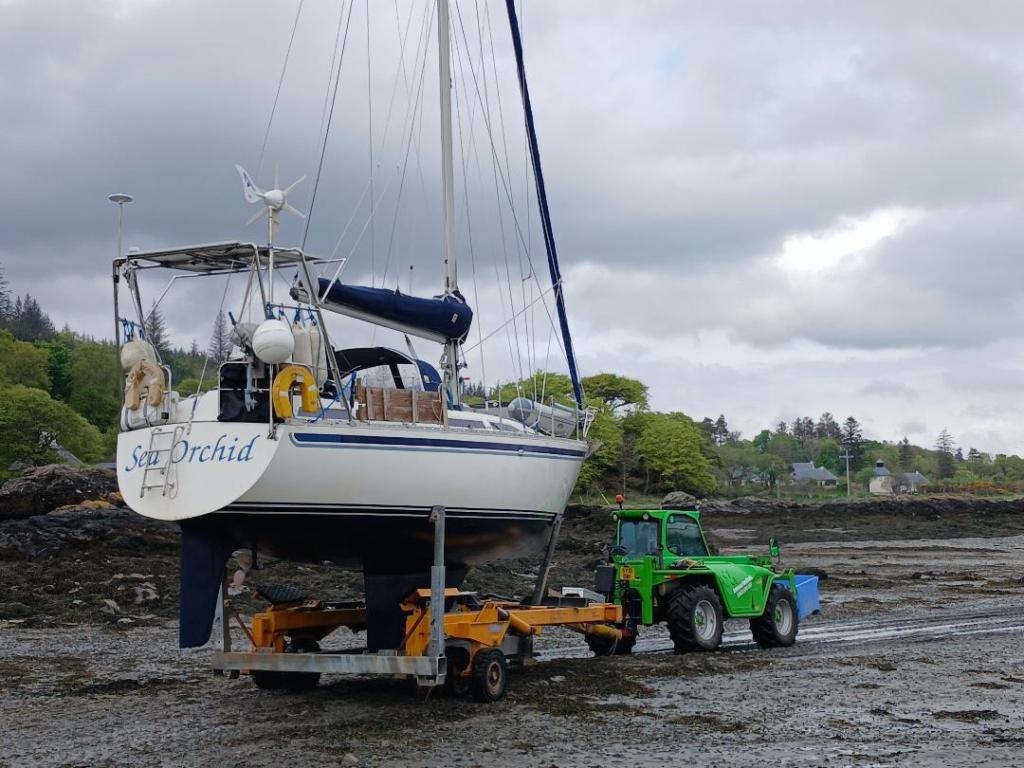
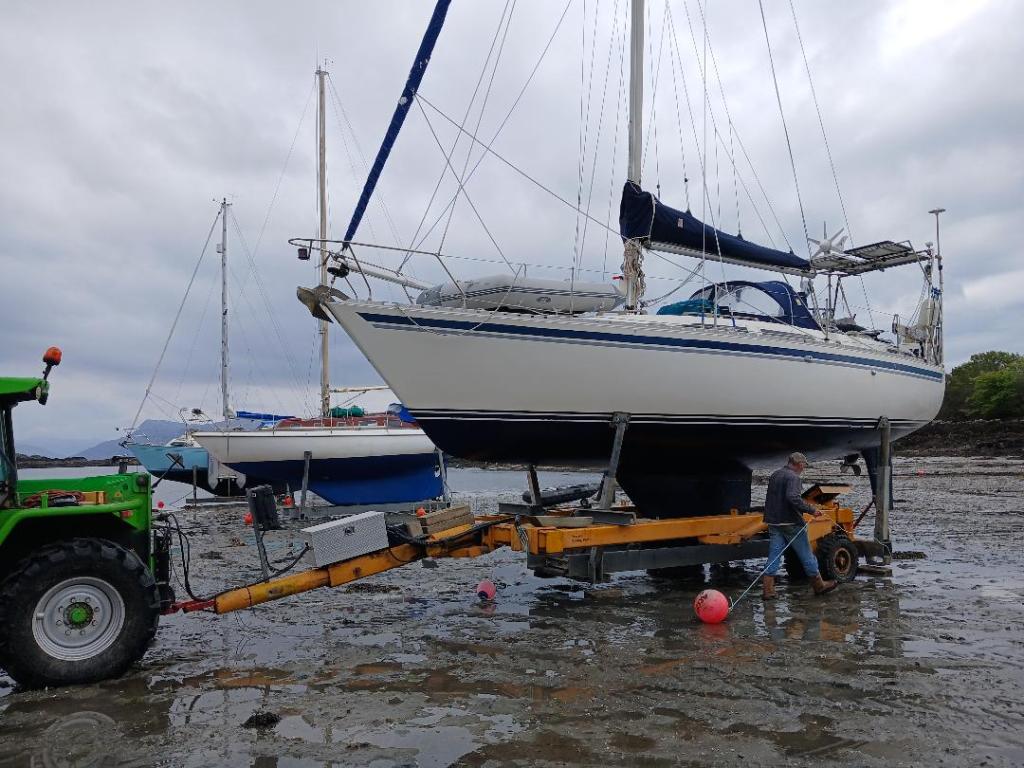
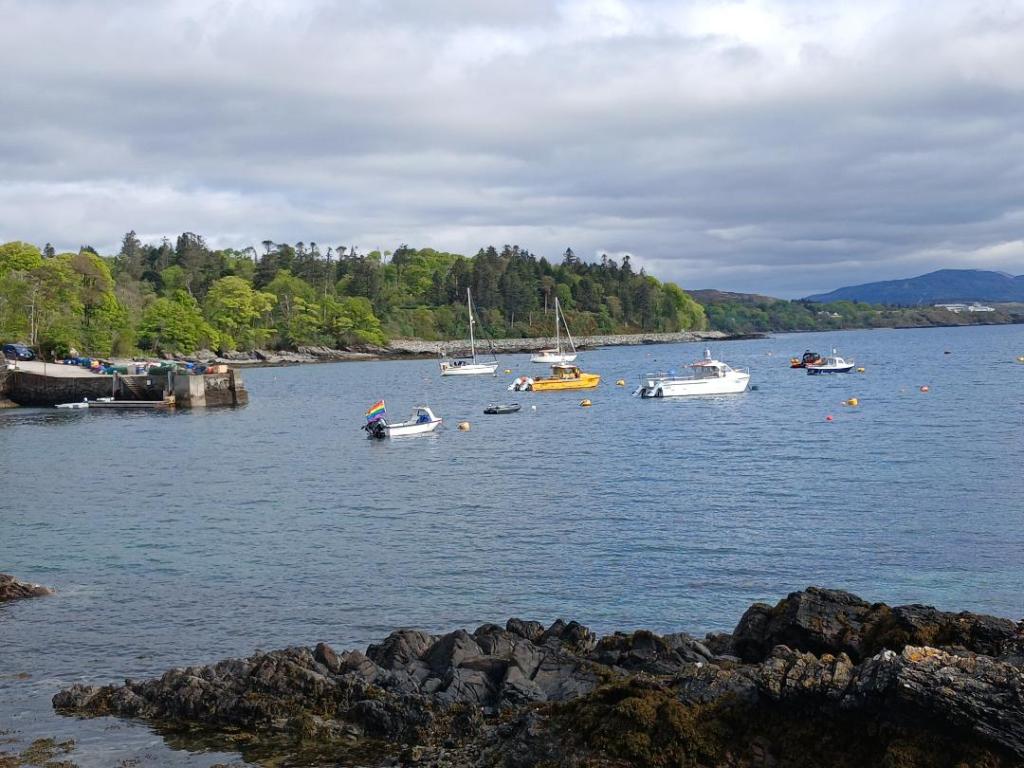
Armadale Bay
Wednesday 6th May
On Sunday I departed Armadale for a shake down sail over to Arisaig, on the mainland side of the Sound of Sleat. Wind NE F4 so it was close to a dead run. I hauled up the new mainsail which is now fully battened, the benefits of which are that it holds a better shape so is more efficient, it doesn’t flog so will last longer, but it weighs about 25% more than the old one, or maybe I’m 25% weaker than last year ! The channel into Arisaig is long and winding and can be down to 1m in depth in places at LWS. I timed arrival for about mid tide and rising and encountered a minimum depth of 2.5m under the keel. The channel opens out into a wide pool with the village of Arisaig at its head.
The following morning I ventured ashore, Arisaig Marine operate a boatyard, moorings, shop and cafe, and have a pontoon with water, accessible all states of tide. In the village is a Spar and what makes this place the ideal spot for crew changes is that it has a station, the last but one stop before Mallaig on the famously picturesque line to Fort William and Glasgow.
Later on Monday I set off back down the channel for a short sail south, around the corner, to the Borrodale Islands. A stiff westerly was blowing and a fair sea had built outside the entrance. We sped along at 7kts on a reach before bearing away east onto a run into Loch Nan Uamh, giving the many reefs and skerries a wide berth. As we pushed on up the loch an enormous rainstorm was fast approaching from astern. It looked like it would engulf me just as I was about to anchor but luckily it passed by about a mile off. The anchorage is one of many gems in this part of the world, nestled in a bay, protected by islands, far from any civilisation and surrounded by beautiful mountains.
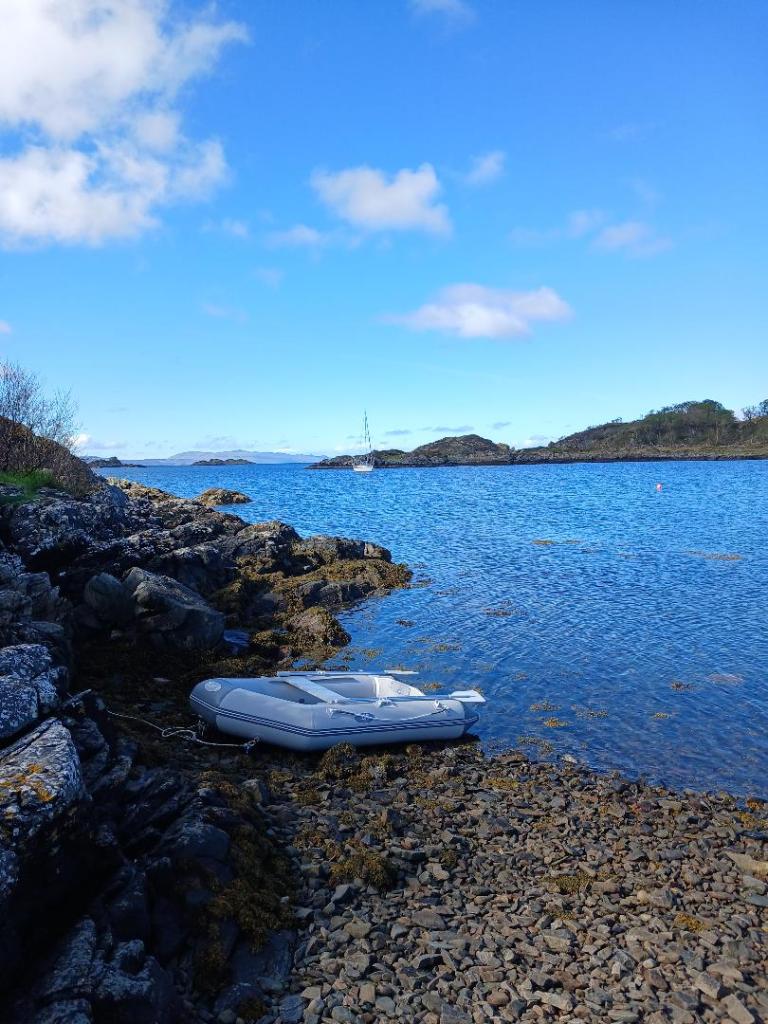
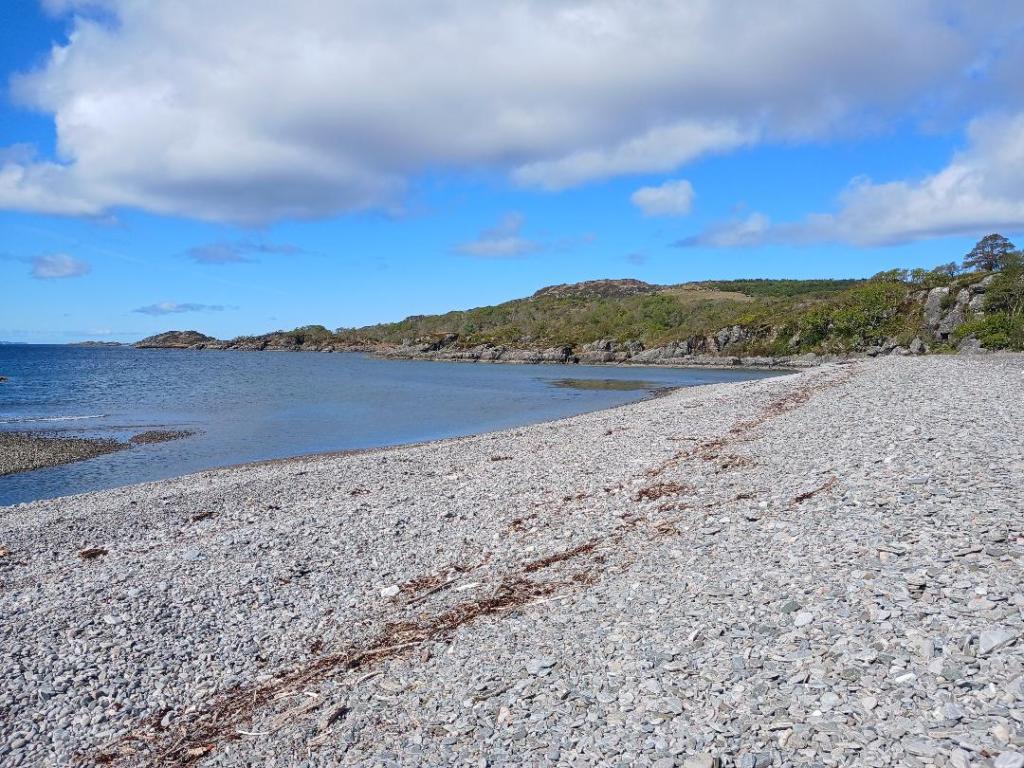
Very close by is a wide pebbly beach where the fugitive Bonnie Prince Charlie boarded a ship and fled to France, having hidden in a cave overlooking the bay.
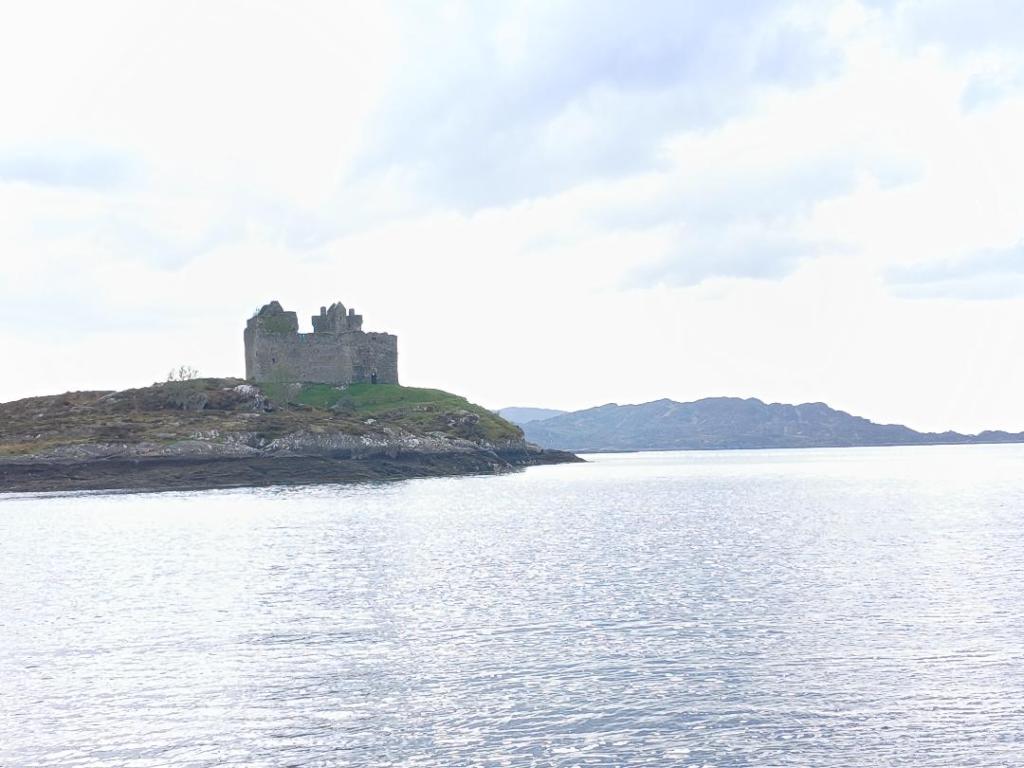
Wednesday, with just a few knots of wind I sailed up to near the head of the Loch to see the impressive railway viaduct, then beat back down and turned south into Loch Moidart. This is another typical glacial melt formed Loch, where the entrance is narrow and littered with rock dropped by the melting ice. Further in the depths increase and the channel broadens. A couple of miles of further on I crossed a shallow sandy bar with a minimum 1.5m depth to spare at an hour before LW. Behind Riska Island is a fabulous anchorage, surrounded by steep wooded hillsides and cliffs. And overlooking us, standing on its own little island, is Castle Tioram, once a stronghold of the McDonalds.
Need to catch a mackerel tonight or it will be a thin dinner, so hoping the new lures do what they say on the packet.
Monday 18th May
Saturday 9th May. Sailed from Loch Moidart 10nm west to Eigg in a N wind F4. Put a reef in the main to see how it would set and all looked good. Just as I was leaving the entrance to Moidart a white tailed sea eagle flew low directly overhead. These enormous birds are now thriving in this area. I Anchored in South Bay and checked out the shop, cafe and facilities by the ferry slipway. I will be back next week with Amanda so more about Eigg later.
On Sunday at 0630 I set off back over to Arisaig on engine to allow time to get sorted before catching the 10.25 train to Glasgow. Arisaig Marine, who run the moorings, provide a dinghy rack and a storage room for outboards. It’s then a 15 min walk to the station.
On Monday Amanda and I returned to Arisaig. We were late arriving at 1800 but nevertheless needed to leave straight away and get back over to Skye as by morning a frontal system would be coming through bringing strong NW winds for a few days. We would be stuck on the mooring at Arisaig unable to dinghy ashore. So with a F3 SW wind we reached back to Armadale with a little motoring to help to get us there just before dark.
After a couple of days sightseeing around Skye, on Thursday the forecast of 30+ kts from north was going to make the mooring at Armadale very uncomfortable and difficult to dinghy ashore. So at 0630 I sailed due east over the Sound and into Loch Nevis. Half way across I had 28kts at times, on the quarter so roared along touching 8 kts. With the new antifoul on it makes for a slippery bottom. On the northern side of the Loch, off Inverie, we picked up a mooring at 0800, just in time for breakfast. Inverie is famous for its Inn, the Olde Forge, the remotest pub in Britain, only accessible by walking 20 miles over mountains or by boat. There is a local brewery and I enjoyed their cask ale called Seven Men. It’s a very small community but does have a primary school. A foot passenger ferry now runs 4 times a day from Mallaig and provides an essential lifeline.
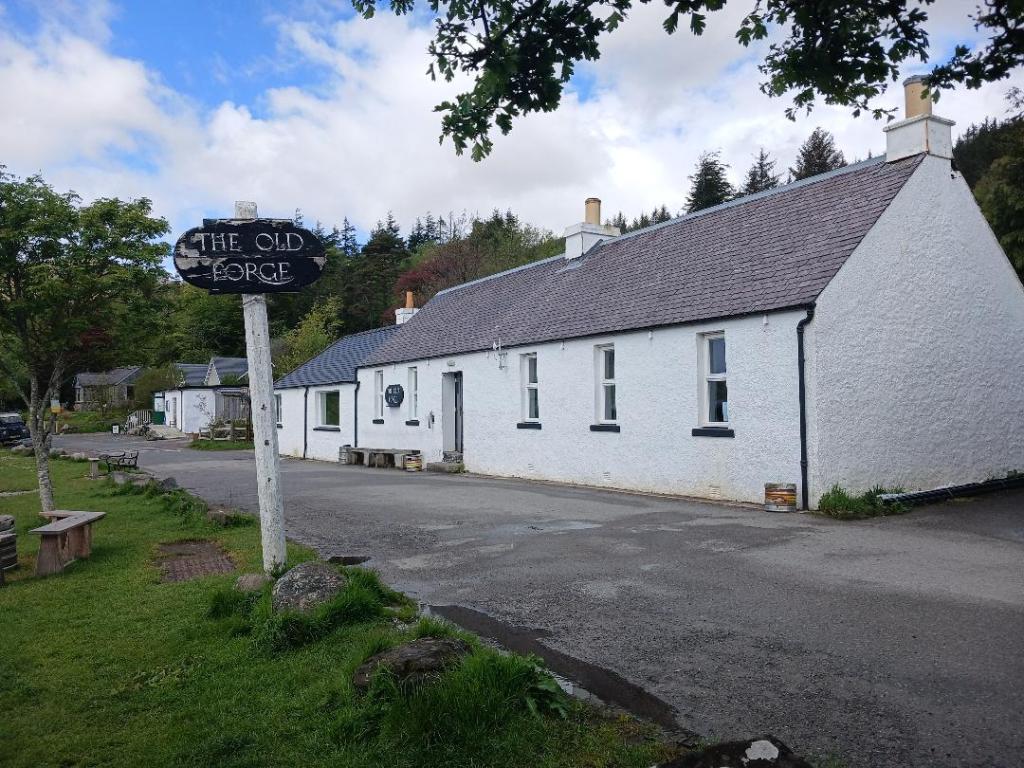
Friday 15th May. With another brisk F5 NW we sailed south to the Small Isles and the island of Eigg. We were greeted by a pod of dolphins on arrival. The island has a thriving community, being now effectively owned by the island’s residents, along with a new cafe, shop, toilet, shower and laundry block, events hall, and was the first place in the world to have it’s own electric grid powered by solar and wind. Geologically too the island has a lot to say, the sugarloaf crag which dominates the skyline, is the largest mass of columnar lava (like Staffa) in Britain. We walked to Kildonnan, the site of St Donnan’s monastery from the early 7th century, where now stands the remains of a later church and graveyard still in use.
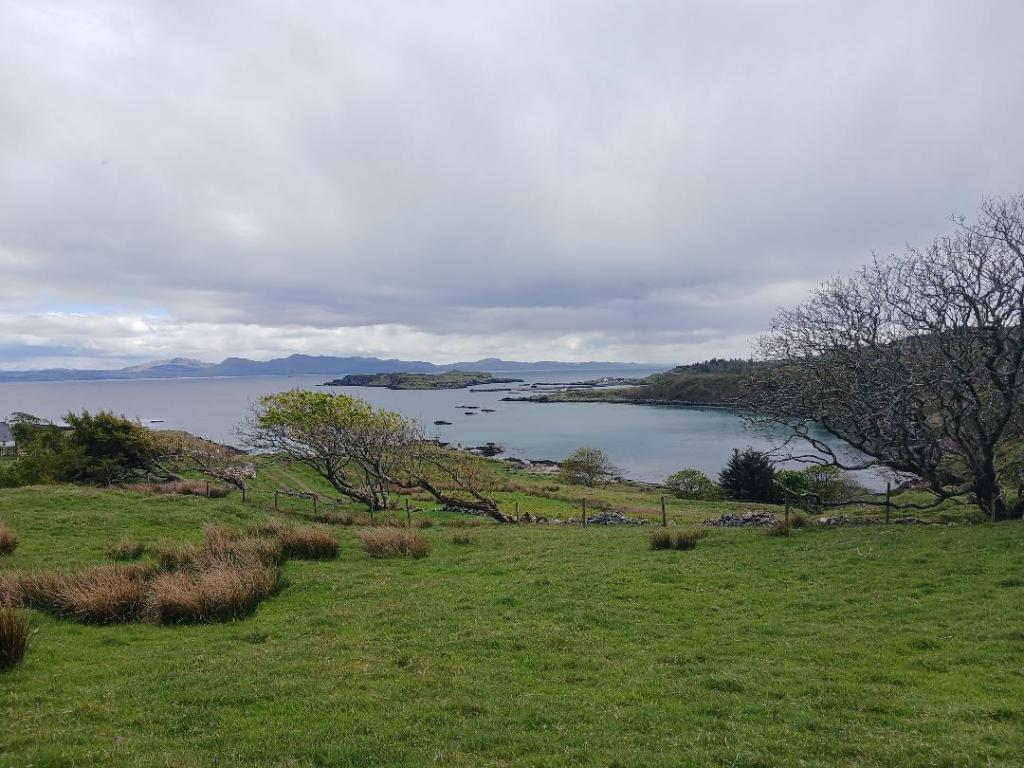
Saturday 16th May. After making full use of the facilities we set off for the nearby island of Muck, motoring the 4nm into the harbour at Port Mor. Muck is the smallest of the four Small Isles, just a couple of miles sq. It is relatively low and flat and sheep outnumber people ten to one. The community shop operates self service and an honesty tin. We walked over the island to a white sandy beach where there is an alternative anchorage facing NW. The silence was deafening until just before the ferry was due in, when it was rush hour, or rush 10 minutes, as the few locals came down to the harbour in tractors and buggies.
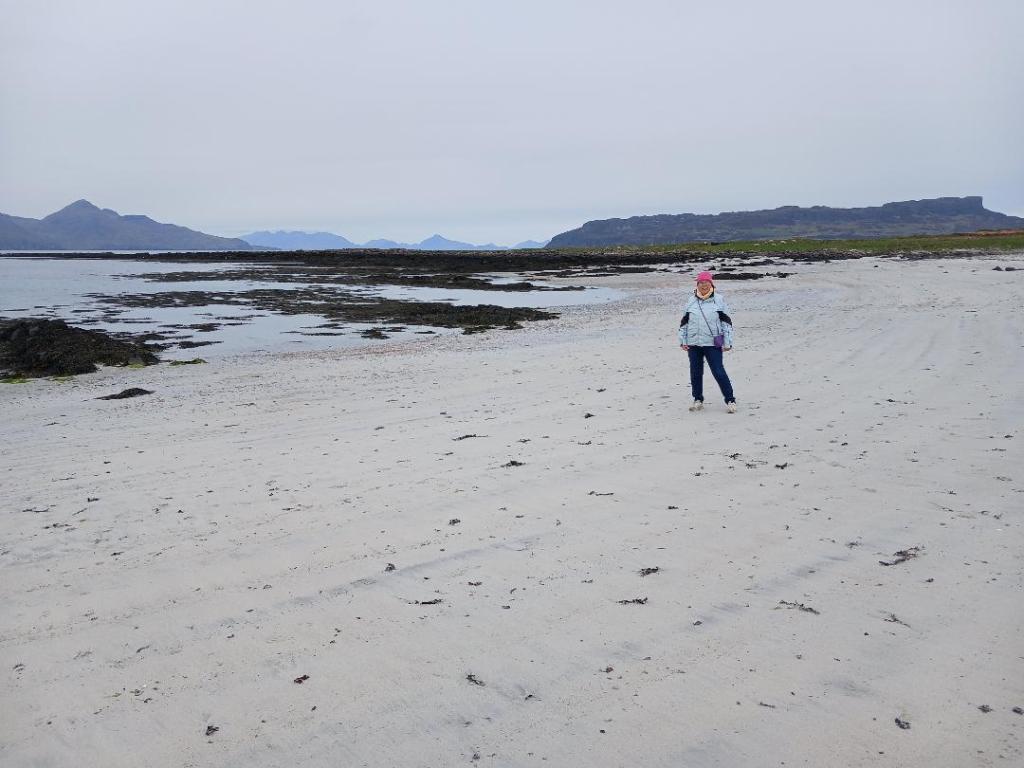
Sunday 17th May. We were woken early by severe rolling caused by SO lying broadside to a swell working its way into the harbour. Decided to evacuate and head off to the next island, Rum. Over the course of the 11nm journey we passed close downwind of a salmon fishery, very smelly and noisy, the salmon can be seen leaping high over each other trying to find some space to swim. Rum is the largest of the islands geographically but a similar small population as Muck. It is very mountainous, a National Nature Reserve, an SSSI, and a Biosphere Reserve. It is home to a large population of Red Deer and over 100 pairs of white-tailed sea eagles, along with golden eagles, otters and seals. We anchored in the only feasible place on Rum, at Loch Scresort on the eastern side. Around the head of the Loch is the main settlement and Kinloch castle, which commands a view down the Loch. The Edwardian castle has been in the ownership of the Scottish government, is now closed and in a state of disrepair, but has just been sold to a private buyer so may be revived. Consequently compared with vibrant Eigg the community and its buildings have been struggling to survive, but are now just starting a recovery, with a new bunkhouse and a number of pods, and a new community and visitor centre is soon to be built.
Sunday 24th May
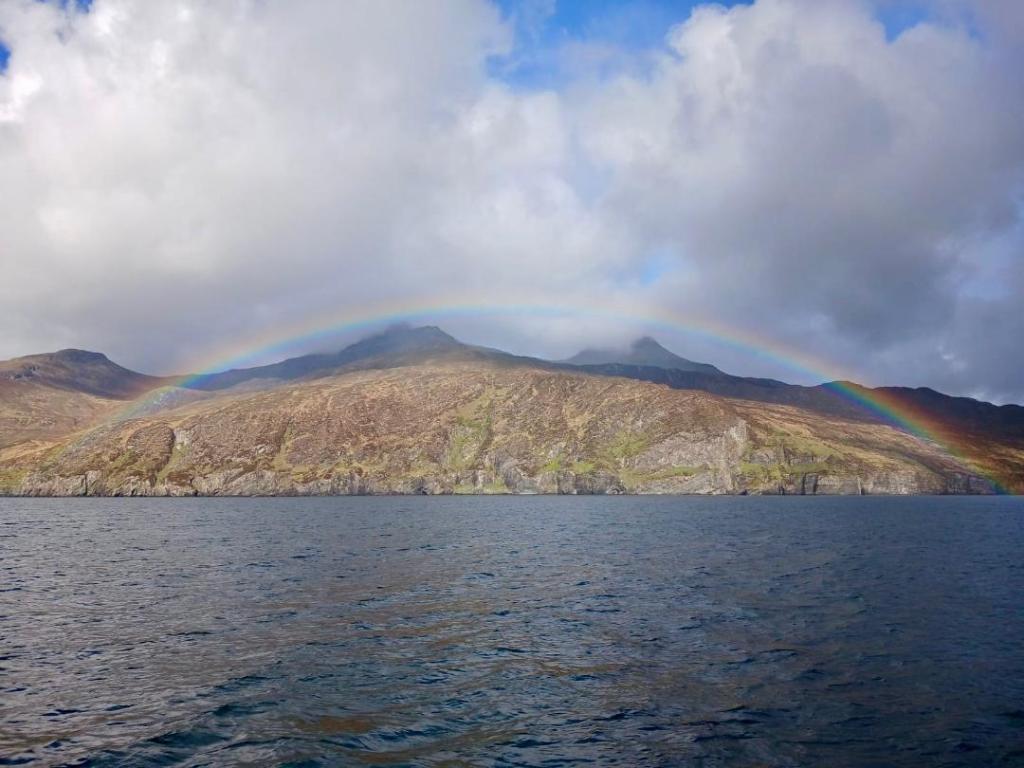
Monday 18th with a light southerly wind we weighed anchor and set off north from Rum bound for Loch Harport on Skye. It was a fine day and the outer Hebrides appeared on the horizon. Turning into the approaches to Harport we could see Macleods Maidens distant on the port side, three towering rock stacks. It’s still another 6nm to the head of the Loch and the village of Carbost. Here we picked up a visitor mooring and there is also a pontoon. It’s a well sheltered spot in anything other than a northerly I imagine. Venturing ashore over the next two days we made the most of the warm comforts of the Old Inn, paid a visit to the Talisker distillery visitor centre, foraged in the local community shop, and took a bus the half hour to Portree. We did not indulge in the experience of the sauna next to the pontoon where a few brave souls were seen first taking a dip in the freezing waters of the loch before entering the sauna. We also took the opportunity to fill up with water on the pontoon. All in all it is an excellent stopover.
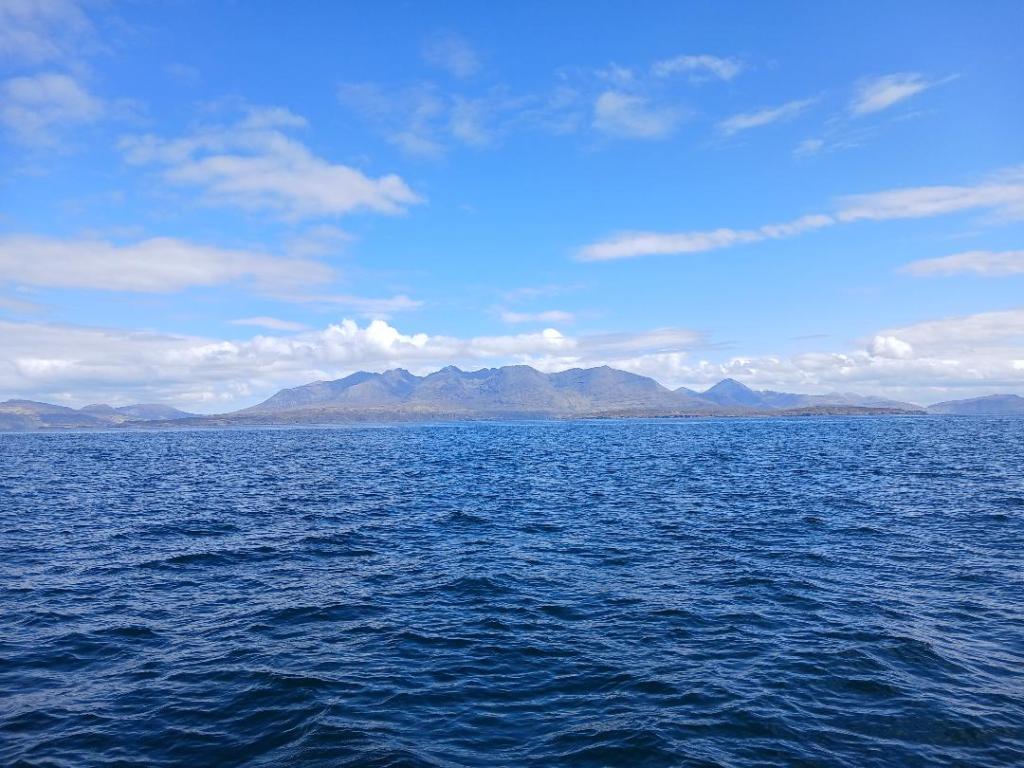
The Cuillins, en route to Loch Harport
Thursday 21st May, with a continuing forecast of strong winds over the next few days we abandoned plans to go further north to Stein in favour of retracing our steps. So we headed back south after first battling a F5/6 and a sizeable sea, tacking out of the loch. Later the winds dropped, so much so that we motored a while past Lochs Eynort and Brittle, the forecast so very wrong ! We turned into the Sound of Soay with the option of the anchorage either on the north side the island or the stunning and unique anchorage in Loch Na Cuilce, at the foot of the Cuillins. Since the thick low cloud was obscuring anything more than the bottom few hundred feet of the mountains and therefore any opportunity to appreciate the awe inspiring scenery, we opted for the former.
Friday, we took the dinghy into the inner harbour and had a short walk around the remains of the buildings and plant of Gavin Maxwell’s failed shark oil processing venture, back in the 1940s. He did however manage to decimate the region’s basking shark population, which has only recently recovered.
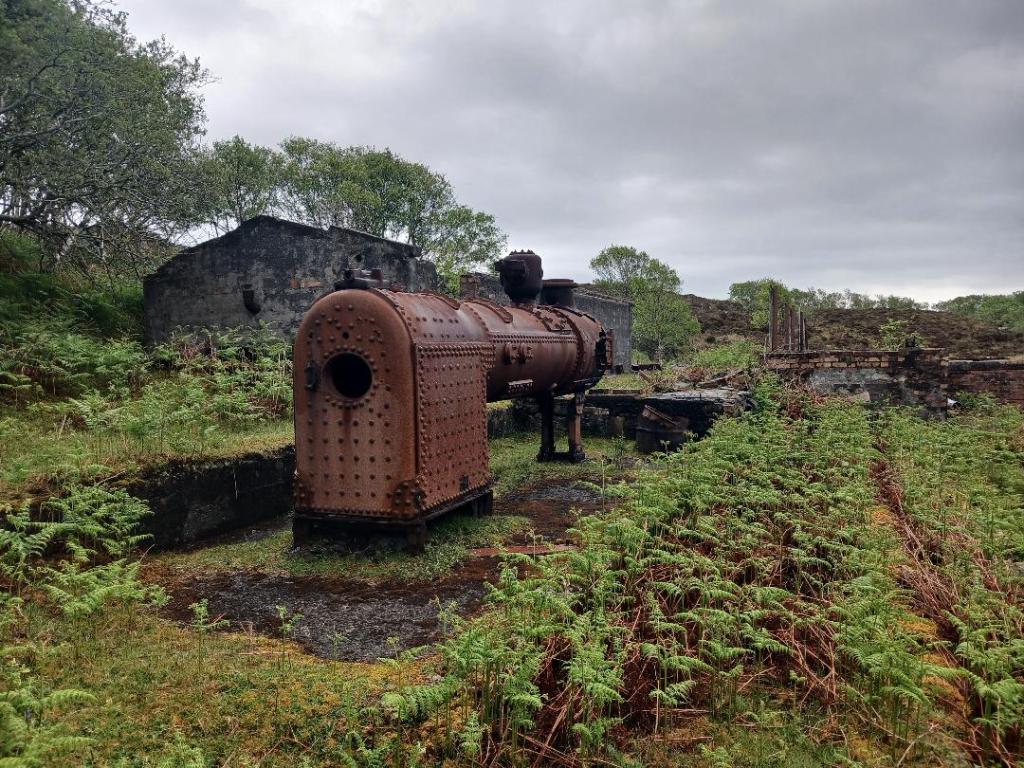
Maxwells place on Soay
With a similar forecast to the previous day we headed south again beating into F4/5. Plan A was to reach Loch Moidart 25nm away, however over the course of the next few hours the wind changed from periods of 6kts to a squall of 26kts, and a direction of SE to SW. Alternative destinations were considered hour to hour ultimately settling on Islornsay when the wind again faltered late afternoon with still 14nm to go. So we diverted up the Sound of Sleat and anchored in the bay which provides good shelter from south winds. There are many moorings so boats have to anchor about half a mile from the pier.
Now back at Armadale where SO will stay on a mooring for a few weeks.
Sunday 28th June
On Wednesday I returned to Sea Orchid with Stewart. He had last been to Armadale in the early 2000s we vaguely thought, when I had chartered an old Nicholson 32 for a week, and with two others we had cruised around the Sound of Sleat. I was relieved to find the dinghy still lashed to the wall above the quay. Sea Orchid was just as I had left her a month earlier, and everything was in working order. So without delay we headed off, beating into a F5 SW wind, to round the Point of Sleat and then free off for a run up to Loch Scavaig. Despite heavy dark clouds all around, shrouding the mighty Cuillins, we were hopeful that later in the evening it would clear. We dropped the hook in the inner pool where two other boats were already at anchor. The wind dropped and after supper we dinghy’d ashore to walk the short distance to Loch Coruisk, the star attraction.
Thursday 25th, we awoke to a rather damp and dreary morning but the anchorage nevertheless looked awesome with still air and mirror glass water. In a light N wind we ran back down to Point of Sleat and then reached due east over to Loch Nevis. We took one of the visitor buoys and went ashore in full oilies as despite forecast for thunderstorms, and threatening skies, we were determined to get to the Old Forge. We didn’t quite make it to the door before the first deluge so we got to the bar looking like a pair of drowned rats. We did manage to get back to the boat later during a short interlude, before heavy rain continued to hammer down on deck all night.
Friday 26th, the rain had stopped the cloud lifted and there were even some patches of blue sky. With a F4 N wind we flew back west over the sea to Skye, paying homage to plastic Mary as we exited Loch Nevis. (Plastic Mary, officially known as Our Lady of Knoydart, is a GRP statue of the Virgin Mary that was erected mid 20th century and stands on a promontory overlooking the entrance). Upon arrival at Armadale I was hoping to be able to go onto the pontoon on the inside of the harbour wall but it was still an hour before half flood tide. I nudged my way in very slowly and managed to dock with just .4m under the keel and 6 inches behind a fishing boat. It meant Stewart was able to step ashore and catch his ferry home, while I filled up with water. Also S&M came down for a chat, they had just returned home having decided to abandon their trip to Norway as while in Orkney the autopilot had packed up. Later I sailed up to Isleornsay for the night as the fresh northerly had kicked up a fair chop in Armadale bay.
Saturday 27th, strong S to SW winds forecast for next couple of days so decided to head around to north east side of Skye, and planned to re-fuel at Portree on Monday. With a light wind initially I was making slow progress, so put the engine on. As soon as I engaged drive there was an alarming metallic knocking noise eminating from the rear end of the prop shaft. Fearing that the prop was about to drop off, I turned around and sailed back to the anchorage at Isleornsay. There was only one thing for it, I would have to go under the boat to investigate. So with wetsuit and diving mask I braved the freezing water, able to stay under for just long enough to clear a load of debris wrapped around the prop. This seemed to do the trick, the knocking noise no more, I think it may have been caused by the rope cutter being clogged and flicking. So I set off again, by this time the wind was a good F5 so under genoa I sped up through the Kyle Rhea narrows, with tide. It was a gusty reach with two reefs in through Loch Alsh and under Skye bridge followed by a close reach into Broadford Bay. A F7 squall hit just as I made the final approach to anchor in 5m on a bottom of mud and sand, so the anchor is well dug in with 40m chain. Tomorrow is forecast for 40 kts offshore.

Loch Coruisk
Thursday 2nd July
Monday 29th June. After a day anchored off Broadford sitting out 40kt winds I was glad to be able to make tracks towards the final destination of Outer Hebrides. I needed to refuel before crossing the Minch and had planned to go into Portree, but with a forecast of SW F5 all day it seemed like a good opportunity to head north. After confirming with the Harbour Master at Flowerdale in Loch Gairloch, that he had fuel, I set course for there. I also checked with Range Control in the Inner Sound that there was no weapons testing there, as if there had been then I would have had to take the Sound of Raasay instead. 25 miles and 6 hours later I sailed into Loch Gairloch and made for the narrow channel into Badachro on the south side, in the rather vain hope of finding space to anchor, but as I feared the pool was completely filled with private moorings. So I carried on another mile further east, to the head of Loch Shieldaig where there are still many moorings but space to anchor. It is a beautiful, peaceful and sheltered spot.
Tuesday. No wind today so motored over to the quay at Flowerdale to fill up with diesel. Pleasantly surprised at the price of £1 / Ltr. Then went onto the pontoon, it drizzled most of the day but was able to walk up the Glen to the waterfall and then onto Gairloch village. I returned to the anchorage in Loch Shieldaig for another night.
Wednesday. Last evening’s forecast made it questionable whether to make the crossing to the Outer Hebrides today but this morning it seems better odds. A short spell of F8 winds are not due to arrive till evening so plenty of time to get into a snug anchorage sheltered from W to S. I headed for just such a place in Loch Claidh, rated by Bob Bradfield, he of Antares fame, as one of his top 10 anchorages. So if it’s good enough for him…. Half way across the Minch, directly in my path, was a large vessel like an ocean tug, stationary but not anchored. I was about 2nm off when the ship announced on Ch16 that it was conducting underwater operations (no sign of a Russian accent) and that all vessels should keep at least 2nm away. I altered course to miss it by about a mile and called them up to check that this would suffice, they were sympathetic toward a sailboat and concurred. Sadly the rains returned while still an hour out so by the time I was anchored up I was thoroughly soaked, the waterproofs are definitely for the bin ! This stretch of coast is some of the remotest on Harris, no roads, tracks or occupied dwellings, and no signal. But still pot buoys, someone is coming a long way to lay them.
Thursday. Bob Bradfield got it wrong ! The wind has veered to NW and funnelling into the anchorage, gusts of 28kts and rising sea, so I’ve cleared out. Headed north sticking close inshore to find reasonably flat water with the F7 offshore wind just aft of the beam, and flying half of the genoa. The skies were teaming with all manner of birds, they love the strong winds. It was noticeable yesterday as I passed the Shiants in very light airs, that there weren’t a lot of birds flying, they were just bobbing, the Guillemots ducking under as I passed while the Puffins panic and scramble to take off. Tonight I’m anchored in the Witches Pool, a secluded spot deep inside an archipelago of islands near the entrance to Loch Erisort. The wind is still howling all around but not affecting in here.
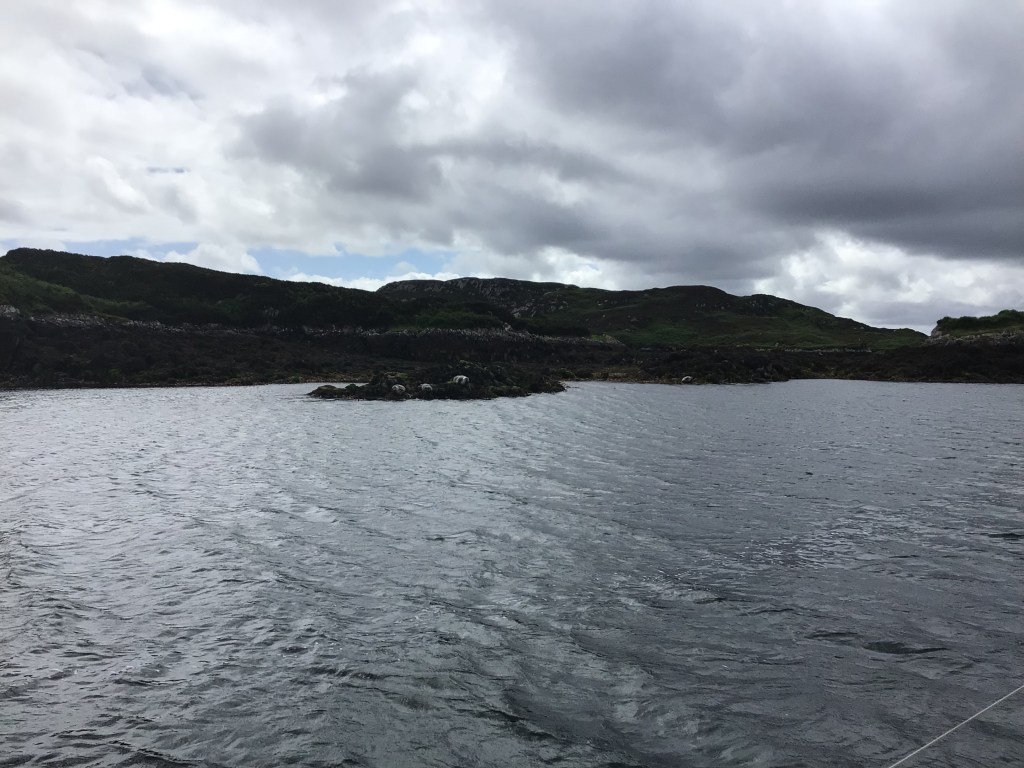
Lots of seals
Wednesday 8th July
Friday 3rd July. Another day of strong SW to W winds forecast so staying within the archipelago of islands and lochs for shelter. I thread my way out of the anchorage through channels, some only a couple of boat lengths wide, seals lazing on the rocks nearby. I cross over Loch Erisort where I’m briefly exposed to gusts over 30kts. Then I’m in the entrance to Loch Leurbost where a short distance further I anchor off the hamlet of Crosbost. Initially I tried anchoring off the SW shore in the lee of the wind, but heavy kelp meant the anchor just slid away, so I crossed over to the NE shore and the anchor immediately dug into mud. Close by is an imposing building that is the Free Church, it seems totally out of proportion to the number of houses but reflects the very high proportion of believers in the area, at least at one time.
Sunday. Yesterday I took the bus into Stornoway and visited the museum in Lewes Castle where they have a few of the 12th century Lewis chess pieces on loan from the British Museum. Forecasts for next few days are not favourable enough to make the long passage up to the Butt of Lewis and then down the west coast to Loch Roag in one day. There are no safe anchorages anywhere on this 50nm passage to split it over 2 days. Although it’s an unfavourable SW wind I head back south, it’s slow progress tacking offshore and back inshore but great sailing nevertheless over flat water in a F4. Just off Loch Odhairn I bizarrely converge on three other sailboats, more than I’ve seen in a whole week, all going in different directions. Late morning the rain returns and visibility drops to about half mile so I head into Loch Shell and an anchorage at Eishken.
Monday. No mobile signal again despite a mast less than half a mile away that I can see from the boat. So I dinghy over to a slip and walk a mile up a track till eventually getting just a little signal, enough to check messages and get a forecast. When I get back to the slip there’s a gathering of people and two powerful speedboats. Chatting to one of the group I learn that I’m within the grounds of the 45,000 acre Eishken Lodge estate, which you can rent for that special occasion. These are guests who have been out hunting stags this morning (I had heard the gunshots) and are now going waterskiing, bearing in mind its blowing F6 and driving rain out on the loch !
Tuesday. 0500 weighed anchor to catch the tide running between the Shiants and coast. Had a little difficulty getting the hook up, the chain seemed to have wrapped on a boulder, managed to shift it by attaching a strop to the chain to take the strain and then driving the boat hard for a few meters. Another grey day with very poor visibility but a nice beat in F4 SW. Turned into East Loch Tarbert and up to the town of Tarbert to spend a few hours on the pontoon doing chores like laundry, rubbish disposal, refill water tanks and top up provisions. This is the main facility on the whole of the outer Hebrides, outside of Stornoway. Later anchored off in the SW corner of Loch Ceann Dibig.

Monday 13th July
Wednesday 8th July, 0600 start today with a view to being close to the entrance of the Sound of Harris when the tidal stream starts NW. However low cloud and mist made visibility very poor as I threaded my way out of East Loch Tarbert, through a multitude of rocks and skerries. Thank goodness for chart plotters and radar ! I tacked south, much like yesterday there were just glimpses of the coast through the mist, all around is grey, all 50 shades of it. I decided it was not the day to traverse the Sound, especially as tomorrow is expected to be better, so I tucked in behind Lingarabay island to drop anchor. It’s a desolate place with an abandoned old quay, which was at least useful for getting ashore. It’s a couple of miles down the road to Rodel at the SW tip of Harris, where there is a tiny drying harbour and the church of St Clements. St Clement was a 1st century saint of mariners, popular in Norway which once ruled here.
Thursday, the day dawned looking much like yesterday, grey, wet and poor visibility. Despite this I set off at midday to catch the tide through the Sound. First I had to negotiate 3nm further down the coast beating into a heavy sea and 20kts. With two reefs in the main and the genoa rolled to the second spot SO bounced along, taking steep waves in her stride. Then we bore away onto a broad reach and followed the Stanton channel which is well buoyed. Visibility was less than half a mile. When we exited the NW end of the Sound I turned north toward With the strong S wind and Atlantic swell now rolling in from west I anchored tucked into a bay behind Aird Nisabost, facing Taransay (the island that featured in the early reality TV show Castaway, with Ben Fogal).
Friday. The sky is bright and there are even patches of blue sky here and there. After a visit to the fine beach I head off up the sound of Taransay beating into a light W wind. I paid a short visit to Loch Leosavay to see Amhuinnsuidhe Castle (how is that pronounced I wonder !) built by the Earl of Dunmore when he bought Harris in the 1860s. Then I beat further up the coast to the narrow channel between the Scarp island and Harris. There are a couple of anchoring possibilities here, I choose the northern one where there is less tidal current but still enough for the boat to lie tide bound. The island is famous for being where in 1934 a German rocket scientist fired an experimental mail rocket, the first attempt failed scattering the mail.
Saturday, set off beating into a NE F4 making fair progress as far as Mealasta Island. I then felt the brunt of the sea, a combination of a 2 to 3m swell from west and steep chop from N. Progress soon declined and following a tack back inshore it became apparent that Loch Roag, only 10 miles upwind, was not going to be achievable. So for only the second time in memory (the first being when I left La Rochelle last year) I turned back and went into Loch Tamanavay.
Sunday, with a forecast the same as yesterday my ambition to reach Roag would have to wait till another time. Instead I sailed back south, passing very gingerly back through the narrow sound at Scarp at low water, just 60cms under the keel at one point ! Then down the west side of Taransay and across the Sound of Harris to the island of Berneray. Now in a shadow and with full sun it felt positively balmy. I saw one other boat, the first in 5 days. The final approach takes a short cut through a reef, the channel is just 20m wide and I had 1m under me. I anchored in the NE corner of Bays Loch, which has many houses around the shore, but you can hear a pin drop.

the bleak landscape of Southeast Harris
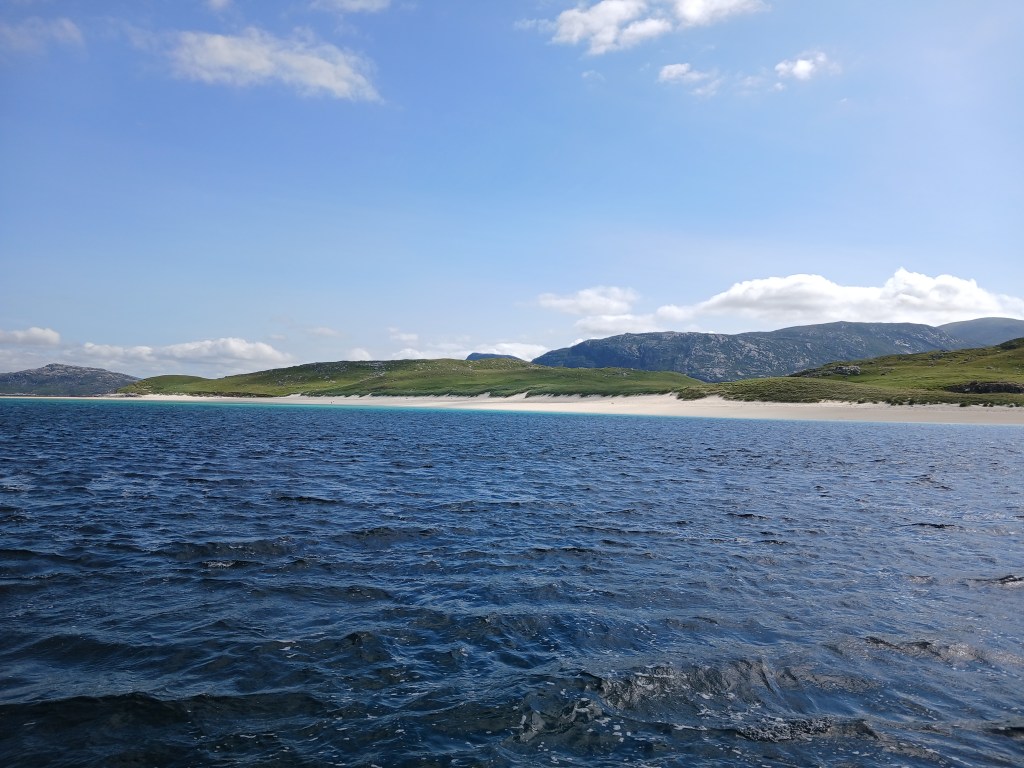
the contrasting landscape of Southwest Harris, just 10 miles apart.
Saturday 18th July
I stayed four days on Berneray, rarely do I spend so long in one place, but the island is a real gem. From the stunning beaches to the local hospitality, the history to the natural world, its a place that makes you think why go anywhere else. Of course the weather helped, I had four days of clear blue skies, little wind and temperatures in high 20s. On the first evening I crossed the bay to the small harbour and had barely set a foot on the slipway when a lady turned up and greeted me. She invited to drop by anytime for a cuppa, or if i needed wifi, both of which I did in due course. Being the only boat in the bay it was a bit like being a goldfish in a bowl. When I went in the shop, the visitor centre, the hostel, or down to the harbour, people new I was from ‘the boat in the bay’. Some may recall that the island is the one that Prince Charles spent time decades ago, living with a crofting family. Areas of the Machair, the belt of common land behind the dunes, are still being cultivated by crofters with potatoes and grain, and other areas grazed by cattle and sheep.
Friday 17th July, the goldfish made an ignominious exit. While retrieving the anchor I managed to foul the prop on an old small mooring buoy and had to go under the boat to cut it free, thankfully no damage done. I weaved my way through the shallows for 3nm to reach deep water at the southern end of the Sound of Harris. Turned south on a dead run, wind F3 but a lumpy sea made it difficult to keep pressure in the sails. However it was a short leg before turning into Lochmaddy where I anchored just north of the ferry terminal, off the old village. I checked out the visitors pontoon and facilities, next to the ferry, where we might come in next week enroute to St Kilda. The Taigh Chearsabhagh Museum & Arts Centre has a digital archive of home movies donated by families across North Uist, dating back to the ’50s.
Saturday, with a lighter and more offshore wind I sailed further south again, another 10nm to Kallin. Here is a small but active commercial fishing harbour with a long history. This is described on information boards inside an old tiny stone boathouse, grandly called the Grimsay Boat Museum. In the cafe on the quay I sampled fried scallops straight off the boats, served with black pudding. From the anchorage, in a pool half a mile east of the harbour, I can see a red deer grazing on the hill sides. Time for some fishing.
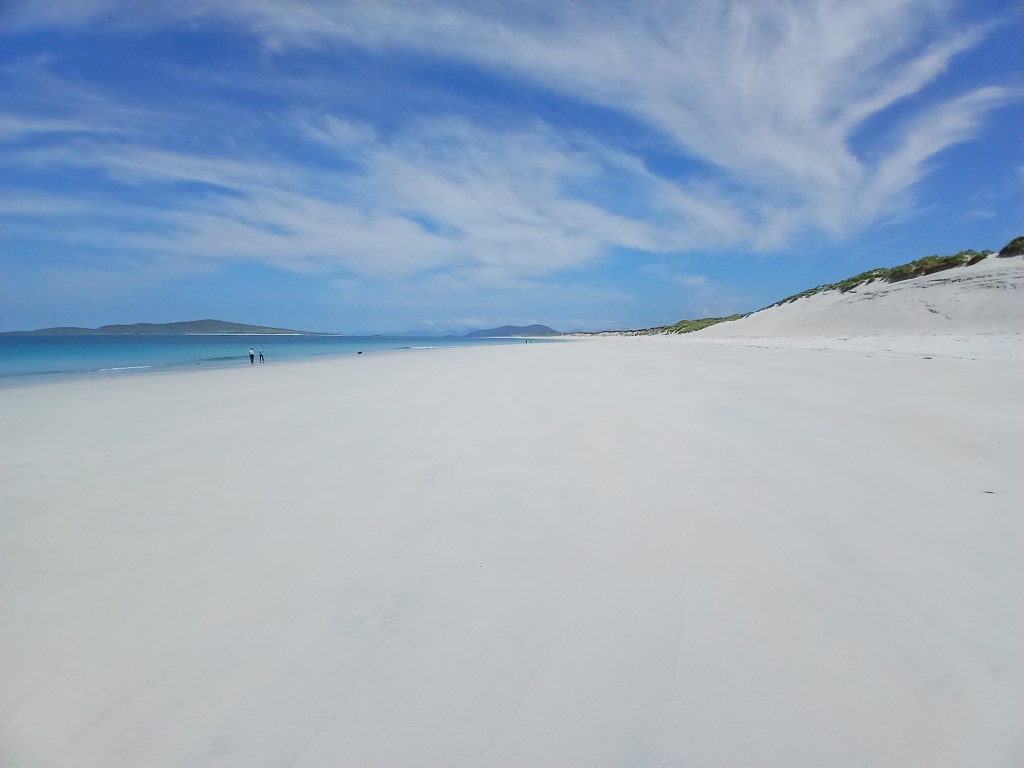
Berneray West Beach
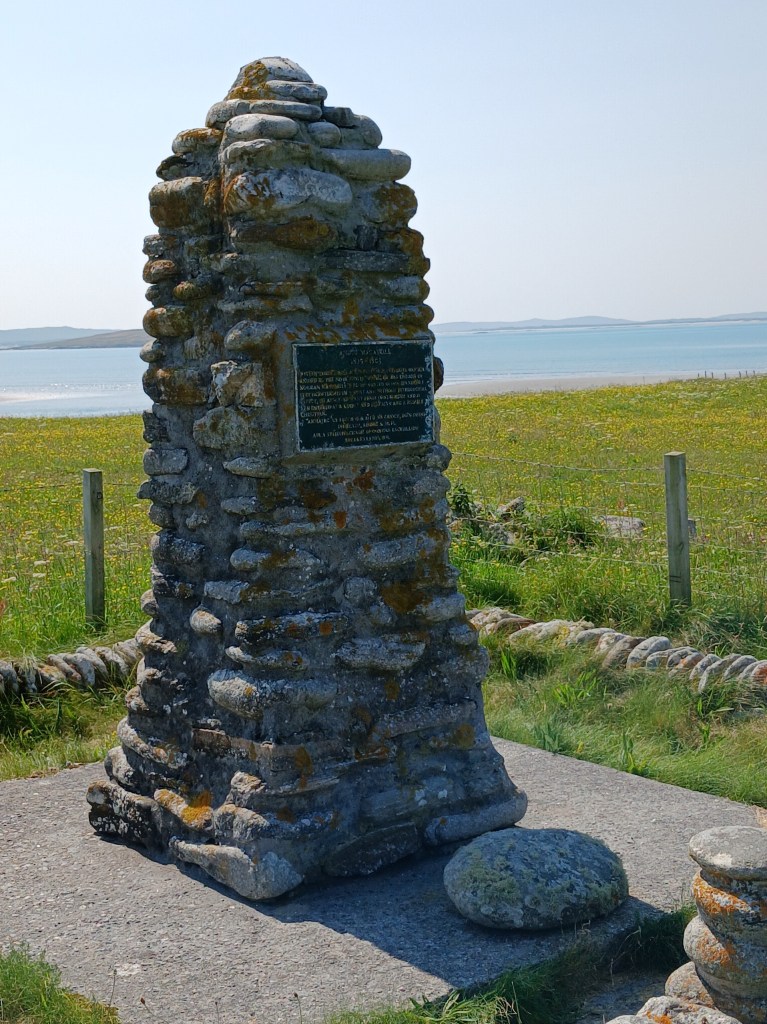
Giant MacAskills birthplace
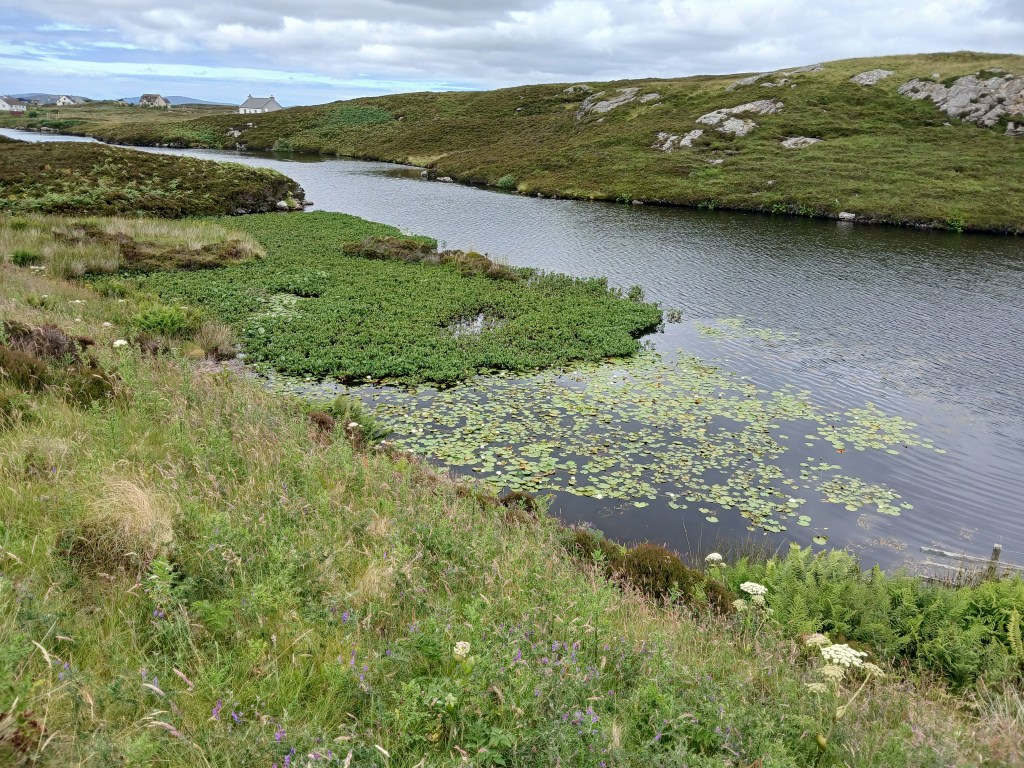
Lillypads at Killin
Wednesday 22nd July
Sunday 19th July. Left the anchorage at Kallin an hour before HW to make my way back out through the narrow channel. As I came into the main buoyed channel there was an enormous ocean going maintenance vessel which had lifted out one of the nav marks, he was maintaining exact position with multiple bow and stern thrusters, a tricky job with the fast flowing currents and wind to contend with. Sailed a further 20nm south to the sizeable (for this part of the world) harbour of Loch Boisdale. Wind offshore F4 broad reach and the sun came out to play so had a great passage. Anchored in the bay in the NW corner, opposite the small marina and clear of the Calmac pier. The village has an air of decline, but there is a small bakery cum cafe and a hotel. There is a working public shower of sorts, and a bus runs regularly up to the Co Op a couple of miles away. There is a pontoon behind the pier which saves walking the extra mile from the marina.
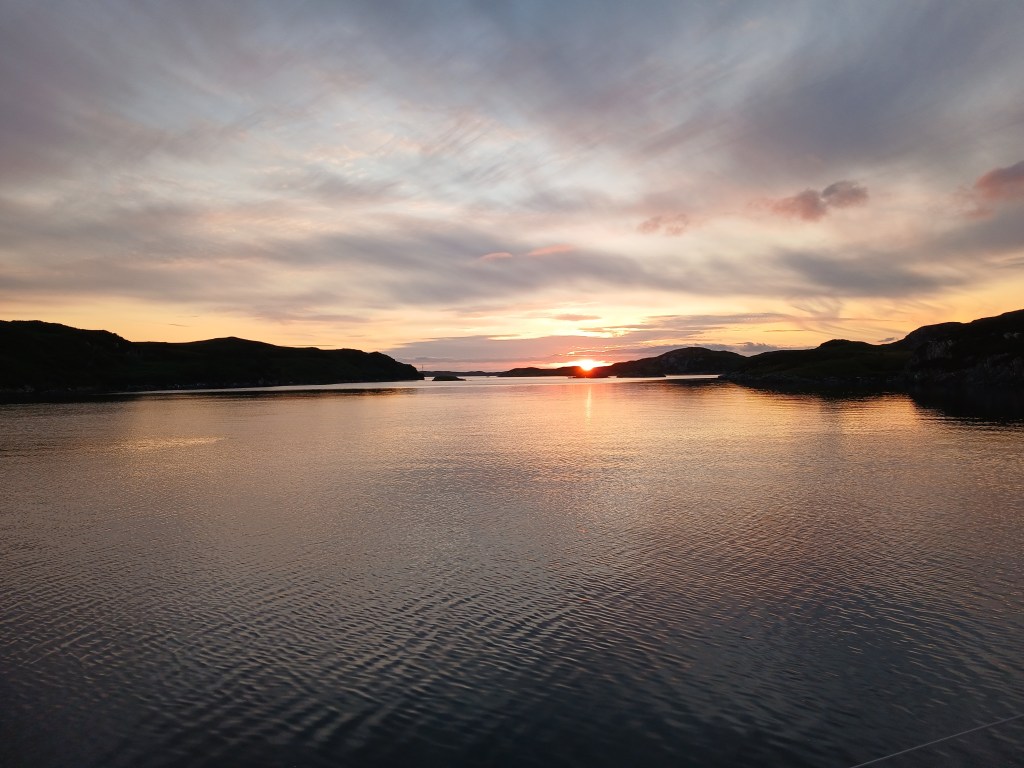
Monday, in a light and variable wind I sailed a few miles further south to Eriskay. Acarsaid Mhor is famous in cruising circles as one of the best hurricane holes on this coast as its narrow entrance is deep enough at all states of tide and gives all round protection. It took two attempts to anchor though in what is a small area of useable space between moorings, two other anchored boats, and underwater obstructions. There is a fishermans pontoon making access ashore easy and its a 2 mile walk to the Politician pub. The name derives from the ship SS Politician which foundered off Eriskay in 1941 laden with over 250,000 bottles of whisky which were recovered by the islanders and rapidly stashed before customs and excise caught up with them . The story is immortalised in the film Whisky Galore.
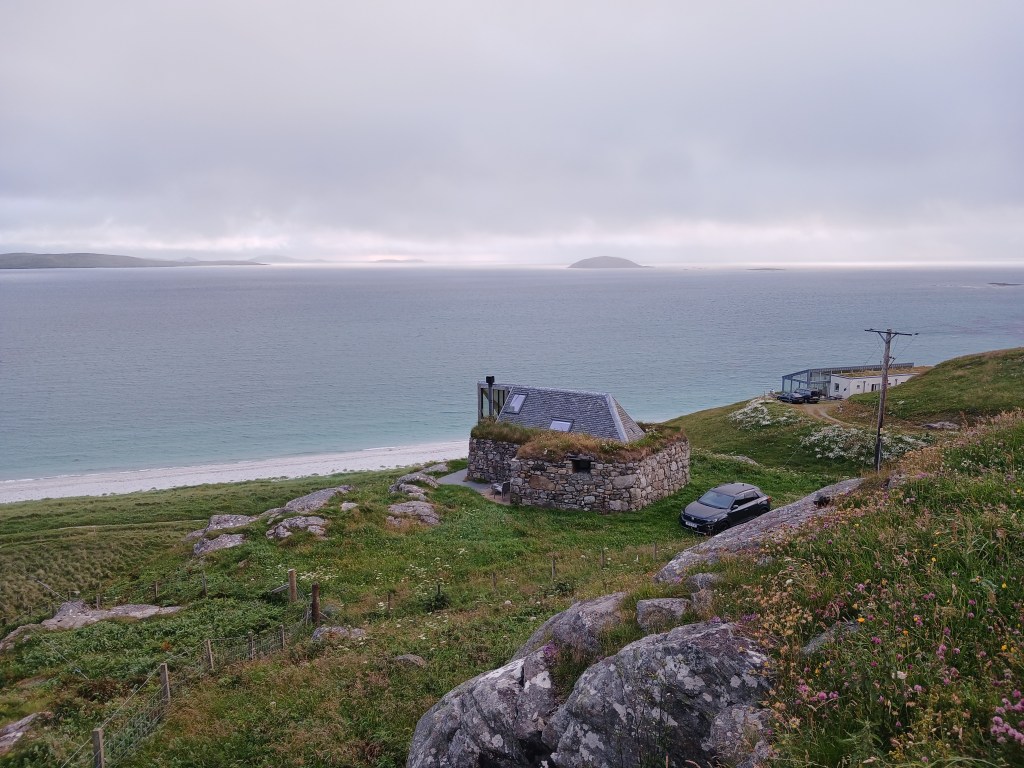
Tuesday, with a F4 NW it was a fast crossing of the Minch, 25nm east to the island of Canna in the Small Isles. There are 10 visitor moorings here now, in the past boats often spent much time trying to get their anchor to hold in the kelp. Dinghy landing at the slip by the Calmac quay and nearby new shower block. The island is owned by the National Trust with lots to see historically and wildlife. It has a Community Shop and bar/cafe so all in all its the ideal stopover enroute to or from Outer Hebrides.
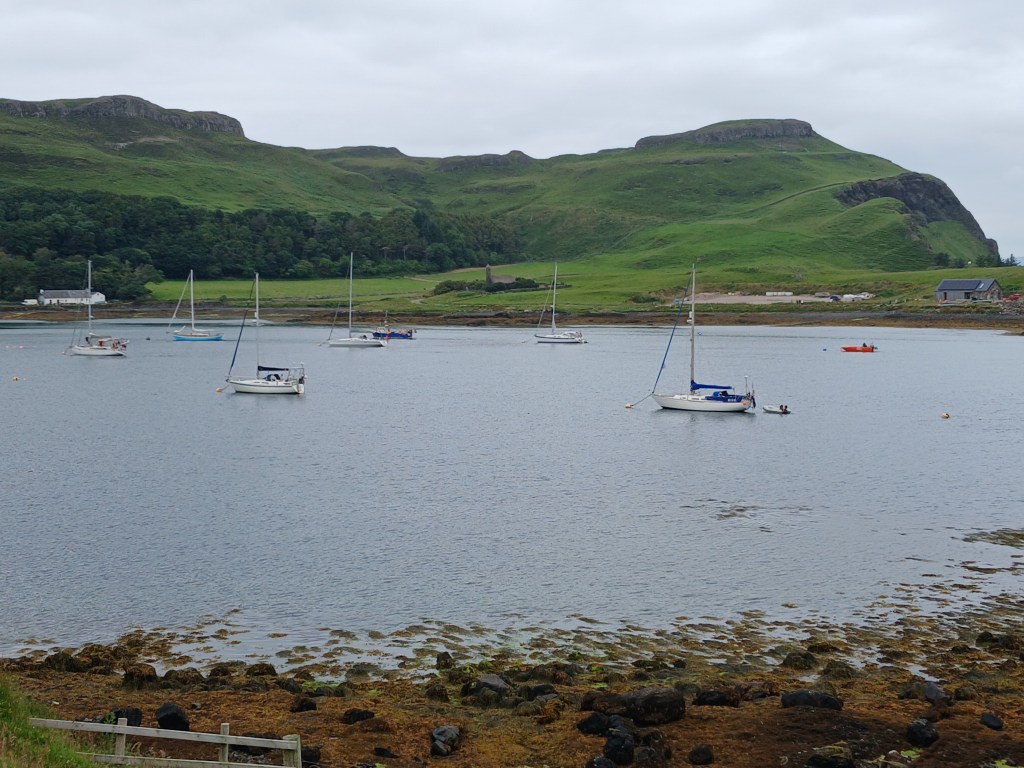
Wednesday, the weather has closed in again such that visibility is less than half a mile. Nevertheless I set off into the gloom to round the north side of Rum and then SW to Arisaig on the mainland. With a F3 NW and flat water SO creamed along at a surprising 5kts so that we arrived at the entrance in good time. Its recommended to traverse the shallow channel in the top half of the tide, as there are minimum depths less than 1m. Will spend the next 2 days here awaiting arrival of Chris and Brian, and then we will have a go at reaching St Kilda.
Wednesday 29th July
Saturday 25th July. Chris and Brian joined me yesterday afternoon and we spent the night on a mooring in Arisaig bay. It was somewhat bouncy with a fresh SW wind and mile long fetch. In the morning the wind had veered to W making a passage west toward the Outer Hebrides untenable, so instead we reached north past Mallaig and into Loch Nevis. Picking up a visitor buoy at Inverie we then ventured ashore to the Old Forge However it was so rammed with people from a couple of trip boats that it was impossible to reach the bar and be served ! Instead we retired back to the boat for a tiny with takeaway fish and chips.
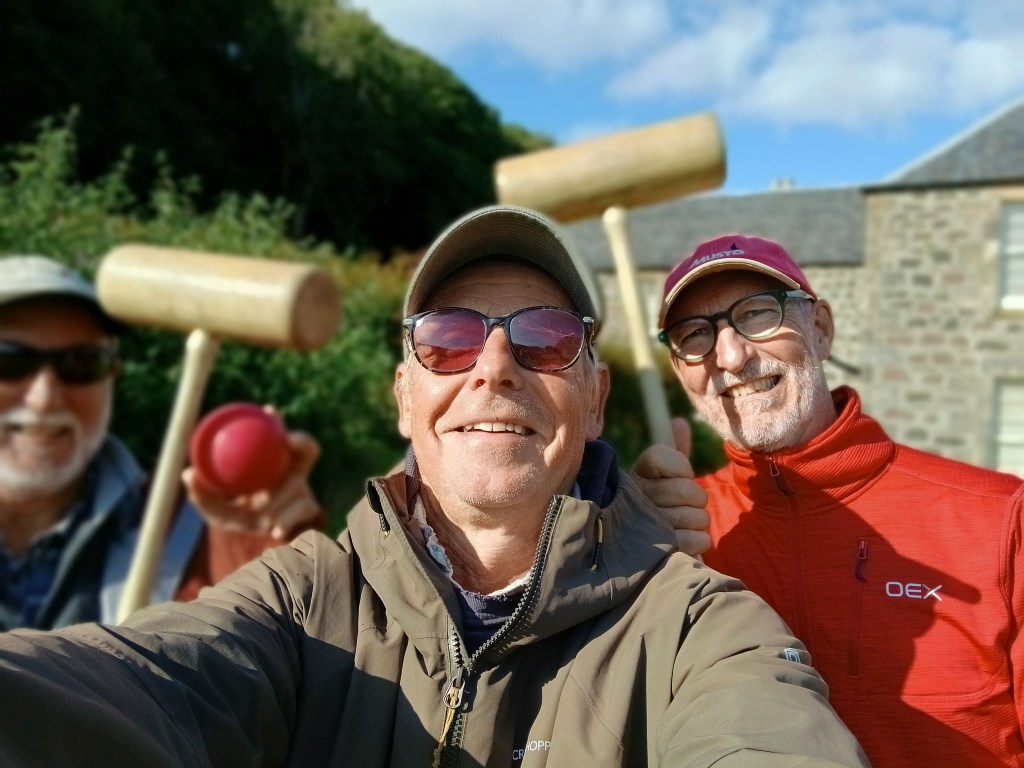
Sunday, with a F4 SW we were now able to start making progress west. After initally motoring to Point of Sleat, a couple of tacks took us past Rum and on to Canna. Here we picked up a mooring just as the sky cleared and the sun came out. We had a look around the grounds of Canna House and a round of croquet before the midges drove us to take refuge in the tiny restaurant where we dined on fresh mackeral.
Monday, we left the mooring in the now familiar drizzly rain which cleared by the time we had rounded the eastern end of the island and were heading west across the Minch. The wind angle was just right for us to make a course for Loch Boisdale on South Uist, 25 nm distant. A few heavy showers blew through and occasional sunny intervals. We had a pod of dolphins pass close by and saw numerous puffins out on the water with their young, rapidly having to learn the ropes before being left to their own devices out on the north Atlantic. On arrival in the Loch we went into the small marina.
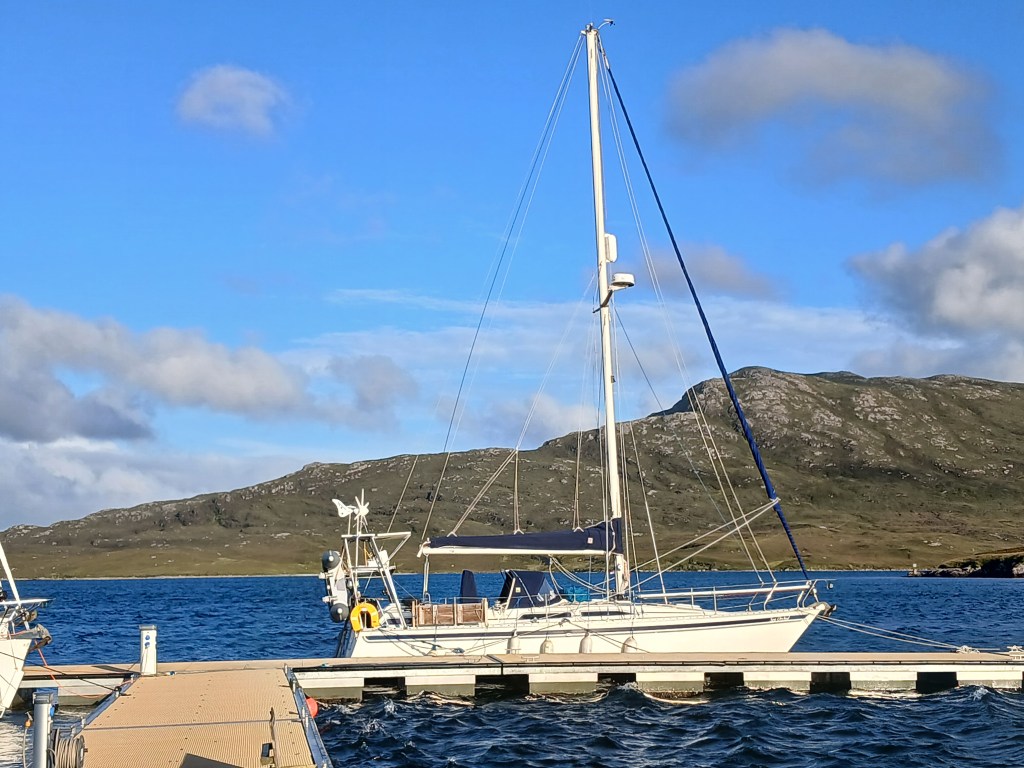
Tuesday, with a forecast of SW F5/6 the plan was to sail north up the eastern side of Uist in what should be sheltered water. We hurried off at 0900 to exit the marina before the traffic lights went red, which would indicate that the Calmac ferry is about to leave and boats must wait. The wind rapidly picked up so we stuck with flying just the genoa on a broad reach. After a couple of hours we had a F6 gusting 7 and had the genoa rolled up to 2 spots. We had a steep sea running up from astern requiring concentrated effort to maintain course. After 4 hours we had a steady F8 and at one point a gust of 40kts blew through. We were down to less than 3 spots on the genoa and still managed a record breaking 11.5 kts surfing off a wave. It was with some relief therefore when we turned into Lochmaddy and escaped the big sea but still faced a fierce wind motoring up to the pontoon behind the Calmac pier. Fortunately there was only one other boat on the outside of the hammerhead and so were able to berth head to wind without too much difficulty.
Wednesday, the wind has subsided to a F4 but the forecast does not favour a crossing to St Kilda. So instead we position ourselves nearer by sailing through the Sound of Harris and anchoring on the south side of Taransay. The wind direction of SSW meant we were able to hold on one tack through the Stanton Channel. Only a little swell is making its way into the bay this evening but enough that SO will roll in the night if broadside on, so I have laid out a kedge to keep the bow pointing out to sea.
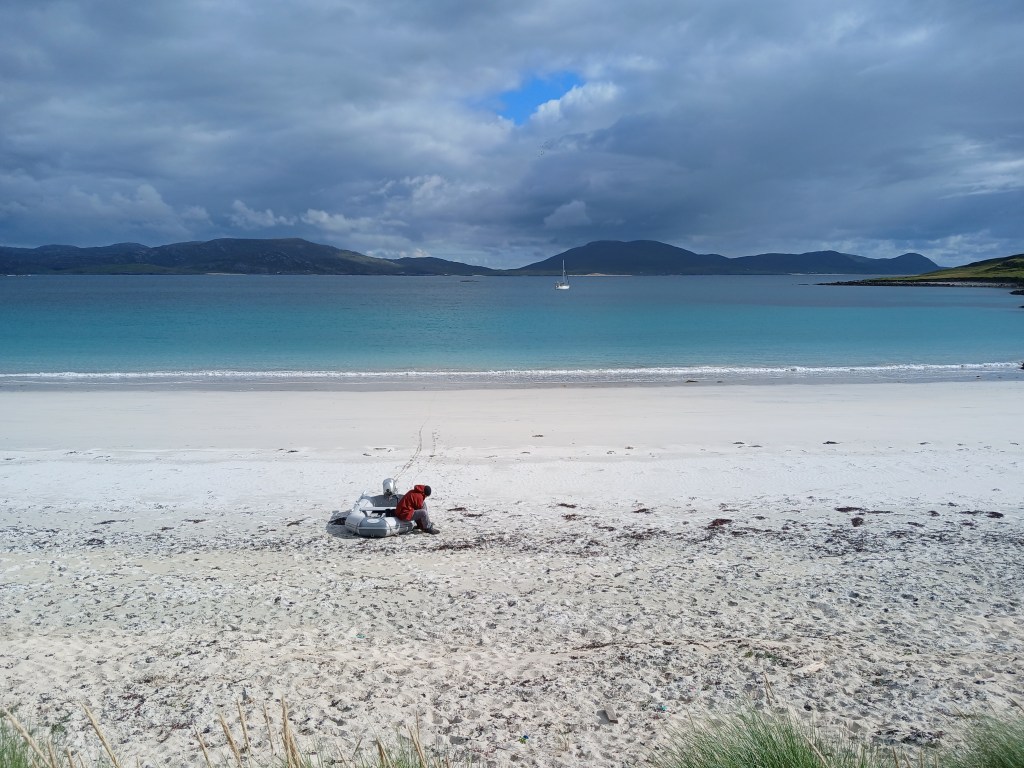
Monday 3rd August
On Thursday the forecast was such that it made sense to wait a day, when the winds would be more favourable, before going to St Kilda.
Friday. Disaster ! Having left the anchorage at 5am and sailed for 6 hours on a beat, in moderate conditions, we were over half way there with about 20nm to go. I went below to make drinks only to discover water swilling around in the galley. A look in the bilges confirmed my worst fear, we were taking on a lot of water. An inspection of thru hull fittings did not reveal the source of the leak so suspicion fell on the keel. In the mean time we started bailing, and for the first time it has been used in anger, deployed the whalepump. We turned around to take some of the lateral pressure off the keel, and headed back toward the Sound of Harris. The flooding was stabilised with pumping out every 30 minutes. I wanted to anchor somewhere with totally flat water as soon as possible in order to get the floor up and find the source of the leak. So late afternoon we stopped in Vacassay Pool, amongst a bunch of islands at the SE end of the Sound. Investigation revealed water ingress at one side of the keel stub near the front. Try as we might we couldnt stop the flow, not even with a rubber pad and wooden blocks braced against a keel nut with wedges. So we were resigned to having to pump out every hour and half through the night. With a shift sytem worked out we turned in after a long and fraught day.
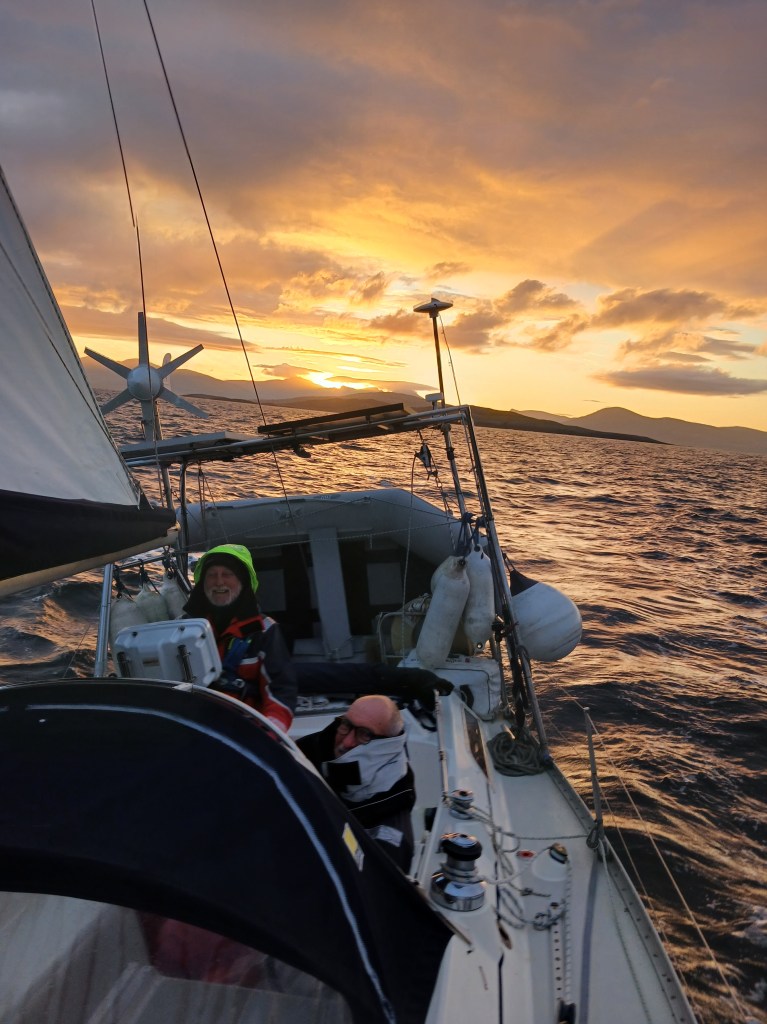
Setting off St Kilda at dawn
Saturday, 6am start to sail back to Arisaig, some 60nm. It was a broad reach in F4 occasionally F5 later. I was satisfied that the the risk was low of the fracture being aggravated by sailing. Pumping every 30 mins all day we arrived at Arisaig entrance at 1800. At the very same time the whalepump failed with a split gasket !! Having anchored back at the same place as last time, in the bay, set to replacing the gasket with a spare. Job done we could rest easy, but pumping would have to continue all night again.
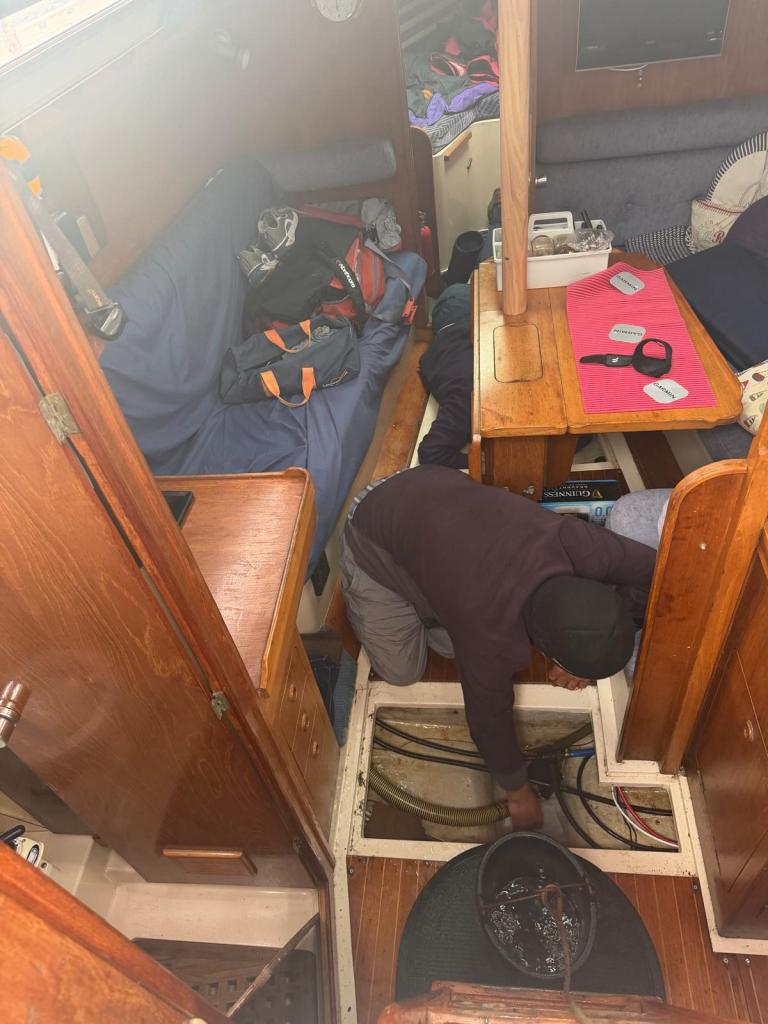
Looking for the leak..
Sunday, en route yesterday I had arranged for the boat to be lifted at Dunstaffnage marina near Oban. It is about the only place in this area that could do this at short notice and have the facilities to make repair. So at 0800 we dropped Chris on the pontoon to retrieve his car, while Brian and I sailed down to Oban via the Sound of Mull. There was little to no wind all day so had to motor most of it. The tide runs strongly at the southern end of the Sound so we needed to exit before the tide turned against us. We managed to make it just a little later than planned but still faced an adverse 3kt current around the southern end of Lismore Island. On arrival at Dunstaffnage we were instructed to moor on the fuel pontoon, ready for a possible lift in the morning.
Monday. Last pump out ! We were hauled out early this morning at high water. Very quick process, motoring straight onto slings on a hydraulic trailer lift. The yard had their grp fabricator guy do an inspection of the problem straight away so that we could make a plan. His view is that the keel stub has split across from side to side, just forward of the bearer that supports the mast. He has seen it before on Moodys. It will likely require the keel to be dropped before structural repair can be made. Timescales unknown we packed up to leave SO probably for some time and it looks like a premature end to this season. Watch this space.
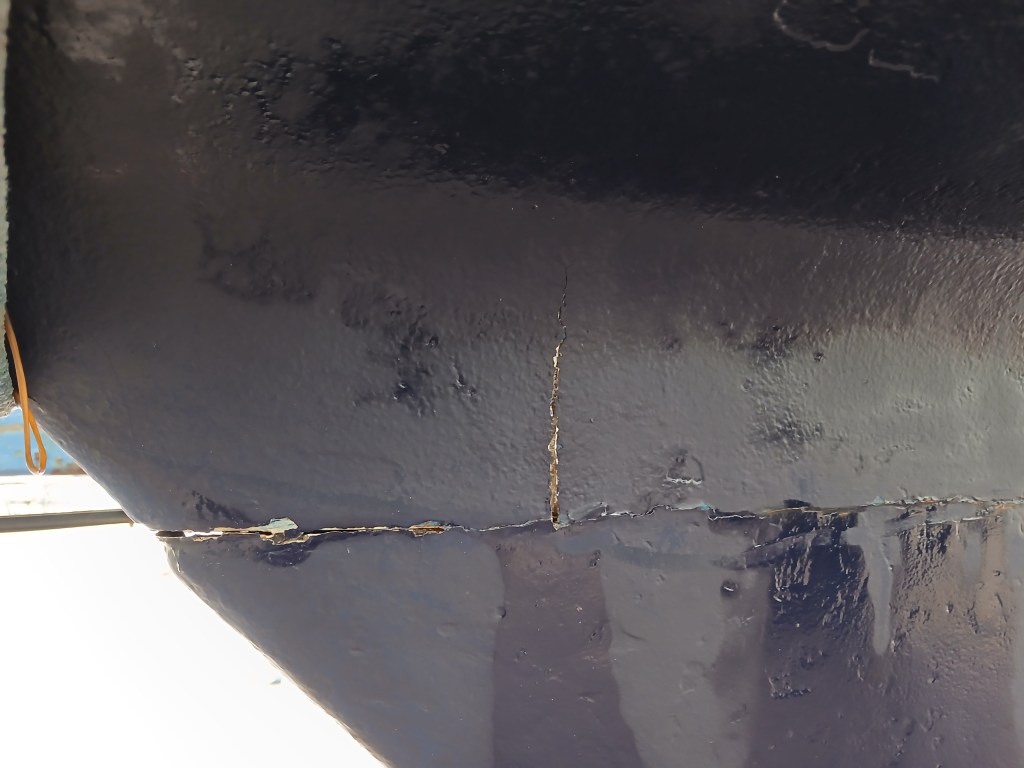
same the other side…
October
Since leaving the boat at Dunstaffnage I have been waiting for the insurance company to make a decision regarding a claim. They have now accepted to cover the cost of repairs which have been estimated at £12,000 !! Repairs are just now commencing and expected to complete in a month. By this time it will be too late in the season to return to Ardvasar Boatyard so SO will remain at Oban for the winter. All being well SO will be back on the ocean waves next Spring.

